
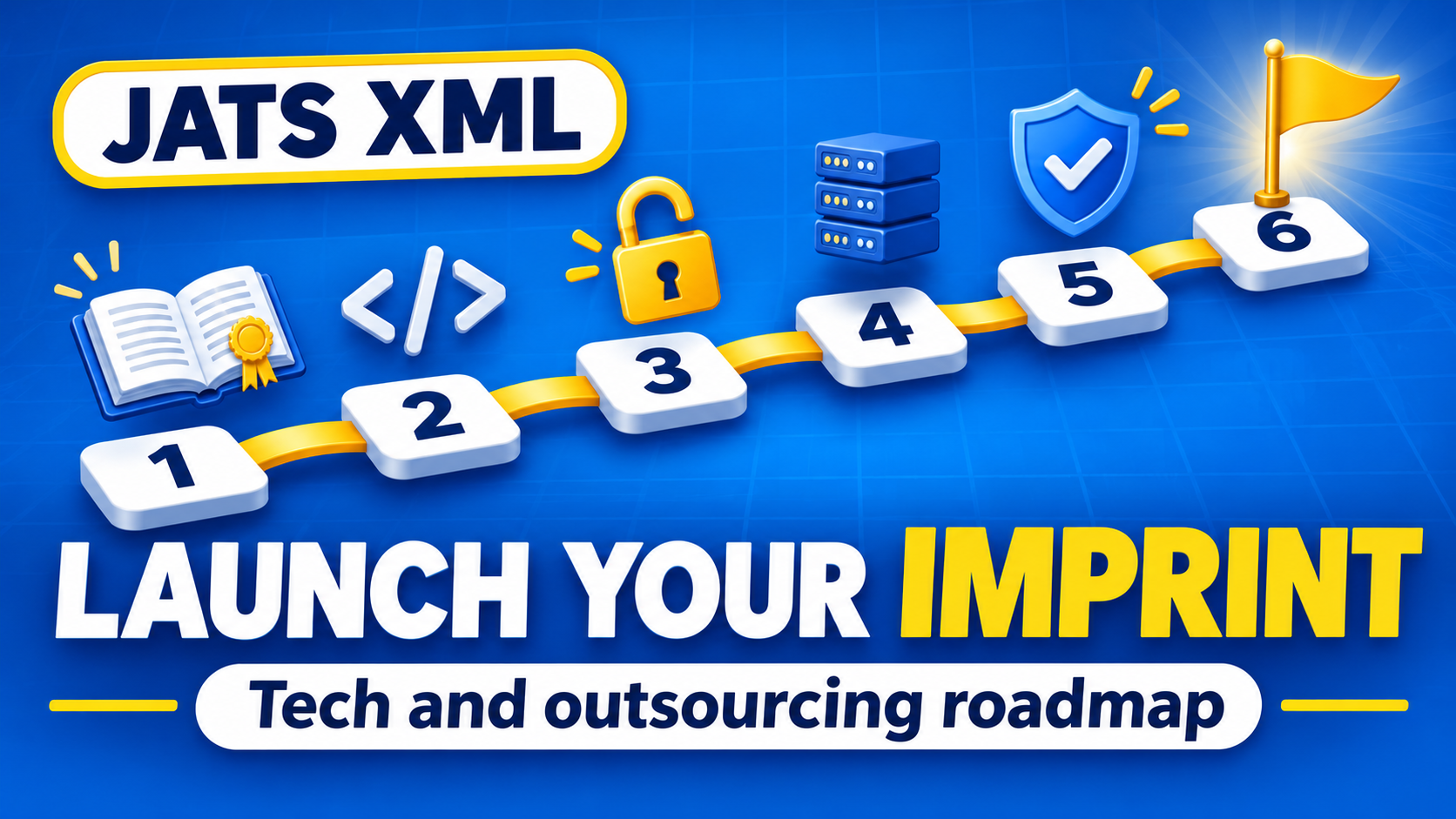
Launching an academic publishing company or imprint is mostly a sequence of decisions made in the right order. Scope comes first, then policies, platform, production route, quality checks and budget. Get the order wrong and you rebuild. A platform cannot export JATS XML, a licence clashes with funder rules, or a budget forgot proof corrections. This roadmap is for universities, learned societies and start-up imprints. It has six steps and shows what to outsource and what to keep. For the market context behind these choices, see our UK publishing trends article.
Step 1: Define Scope and Open Access Model
Decide what you will publish, for whom and under which access terms before you choose any technology. Write the answers on one page, because every later step refers back to it.
- Content types: journals, monographs, edited collections or conference series
- Discipline, language and audience
- Expected volume in year one and in year three
- Open access model: who pays, if anyone, through author charges, institutional funding, library or consortium support, or no charges at all
- Licence: funder policies often expect CC BY for articles, so check the funders your authors rely on
- Success measures, such as indexing, downloads and author satisfaction
Step 2: Set Editorial Policies and Governance
Indexes and funders judge an imprint on its policies as much as on its content. The Directory of Open Access Journals, for example, expects a named editor and an editorial board listed on the website. It also expects a documented peer review process, stated licence and copyright terms, and clear statements of any author charges. DOAJ checks that the journal name and ISSN match the ISSN register as well. Read the current DOAJ guide to applying before you draft your policies.
- Editorial board with names and affiliations, published on the site
- Peer review policy that states the type used, such as single or double anonymous
- Publication ethics policy; many imprints follow COPE guidance
- Licence and copyright terms, written in plain language
- A statement of author charges, or a statement that there are none
- ISSN for each journal, and a preservation plan for the archive
Step 3: Choose a Platform
An open access publishing platform has to manage submissions and peer review, then publish and deliver the final content. Choose on total cost and exit options, not on the licence fee alone. Open-source systems such as Open Journal Systems give control but need hosting, upgrades and support. Hosted services trade some control for convenience.
- Submission and peer review management with a clear audit trail
- A publishing site with HTML, PDF and downloadable XML
- JATS XML import or export, so content can move to another system
- DOI registration and ORCID support
- Accessible templates and output
- Clear data ownership, and a documented way to export all content and metadata if you leave
Step 4: Decide What to Outsource
Keep the decisions that carry your reputation, and outsource the technical stages that need tools and volume. Our academic publishing services support societies, university presses and commercial publishers on the production side of this split.
| Task | Usually kept in-house | Usually outsourced | Note |
|---|---|---|---|
| Editorial decisions and peer review | Yes | No | These carry the imprint’s independence |
| Editorial office administration | Often | Sometimes | Depends on volume and staffing |
| Copyediting | No | Yes | Needs subject-aware editors and a style sheet; see copyediting services |
| Typesetting and proofs | No | Yes | Reusable templates; typesetting covers InDesign and LaTeX |
| JATS XML and metadata | No | Yes, with validation | Check against the schema; see LaTeX vs XML typesetting |
| Platform hosting | Either | Either | Self-hosting needs technical staff |
| Accessibility checks | Shared | Yes | Validate files; see the EAA EPUB checklist |
| Indexing applications and promotion | Yes | Sometimes | Built on your own policies and content |
Brief suppliers in writing, as set out in our guide to working with typesetters and production suppliers. To test the economics, use our in-house vs outsourced cost model, and for growth read scaling journal production without hiring.
Step 5: Specify Outputs, Including JATS XML
Ask your production partner to deliver JATS XML, PDF, HTML and, for books, EPUB, all from one set of validated files. State the JATS version you want, name any publisher-specific profile, and ask for validation reports. See the JATS version list and the NISO standard for the current specification.
Open access terms belong in the metadata too. Put the licence, funder and funding statement in the XML so repositories and indexes can read them without guesswork.
Step 6: Set Quality Checks and a Budget
Quality checks work best as written gates between stages. Each gate names who checks what, so errors are caught where they are cheapest to fix.
| Stage | Check | Owner |
|---|---|---|
| Submission and review | Policy followed, reviewer records kept, conflicts declared | Editor |
| Copyediting | Style sheet applied and query log closed | Supplier, then editor |
| Proofs | Agreed rounds used and corrections consolidated | Editor and authors |
| XML and metadata | Validates against the JATS schema; references, ORCID, funding and licence complete | Supplier, spot-checked by the imprint |
| Output files | PDF, HTML and EPUB open correctly and pass accessibility checks | Supplier |
| Release | DOI registered, deposit made and archive confirmed | Imprint |
| Budget line | Type | How to keep it predictable |
|---|---|---|
| Platform and hosting | Recurring | Compare total cost over several years, including upgrades |
| Production per article or book | Per item | Itemised quotes that state proof rounds and author alteration rules |
| Editorial office | Recurring | Decide early what staff do and what is bought in |
| DOIs, indexing and preservation | Recurring | List every membership and deposit fee in the plan |
| Open access funding or waivers | Recurring | Set the waiver policy before the first call for papers |
| Contingency | One-off | Reserve for late changes and corrections |
Run a pilot issue, or two books, through the full chain before you announce the launch. Fix the specification from what the pilot shows, then lock it.
FAQs
How much does it cost to start an academic imprint?
Costs vary widely with output, platform and staffing, so no single figure applies. The main lines are platform and hosting, editorial office time, production, DOIs and indexing, open access funding and contingency. Itemised quotes for the same scope are the best way to build a budget.
Do I need JATS XML for a new journal?
It depends on your platform and indexing plans. JATS XML is the standard format for exchanging journal articles and is used by archives such as PubMed Central. Many platforms, indexes and repositories work better with it, and validated XML from your production partner keeps your content portable.
What does DOAJ require from a new journal?
DOAJ checks for an identifiable editor and editorial board listed on the site, and a documented peer review process. It also looks for stated licence and copyright terms, clear statements of any author charges, and an ISSN that matches the ISSN register. Read its current guide to applying first.
Should a university press outsource production?
Often in part. Editorial decisions, policy and relationships stay in-house, while copyediting, typesetting, XML and accessibility checks are commonly bought in. The right split depends on volume, skills and cost, which our in-house vs outsourced cost model helps to test.
How long does it take to launch a journal?
There is no standard timeline. Policies, platform set-up and a pilot issue can take months rather than weeks, and indexing applications follow once there is published content. Plan the schedule backwards from your first call for papers, and leave time for a pilot before launch.
Start With One Page and One Pilot
Write the scope page, agree policies, choose a platform you can leave, and run a pilot through the full chain before you announce. A clear specification and written quality checks protect your reputation more than any single tool.
Book a Consultation on Your Academic Imprint
Tell us your scope, platform plans and expected volume. We will review your production specification and outline what to keep in-house and what to buy in.