
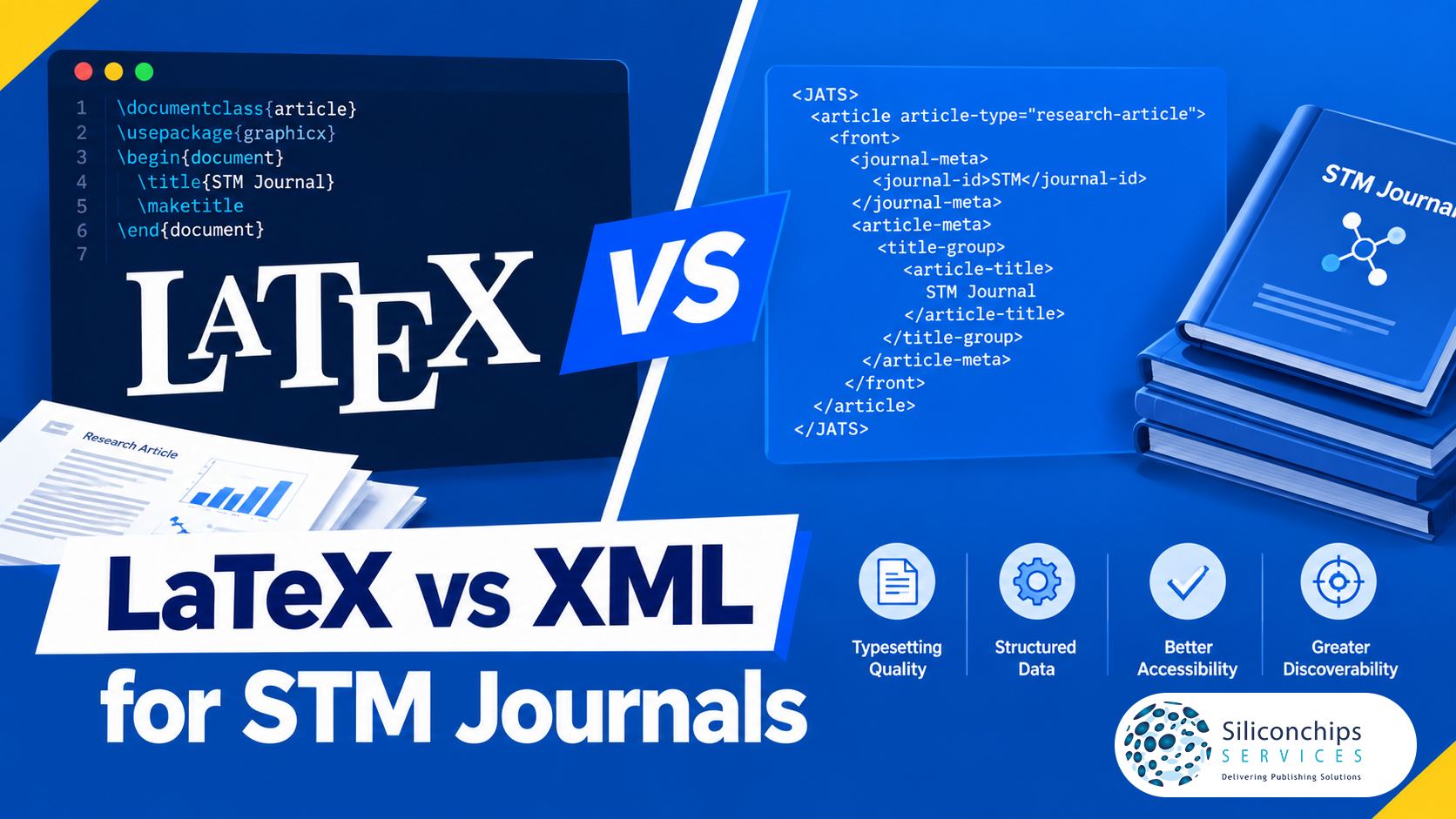
LaTeX and JATS XML are complementary tools, not competing alternatives. LaTeX handles mathematical composition with unmatched precision; JATS XML structures content for machine-readable archiving, platform delivery, and multi-format output. The most efficient STM journal production programmes use LaTeX for composition in equation-heavy disciplines and generate validated JATS XML as a downstream output — not as a separate process.
STM journal publishers face a recurring production decision: when does a LaTeX-based composition route make more sense than an XML-structured approach, and when does the reverse apply? The answer depends on your manuscript mix, your target output formats, your indexing obligations, and the volume of content you handle each publishing cycle.
This comparison maps each approach across the criteria that matter most in 2026: discipline fit, output format requirements, conversion accuracy, and the degree to which each can be systematically automated at scale.
How LaTeX and XML Typesetting Differ
LaTeX is a document preparation system in which authors and typesetters write structured code that a rendering engine converts into a precisely formatted PDF. It was designed for mathematical and scientific content and has been the standard composition tool in physics, mathematics, computer science, and engineering for decades.
JATS (Journal Article Tag Suite) XML is a semantic markup language that encodes article structure — metadata, abstract, body sections, figures, tables, equations, references — in machine-readable tags. It is the required interchange format for PubMed Central, CrossRef, DOAJ, and most major scholarly repositories and platforms.
The fundamental difference is purpose. LaTeX is a composition tool: it produces beautiful, typographically precise output — primarily PDF — from coded source. JATS XML is a structural representation format: it encodes what content is and how it relates to other content, enabling transformation, archiving, and platform-agnostic delivery.
A well-run STM journal production programme uses both. LaTeX composes the proof; JATS XML archives and distributes the article. The challenge — and the point where many publishers lose efficiency — is the conversion step between the two.
| Criterion | LaTeX | JATS XML |
|---|---|---|
| Primary purpose | Typographic composition, PDF generation | Structural encoding, interchange, archiving |
| Mathematical equations | Native, precise, repeatable | Encoded via MathML (requires conversion) |
| Output formats | PDF (primarily), HTML via conversion | HTML, EPUB, PDF, repositories (all via transform) |
| Author familiarity in STM | Very high (maths, physics, CS, engineering) | Low for authors; production-team handled |
| Repository compliance | Not directly accepted; requires conversion | Native format for PubMed, CrossRef, DOAJ |
| Accessibility (WCAG / PDF/UA) | Requires post-processing; not automatic | Semantic tags support accessibility natively |
| Macro complexity | High — custom macros require expert management | Schema-governed — validation is deterministic |
| Multi-format production | Additional steps needed per format | Single source generates all outputs |
Best Fit by Discipline: A Decision-Tree View
The right typesetting approach for an STM journal depends heavily on the nature of the content its authors submit. Discipline determines submission format, equation density, figure complexity, and the typical technical skills of the editorial team.
Use LaTeX as your primary composition route when:
- The majority of authors submit
.texsource files (mathematics, physics, theoretical computer science, engineering) - Articles contain complex display mathematics, multi-line equations, or specialised symbol sets
- Your journal is indexed by arXiv, where LaTeX source is the expected deposit format
- Your proofing standard requires exact rendering of notation across print and digital PDF
Use a JATS XML-structured approach as your composition route when:
- Authors submit in Word or mixed formats (life sciences, medicine, social sciences, humanities)
- Multi-format output — HTML5 article pages, EPUB, repository packages — is a first-class requirement
- Your journal is continuous-publication or high-volume, where per-article throughput matters most
- Open access obligations require rapid repository deposit in validated JATS XML
| Discipline / Journal Type | Typical Source Format | Recommended Approach |
|---|---|---|
| Mathematics, theoretical physics | LaTeX (.tex) | LaTeX-led |
| Engineering, computer science | LaTeX (.tex) | LaTeX-led |
| Chemistry, materials science | Mixed (Word + LaTeX) | Hybrid |
| Biomedical, clinical sciences | Word (.docx) | JATS-structured |
| Life sciences, ecology | Word (.docx) | JATS-structured |
| Social sciences, economics | Word (.docx) | JATS-structured |
| Humanities, linguistics | Word (.docx) | JATS-structured |
| Mixed-source multi-discipline journals | Word + LaTeX (variable) | Hybrid |
A hybrid approach — where LaTeX source is accepted for equation-heavy submissions and Word-based content is tagged directly into JATS XML — is increasingly common in multidisciplinary journals and gives production teams flexibility without requiring authors to change their preferred tools.
For complex journal typesetting across disciplines, specialist typesetting services manage both routes within a single production programme, handling macro management, style application, and cross-format consistency without requiring separate vendor relationships.
Converting LaTeX Manuscripts into JATS XML
LaTeX to JATS XML conversion is a specialist production task. Automated tools — including
latexml, tex4ht, and publisher-built XSLT transforms — handle the structural mapping, but consistently accurate output requires expert review of custom macros, non-standard packages, bibliography handling, figure tagging, and MathML rendering.
Converting a LaTeX source file into validated JATS XML is not a single-step process. The conversion must preserve mathematical meaning (not just visual appearance), resolve custom macros that have no XML equivalent, correctly tag bibliographic entries, map figure callouts to JATS figure elements, and produce MathML that renders accurately across platforms including PubMed Central’s viewer and HTML5 article pages.
Common challenges in LaTeX to JATS XML conversion:
| Conversion Challenge | Impact if Unresolved | Production Requirement |
|---|---|---|
| Custom LaTeX macros | Tags fail to map; XML invalid or incomplete | Expert macro audit before conversion begins |
| Non-standard packages | Equation rendering breaks in MathML output | Package inventory and substitution mapping |
| Bibliography style files (.bst) | References malformed or missing in JATS back matter | BibTeX-to-JATS reference mapping and validation |
| Nested tables and multi-row spanning | JATS table structure fails schema validation | Manual table reconstruction in XML |
| EPS / vector figure formats | Figures incompatible with web delivery | Format conversion and alt text assignment |
| Unicode and special characters | Characters appear garbled or absent in XML | Character mapping audit against journal’s Unicode profile |
Publishers running high-volume STM journals increasingly automate the initial conversion pass — using tools such as latexml or custom XSLT scripts — and then apply human quality control to resolve the issues that automation alone cannot catch reliably. This hybrid approach reduces cost per article while maintaining the accuracy that indexed databases require.
Siliconchips Services’ LaTeX typesetting services include the full conversion chain: LaTeX source review, macro audit, composition and proofing, JATS XML generation, MathML validation, and final delivery packages for PubMed Central, CrossRef, and publisher platforms.
Automation Potential: Where Each Approach Scales — and Where It Doesn’t
Automation in STM journal production is not binary. Both LaTeX-led and JATS-structured approaches contain stages that automate reliably and stages that continue to require expert human judgement. Understanding which is which determines how much a production team can genuinely scale without sacrificing quality.
What automates well in LaTeX-led production:
- PDF compilation from clean, well-structured
.texsource files - Journal template application via class files and style packages
- Bibliography formatting through BibTeX or BibLaTeX
- Cross-reference numbering for equations, figures, tables, and sections
- Batch proof generation for high-volume issues
What requires expert human oversight in LaTeX-led production:
- Diagnosing and resolving macro conflicts and package errors
- Reviewing complex display mathematics for semantic accuracy (not just visual appearance)
- Correcting MathML generated from non-standard equation environments
- Managing author-introduced structural inconsistencies that break automated transforms
What automates well in JATS-structured production:
- Structured content ingestion from Word templates with consistent styles applied
- Schema-based validation of tag completeness and hierarchy
- Multi-format transformation (HTML5, EPUB, metadata export) from a single validated XML source
- CrossRef and repository deposit packaging
- Automated metadata consistency checks across article, PDF, and XML
What requires expert oversight in JATS-structured production:
- Equation encoding where authors use inconsistent notation in Word source
- Figure tagging and caption accuracy for complex multi-panel images
- Reference verification and DOI matching
- Semantic tagging decisions for unusual article types or non-standard structures
Publishers looking to systematically reduce per-article production cost can explore journal production automation services that combine rule-based processing for repeatable tasks with human review at the stages where errors have the highest downstream impact.
Choosing a Production Approach for Scale: A Practical Framework
Before selecting or changing your typesetting approach, answer four questions: What format do most of your authors submit? What output formats does your distribution require? What are your indexing obligations? And what is your article volume per year? The answers typically point to LaTeX-led, JATS-structured, or a managed hybrid — not a single universal answer.
There is no single correct answer for all STM journals. The right production approach depends on your journal’s specific conditions in 2026. Use the framework below to identify where you sit.
| Your Situation | Recommended Approach | Key Reason |
|---|---|---|
| ≥ 60% of submissions arrive as LaTeX source | LaTeX-led + JATS output | Preserves author source; adds XML downstream |
| ≥ 60% of submissions arrive as Word | JATS-structured | Direct tagging more efficient than Word-to-LaTeX-to-XML |
| PubMed Central or CrossRef deposit required | JATS XML mandatory | JATS XML is the required submission format |
| High equation density (maths, physics, CS) | LaTeX-led | No tool matches LaTeX for mathematical precision |
| Continuous publication, online-first | JATS-structured | HTML5 and platform delivery via XML transform |
| Multi-discipline journal, mixed submissions | Hybrid | Route by article type; one partner, two tracks |
| Backlist conversion to digital formats | JATS XML conversion | PDF-to-XML or LaTeX-to-XML enables discoverability |
| >500 articles per year, growing | Automated hybrid | Automation + human QA required for cost control at volume |
The most important shift in STM journal production thinking for 2026 is treating LaTeX and JATS XML as connected stages in a single production chain, not as alternatives between which a publisher must choose once and permanently. Most well-run journals of any significant volume now use both — the question is how efficiently the handoff between them is managed.
Not sure which production approach fits your journal?
Discuss your manuscript mix, output requirements, and indexing obligations directly with our STM typesetting team.
Frequently Asked Questions
Is LaTeX better than XML for STM journals?
LaTeX and JATS XML serve different functions, so the comparison is not directly applicable. LaTeX excels at composing mathematically precise PDFs from structured code — it is the preferred tool for disciplines with high equation density. JATS XML excels at structuring content for machine-readable archiving, multi-format delivery, and repository compliance. Most high-performing STM journals use LaTeX for composition and produce JATS XML as a required downstream output.
Do all STM journals need JATS XML?
Any STM journal that deposits content with PubMed Central, CrossRef, DOAJ, or a national repository requires JATS XML. It is also increasingly the expected format for open access platform delivery and funder-mandated archiving. Journals that publish only to a closed platform and have no repository obligations may not require JATS XML today — but most face this requirement eventually as open access mandates expand.
What is the typical turnaround for LaTeX to JATS XML conversion?
A standard article with moderate equation complexity and clean LaTeX source typically converts in one to three working days, including QA. Articles with heavy custom macros, non-standard packages, or complex multi-panel figures take longer and benefit from an upfront macro audit to prevent conversion failures mid-batch. High-volume journals working with a specialist partner can expect consistent article-level turnaround within agreed service levels.
Can automated tools handle the full LaTeX to JATS XML conversion without human review?
Automated tools handle the structural mapping reliably for clean, well-structured LaTeX source that uses standard packages and follows the journal’s template. Custom macros, non-standard environments, complex tables, and equations with discipline-specific notation typically require human review to ensure the MathML output is semantically accurate rather than visually approximate. For production at scale, automation handles the repeatable elements and experts manage the exceptions.
What is MathML and why does it matter for STM journals?
MathML (Mathematical Markup Language) is an XML-based standard for encoding mathematical notation in machine-readable form. It is the format that PubMed Central, HTML5 article pages, and screen readers use to render equations — as opposed to image-based equation representations that are not searchable or accessible. When converting LaTeX to JATS XML, every equation must be converted to valid MathML. Errors in this conversion produce equations that display incorrectly or fail accessibility requirements.
How does typesetting approach affect a journal’s indexing eligibility?
Indexing databases do not evaluate your typesetting tool — they evaluate the quality and completeness of your JATS XML, your metadata, and your content integrity. A journal using LaTeX for composition and producing well-validated JATS XML with complete metadata meets the technical requirements of PubMed, Scopus, and Web of Science. A journal producing poor-quality XML from any source fails those same requirements. The composition route matters far less than the quality of the final XML output.
What should I look for in a LaTeX typesetting partner for STM journals?
Look for a partner that can demonstrate experience with your specific disciplines and equation types, manages custom macro libraries rather than requiring authors to simplify their source, produces validated JATS XML with MathML from LaTeX in a single production chain, handles the full proof cycle including author corrections back to source, and provides consistent turnaround at your article volume. Request a sample conversion using a representative article from your journal before committing to a full engagement.
Matching the Approach to the Journal — Not the Journal to the Approach
The most productive STM journals in 2026 are not the ones that selected LaTeX or JATS XML as an ideological preference years ago. They are the ones that matched their production approach to their actual manuscript mix, output obligations, and volume — and then built or engaged the specialist capability to execute that approach consistently.
For equation-intensive disciplines, LaTeX typesetting remains irreplaceable. For multi-format delivery and repository compliance, JATS XML is non-negotiable. Managing the conversion between them — accurately, at volume, without losing mathematical precision or metadata integrity — is where specialist production expertise makes the clearest difference.
Discuss Your Typesetting Approach With Our Team
Whether you’re reviewing your current production setup, evaluating a move to a hybrid approach, or looking to reduce per-article cost at scale — our STM typesetting specialists can help you map the right route.