
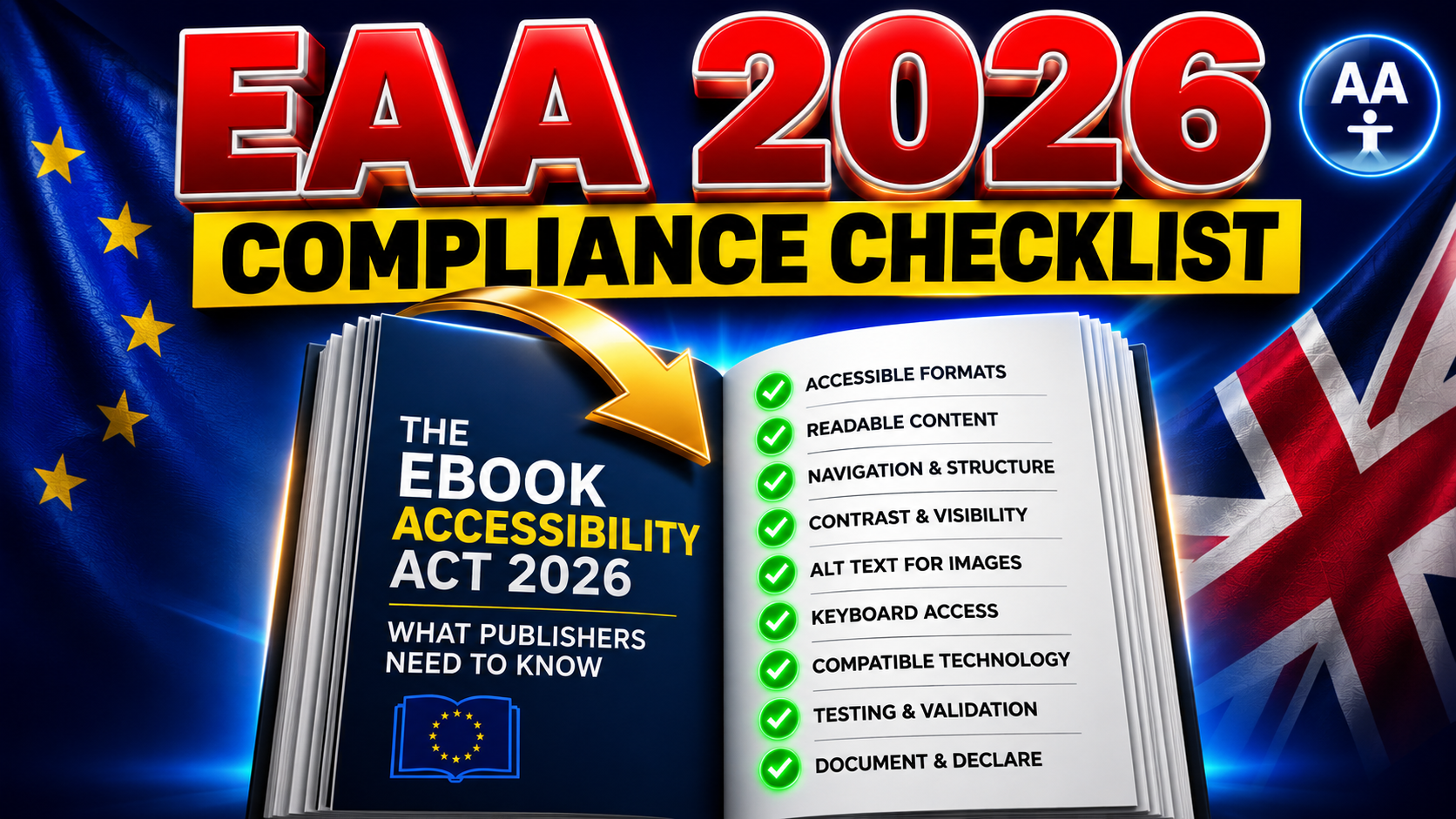
Publishers reviewing EPUB conversion services usually ask one question first: what does the European Accessibility Act actually require of an ebook, and does it apply to titles already on sale? The EAA has applied to ebooks and ereading software sold to EU consumers since 28 June 2025, and the practical target is a reflowable EPUB 3 file meeting EPUB Accessibility 1.1 at WCAG Level AA. This checklist covers requirements, deadlines, metadata and remediation priorities.
The European Accessibility Act (Directive (EU) 2019/882) has applied to ebooks sold in the EU since 28 June 2025. Compliant titles are normally reflowable EPUB 3 files meeting EPUB Accessibility 1.1 and WCAG Level AA, carrying schema.org accessibility metadata, a conformance statement, semantic structure, genuine alt text, and matching ONIX records.
What the European Accessibility Act Requires for Ebooks
The EAA requires ebooks sold to EU consumers to be perceivable, operable, understandable and robust for people with disabilities. In practice that means structured, reflowable EPUB 3 content, working navigation, text alternatives, a declared language, accessibility metadata that travels with the file, and digital rights management that never blocks assistive technology.
The European Accessibility Act was adopted on 17 April 2019 and became applicable on 28 June 2025. Ebooks, ereading software and the ecommerce services selling them are named categories. Member states transposed it separately, so penalties differ by country.
Two points are frequently misread. The EAA applies on the basis of the market you sell into, not where you are registered, so a UK or US publisher supplying EU readers is in scope. And although micro-enterprises providing services (under 10 people, turnover under €2 million) are exempt, retailers and library platforms still apply their own ingestion rules.
One limitation to state plainly: no supplier can certify legal compliance for you. A production partner delivers conformant files and the evidence; the accessibility statement and legal responsibility stay with the publisher.
EPUB Accessibility 1.1 and WCAG 2.2 AA Explained
EPUB Accessibility 1.1 is the W3C specification defining when an EPUB publication may be called accessible. It layers publication-specific rules — discovery metadata, page navigation, media overlays and conformance reporting — on top of WCAG. WCAG supplies the content criteria; EPUB Accessibility 1.1 supplies the packaging, declaration and certification rules.
EPUB Accessibility 1.1 requires WCAG 2 conformance at Level A minimum, while strongly recommending the latest version at Level AA. WCAG 2.2 is that version, so the strongest defensible claim is “EPUB Accessibility 1.1 – WCAG 2.2 Level AA”.
The EU harmonised standard, ETSI EN 301 549, currently references WCAG 2.1 Level AA, with a WCAG 2.2 revision in development. Because 2.2 adds criteria without removing earlier ones, building to 2.2 AA now meets the baseline and reduces rework.
- Semantic structure and reading order — real headings, lists, tables with headers, figures and captions in the intended sequence
- Navigation — nav document, landmarks, and a page list where a print equivalent exists
- Text alternatives — meaningful alt text, extended descriptions, MathML for equations
- Language, hazards, access — declared language, honest hazard values, DRM that does not impair assistive technology
EAA vs ADA Title II vs WCAG: Requirements Compared
WCAG is a voluntary technical standard; the EAA and ADA Title II are laws referencing it. The EAA covers ebooks sold to EU consumers from 28 June 2025 via EN 301 549. ADA Title II covers US state and local government entities, including public universities, at WCAG 2.1 Level AA. UK duties flow from the Equality Act 2010.
| Area | EAA (EU) | ADA Title II (US) | UK position |
|---|---|---|---|
| Legal instrument | Directive (EU) 2019/882, transposed nationally | DOJ rule, 28 CFR Part 35 Subpart H (2024) | Equality Act 2010; PSBAR 2018 for public bodies |
| Who is covered | Anyone selling ebooks to EU consumers | US state and local government bodies, incl. public universities | Any service provider serving UK customers |
| Technical standard | EN 301 549 (WCAG 2.1 AA); EPUB Accessibility 1.1 for ebooks | WCAG 2.1 Level AA | None in statute; WCAG AA is the benchmark |
| Key dates | From 28 June 2025; Article 32 transition ends 28 June 2030 | 26 April 2027 (populations 50,000+); 26 April 2028 (smaller bodies) | In force now; no single ebook deadline |
The US dates matter to academic publishers because ADA Title II reaches digital course materials supplied to public institutions. In April 2026 the Department of Justice moved both dates back a year via an interim final rule, leaving WCAG 2.1 Level AA unchanged. Building once to EPUB Accessibility 1.1 at WCAG AA serves both markets.
Backlist vs Frontlist: What the Timeline Actually Says
There is no blanket backlist grace period. The EAA applies to services provided to consumers after 28 June 2025, which captures backlist ebooks still on sale. Article 32 provides a narrow transition to 28 June 2030 for products used to deliver a service, and lets pre-2025 contracts run unaltered until expiry, capped at five years.
The widely quoted “2030 deadline” comes from Article 32, which covers products a service provider lawfully used before the application date and contracts concluded before 28 June 2025. It is not a general amnesty for legacy EPUBs.
| Title category | Position under the EAA | Recommended action |
|---|---|---|
| Frontlist after 28 June 2025 | In scope with no transition | Produce born-accessible EPUB 3; block release on failed validation |
| Backlist actively sold in the EU | In scope — the sale is an ongoing service | Prioritise by revenue and effort; remediate in waves |
| Fixed-layout and illustrated titles | In scope; some WCAG criteria are unreachable | Declare limitations honestly, or supply a reflowable alternative |
Sequencing beats tackling a whole catalogue at once: audit a sample and treat maths-heavy, table-heavy and image-heavy books separately. Our EPUB conversion services are used this way — sampled audit first, then batched remediation with conformance evidence.
Accessibility Metadata Publishers Must Add
EPUB Accessibility 1.1 requires schema.org metadata in the package document declaring accessMode, accessibilityFeature and accessibilityHazard. It recommends accessibilitySummary and accessModeSufficient. Conformance requires a dcterms:conformsTo statement plus an a11y:certifiedBy value. The same information must also appear in ONIX so retailers can display it.
- accessMode — sensory modes needed, such as textual and visual (required)
- accessibilityFeature — alternativeText, structuralNavigation, MathML, pageNavigation (required)
- accessibilityHazard — flashing, motion or sound hazards, or “none” (required)
- accessModeSufficient and accessibilitySummary — sufficient access combinations plus a note covering known shortfalls (recommended)
- dcterms:conformsTo and a11y:certifiedBy — exact conformance string plus the evaluating organisation
- ONIX record — matching codes so features surface in retail and library listings
Metadata is a declaration, not a certificate. Declaring alternativeText on a file whose images carry filenames as alt text creates an inaccurate claim.
Get your backlist assessed before you commit to a remediation budget
We can audit a sample of your EPUB files against EPUB Accessibility 1.1 and WCAG Level AA, report failures by category, and cost a remediation plan.
Step-by-Step EPUB Remediation Checklist
Effective remediation runs in order: inventory and prioritise titles, audit a sample, fix structure before appearance, add real image descriptions, encode maths as MathML, apply and verify metadata, validate with EPUBCheck and Ace by DAISY, then complete manual screen-reader review before republishing and updating ONIX records.
- Inventory and audit — list every ISBN sold in the EU, then test a sample of each type
- Structure and navigation — genuine headings, lists, tables, figures, landmarks, page-break markers
- Write meaningful alt text — describe function and content; mark decorative images
- Encode mathematics — replace equation images with MathML
- Declare language, hazards, contrast — set language, state hazards, verify colour contrast
- Apply accessibility metadata — schema.org properties, conformance statement, certifier details
- Validate technically — run EPUBCheck and Ace by DAISY, resolving every error
- Review manually — screen-reader testing of alt text quality, table logic and reading order
- Update distribution records — refresh ONIX codes, republish, retain the report
Automated validation is necessary but not sufficient. A file can pass EPUBCheck with zero errors and remain unusable: alt text reading “image1”, tables built from tab characters, or a chapter order contradicting the narrative all pass a machine check. Human review finds most real failures, and book formatting and layout design decisions set how much remediation is needed.
Accessible files are better structured for discovery too — genuine headings, descriptive captions and accurate metadata help retailers, library systems and answer engines interpret content — which is why accessibility and AEO, GEO and SEO services overlap.
Frequently Asked Questions About EAA Ebook Compliance
These answers cover the questions publishers ask most often: whether the EAA reaches UK and non-EU publishers, whether backlist titles are exempt, how fixed-layout titles are treated, which conformance string to use, whether a tagged PDF qualifies, and realistic timescales for backlist remediation.
Does the European Accessibility Act apply to UK publishers?
The EAA is not UK domestic law after Brexit, but it applies to any organisation selling covered products or services to EU consumers, so a UK publisher distributing ebooks into the EU is in scope. The Equality Act 2010 separately imposes an anticipatory duty to make reasonable adjustments for UK customers.
Are backlist ebooks exempt until 2030?
No. The directive applies to services provided to consumers after 28 June 2025, and selling an existing ebook is an ongoing service. Article 32 creates only a narrow transition covering products used to deliver a service and pre-2025 contracts. Confirm how your main markets transposed it, then prioritise backlist remediation.
What conformance string should we use in the package document?
Use the pattern defined by EPUB Accessibility 1.1, matching case and spacing exactly. For a title meeting the current recommended baseline that is “EPUB Accessibility 1.1 – WCAG 2.2 Level AA”, paired with an a11y:certifiedBy property naming the evaluator. Claim only the level genuinely achieved.
Can fixed-layout and illustrated books be made compliant?
Fixed-layout titles improve considerably with semantic markup, reading order, alt text and metadata, but some WCAG criteria — notably text resizing and reflow — cannot be met by fixed layout. Declare those limitations in the accessibility summary and consider a reflowable alternative where content allows.
Does a tagged PDF satisfy the requirement instead of an EPUB?
Industry practice is that at least one accessible format, plus a statement naming which formats are accessible, addresses the reader’s access need. For consumer distribution, accessible EPUB 3 is what retailers and library platforms expect. Where PDF is the product, it should be tagged and tested against PDF/UA.
How long does backlist remediation take?
It depends on source quality, structural complexity and volume. A clean, well-tagged EPUB 3 may need only metadata and image descriptions, while a legacy file built from a scanned layout, with equations and tables as images, effectively needs reconversion. Sample before budgeting rather than trusting averages.
Conclusion: Treat Accessibility as Standard Production
The EAA has applied to EU ebook sales since 28 June 2025 and there is no broad backlist exemption. Build frontlist titles as born-accessible EPUB 3 at EPUB Accessibility 1.1 with WCAG Level AA, declare metadata honestly, validate technically and manually, then remediate backlist titles in prioritised waves.
Publishers coping best with the EAA are not those who ran one remediation project, but those who changed what “finished file” means: accessibility criteria sit in the brief for editors, designers and typesetters, validation is a release gate, and metadata is a factual claim.
Decide three things next: which titles are genuinely in EU sale, what a sampled audit says about your remediation effort, and who owns the accessibility statement.
Request an accessibility audit for your EPUB catalogue
Siliconchips Services provides accessible EPUB 3 conversion, backlist remediation, accessibility metadata, MathML encoding and validated multi-format delivery for academic, STM, educational and trade publishers — managed from the UK, delivered with our India team.