
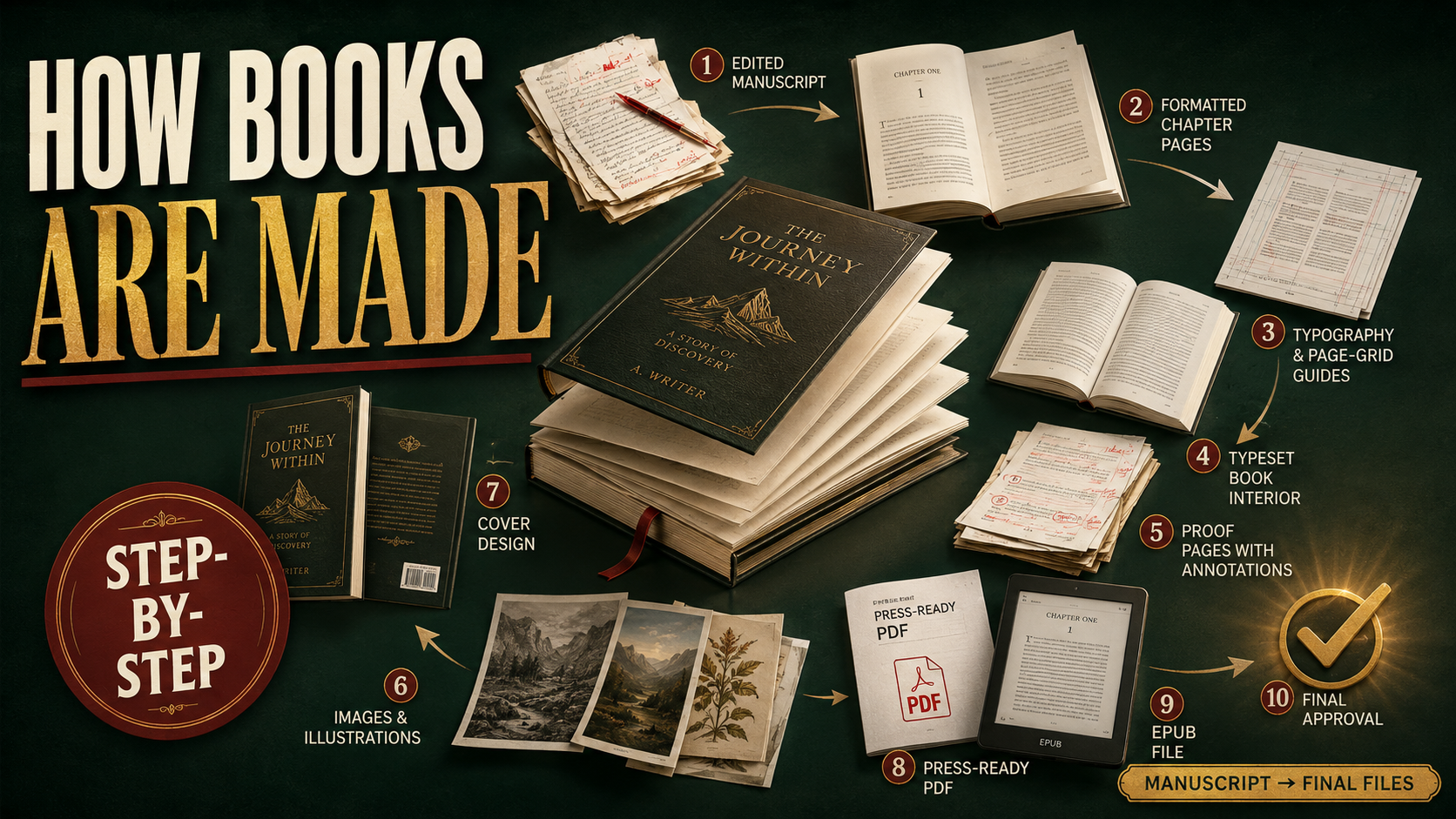
Book production services turn an approved manuscript into accurate, attractive, accessible, and distribution-ready files. The process normally covers manuscript assessment, copyediting, formatting, typesetting, proof review, corrections, eBook conversion, final validation, and delivery. Publishers benefit when one controlled source, clear responsibilities, and defined quality checks keep the printed book, EPUB, metadata, and future editions consistent.
Professional book production follows seven stages: manuscript intake, editorial preparation, design specification, formatting and typesetting, proofreading, correction control, and final-file delivery. Required outputs may include press-ready PDF, EPUB 3, accessible PDF, cover files, source files, images, fonts, and metadata. Every stage should have an owner, acceptance criteria, and approved source.
Book Production Services: Process Overview
Book production begins after the manuscript and publishing brief are sufficiently stable. A production team inspects the files, applies editorial and design requirements, creates sample pages, composes the full title, manages proofs and corrections, generates required formats, and audits the final package against printer, retailer, library, and accessibility specifications.
Scope depends on the title. A novel may need copyediting and reflowable EPUB, while an illustrated or technical book may require image correction, complex tables, indexing, LaTeX equations, specialist symbols, and separate output specifications.
| Production Stage | Main Activity | Primary Deliverable |
|---|---|---|
| 1. Intake | Review manuscript, images, tables, permissions, brief, schedule, formats, and distribution needs | Complete input package and query list |
| 2. Editorial preparation | Apply copyediting, style, consistency, reference, and structural requirements | Approved edited manuscript |
| 3. Design and sample | Define trim, grid, typography, headings, page elements, figures, and tables | Approved sample pages and design specification |
| 4. Typesetting | Compose the complete interior and place or process visual and technical content | First proof |
| 5. Proof and corrections | Proofread, collect author and publisher changes, resolve queries, and control versions | Approved final proof |
| 6. Format generation | Create press PDF, EPUB, accessible PDF, cover, images, and metadata as required | Validated publication files |
| 7. Delivery | Audit file names, versions, assets, specifications, and destination packages | Complete archive and distribution package |
Siliconchips Services provides book production services for publishers, covering editorial support, professional composition, digital conversion, quality checks, and delivery for books and journals.
Book Formatting: Preparing Content for Design
Book formatting organises manuscript content before and during composition. It standardises headings, paragraphs, lists, quotations, tables, notes, captions, references, and special elements so the design can be applied consistently. Good formatting separates meaning from appearance, reduces manual repair, and helps printed and digital versions retain the correct hierarchy.
Formatting starts with the manuscript. Inconsistent headings, manual spaces, text boxes, unlinked notes, and uncontrolled images create avoidable errors. Map every content type to a named style or structural rule.
Manuscript formatting checklist
- Heading hierarchy — distinguish chapter titles, sections, subsections, and unnumbered headings consistently
- Paragraph types — identify body text, extracts, lists, examples, exercises, notes, and special boxes
- Figures and tables — supply numbered files, captions, callouts, permissions, and usable source assets
- Notes and references — confirm numbering, links, bibliography style, URLs, and persistent identifiers where relevant
- Special characters — identify equations, phonetics, multilingual text, symbols, and fonts requiring technical review
- Front and back matter — define title pages, copyright, contents, foreword, appendices, glossary, bibliography, and index
- Accessibility inputs — provide alternative text, language information, logical reading order, and meaningful link text
| Area | Formatting | Typesetting |
|---|---|---|
| Purpose | Organises and standardises content elements | Creates the designed reading experience |
| Typical decisions | Hierarchy, styles, labels, numbering, and content relationships | Typography, spacing, page composition, placement, and visual balance |
| Main risk | Inconsistent or unidentified content structure | Layout defects or altered technical meaning |
| Primary result | Clean, consistently marked manuscript | Complete pages and digital presentation |
Professional Book Typesetting and Page Composition
Book typesetting applies the approved design to every page while protecting readability and content accuracy. The compositor controls typefaces, spacing, line length, page breaks, running heads, folios, figures, tables, notes, and technical material. Complex titles may use Adobe InDesign, LaTeX, or specialist composition tools according to content and outputs.
Approve sample pages before full composition. Include ordinary text and the hardest recurring elements, then review typography, navigation, page economy, accessibility, and the treatment of variable headings, tables, figures, and notes.
Typesetting quality checklist
- Design consistency — approved fonts, styles, spacing, grids, margins, running heads, and folios are applied throughout
- Readable pages — control line length, leading, widows, orphans, awkward breaks, rivers, and excessive white space
- Technical accuracy — equations, units, symbols, code, tables, notes, and cross-references match the approved manuscript
- Image quality — check resolution, colour mode, crop, labels, placement, captions, credits, and reproduction size
- Font integrity — confirm glyph coverage, embedding rights, language support, weights, and output behaviour
- Navigation — contents, headings, page references, notes, links, bookmarks, and index entries resolve correctly
Explore Siliconchips Services’ professional book typesetting services for InDesign, LaTeX, complex layouts, technical books, journals, and multi-format publication.
Proofreading and Correction Management
Proofreading checks the composed book for textual, typographic, layout, and cross-reference errors before final files are released. Corrections must be collected, clarified, approved, applied to the controlled source, and verified. Late rewriting should be separated from genuine production corrections because extensive changes can affect pagination, indexes, references, and schedules.
Copyediting and proofreading serve different purposes. Copyediting prepares the manuscript before composition; proofreading inspects the designed pages against the approved content and specification. A proofreader checks both the words and their presentation, including running heads, page numbers, tables, captions, notes, and page breaks.
| Proof Stage | Main Check | Approval Point |
|---|---|---|
| First proof | Content placement, design application, textual errors, figures, tables, notes, and queries | Publisher confirms direction and supplies consolidated corrections |
| Revised proof | Approved corrections, reflow effects, pagination, cross-references, and unresolved items | Author or publisher closes remaining corrections |
| Final proof | Correction accuracy, title data, contents, folios, links, and file completeness | Authorised release for format generation |
| Post-conversion check | EPUB, accessible PDF, navigation, metadata, images, fonts, and device behaviour | Final digital files accepted for distribution |
Correction-control checklist
- One consolidated return — combine author, editor, designer, and publisher comments before application
- Clear annotation — corrections must identify the location, replacement, and decision without ambiguity
- Substantive-change escalation — route changes affecting meaning, permissions, design, index, or schedule for approval
- Version naming — distinguish source, proof rounds, approved files, and released packages
- Correction verification — compare every marked item and inspect any page reflow or linked element it affects
Final Files for Printing, eBooks, and Digital Distribution
Final book files should match each destination’s technical and commercial requirements. A typical package may contain a press-ready interior PDF, separate cover PDF, EPUB 3, accessible PDF, source files, linked images, approved fonts, metadata, validation reports, and an archive manifest. Publishers should verify specifications before generating the final package.
There is no universal “final PDF”. Printers, print-on-demand services, institutions, and retailers can require different trim, bleed, colour, fonts, images, metadata, and packaging. Use each destination’s current specification rather than a generic preset.
| Final Output | Main Purpose | Quality Checks |
|---|---|---|
| Press-ready PDF | Offset or digital printing | Trim, bleed, colour, images, fonts, transparency, page count, and printer profile |
| Print-on-demand PDF | Unit or short-run manufacturing | Platform dimensions, margins, spine, cover template, fonts, and image resolution |
| EPUB 3 | eBook retailers, libraries, and reading applications | EPUB validation, navigation, reflow, fonts, images, metadata, links, and device tests |
| Accessible PDF | Institutional and inclusive digital reading | Tags, reading order, headings, tables, alternative text, links, language, and metadata |
| Source archive | Corrections, reprints, new editions, and future conversion | Editable files, images, fonts, licences, links, manifest, and version record |
Final delivery checklist
- Content approval — every authorised correction appears in each required format
- File validation — run format, font, link, image, metadata, and accessibility checks
- Destination compliance — confirm printer, print-on-demand, retailer, library, or platform specifications
- Cross-format consistency — title, author, copyright, ISBN, contents, links, and edition data agree
- Archive completeness — include approved sources, assets, licences, reports, and a clear manifest
Professional digital publishing services support EPUB conversion, accessible files, metadata, validation, device testing, and distribution-ready book outputs.
Planning a new title or improving an existing book list?
Siliconchips Services can review your manuscripts, formats, design requirements, images, technical content, accessibility needs, schedule, and distribution destinations before preparing a tailored production proposal.
Frequently Asked Questions About Book Production Services
Publishers commonly ask what book production includes, how formatting differs from typesetting, when proofreading occurs, and which final files are required. The answers below clarify production scope, design approval, eBook delivery, accessibility, timing factors, and the information a service provider needs to prepare an accurate proposal.
What do book production services include?
Book production services can include manuscript assessment, copyediting, formatting, interior design, sample pages, typesetting, image processing, proofreading, correction management, indexing support, cover preparation, EPUB conversion, accessible PDF, final validation, and delivery. The exact scope depends on the title, publisher resources, distribution channels, content complexity, and required formats.
What is the difference between book formatting and typesetting?
Formatting identifies and standardises content elements such as headings, body text, quotations, lists, captions, notes, and references. Typesetting applies the approved visual design through typography, spacing, page composition, image placement, and navigation. Formatting creates consistent structure; typesetting turns that structure into professional pages and digital presentation.
When should proofreading happen during book production?
Proofreading normally occurs after the first full typeset proof is available. The proofreader checks text, layout, page elements, figures, tables, notes, and cross-references against the approved manuscript and design. A later verification pass confirms that corrections were applied accurately and did not introduce new page, pagination, link, or formatting problems.
Which software is used for professional book publishing?
Adobe InDesign is widely used for designed book interiors, while LaTeX suits mathematics-heavy and technical publications. Image tools prepare artwork, and specialist applications validate PDF, EPUB, fonts, links, and accessibility. The correct technology depends on content and outputs; software does not replace editorial judgement, typographic expertise, or final quality review.
Which final files should a publisher receive?
Depending on the contract, a publisher may receive press-ready interior and cover PDFs, print-on-demand files, EPUB 3, accessible PDF, editable source files, linked images, approved fonts, metadata, validation reports, and an archive manifest. File specifications should be agreed before production and tested against the intended printer, retailer, library, or platform.
How long does professional book production take?
Timing depends on manuscript length, editorial condition, design complexity, image and table volume, technical content, proof rounds, author response times, indexing, formats, and destination requirements. A provider should build the schedule from these factors, identify dependencies, and state which late manuscript changes or missing assets could alter the agreed delivery date.
Can one provider produce both printed books and eBooks?
Yes. A provider with print composition and digital conversion expertise can deliver press-ready PDF, print-on-demand files, EPUB 3, accessible PDF, and supporting metadata. The publisher should confirm how corrections remain consistent across formats, which device and platform tests are included, and whether source files will support future editions.
Professional Book Production Protects Quality at Every Stage
Effective book production connects editorial preparation, structured formatting, considered design, accurate typesetting, disciplined proofreading, controlled corrections, and destination-ready files. Publishers should define outputs and acceptance criteria early, approve representative samples, and retain complete source archives. These controls create books that are consistent, readable, reusable, and ready for their intended markets.
Siliconchips Services supports professional book publishing through editorial expertise in the UK and US, production delivery in India, and specialist capability across InDesign, LaTeX, proofreading, image handling, EPUB, accessible PDF, and multi-format delivery.
Turn your manuscript into publication-ready files
Share your book brief, sample manuscript, page extent, images, technical elements, formats, schedule, and distribution destinations with Siliconchips Services.