
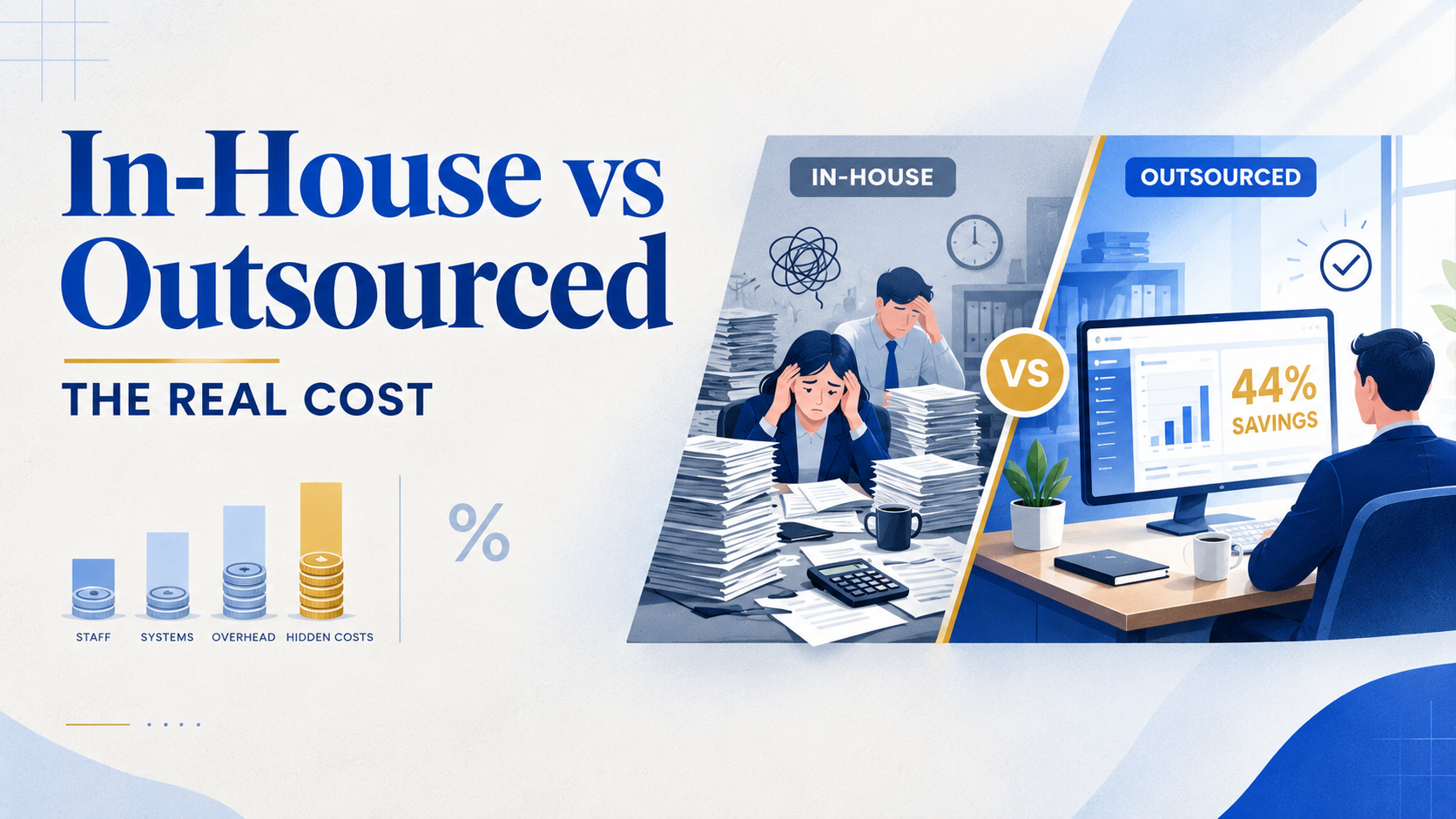
Book publishing companies face a fundamental decision that directly impacts their bottom line: whether to build in-house production capacity or outsource to specialist vendors. The true cost difference isn’t just about salaries versus vendor invoices. It includes software licences, training overhead, peak-capacity planning, quality control systems, and the hidden costs of managing fluctuating demand with fixed headcount.
Understanding the True Cost of Production
Publishing managers often compare production costs by looking at salaries alone, but that misses most of the actual expense. In-house production carries multiple cost layers that outsourcing eliminates or dramatically reduces: software licences for design and project management tools, ongoing training as standards evolve (EPUB accessibility, WCAG compliance, new typesetting requirements), benefits and employer taxes that typically add 20–30% above base salary, management overhead for HR coordination and team scheduling, office space and equipment allocation, and recruitment costs when staff turnover occurs.
Peak-capacity planning presents a particularly difficult challenge. Publishers must either staff for average workload and accept missed deadlines during busy periods, or staff for peak load and carry unused capacity for months. Most choose the former, leading to bottlenecks during critical publishing windows, or the latter, accepting significant inefficiency costs built into their annual budget.
When you account for all these factors—not just the headline salary figure—the total cost of maintaining in-house production capacity typically runs 44% higher per title than outsourcing to a specialist vendor. This holds true across most mid-sized publishers handling 50–400 titles annually, though your specific situation will vary based on title complexity, local salary levels, and the vendor rates available to you.
| Approach | What’s Included | Typical Cost Advantage |
|---|---|---|
| In-House Production | Staff salaries, employer taxes and benefits, software licences, training, office space, equipment, recruitment, management coordination, peak-capacity planning | Full control and oversight; best for very high volume (500+ titles) with consistent formats |
| Outsourced Production | Vendor fee covers all production services, software, training, and capacity management; you retain project coordination and quality oversight | 30–45% lower cost per title; scales flexibly with volume; access to specialist skills without training overhead |
The cost advantage of outsourcing stems from vendors spreading their fixed costs (software, infrastructure, training, management systems) across multiple publishing clients. What would be a dedicated expense for your business becomes a shared expense across dozens of publishers, driving per-title economics that most individual publishers cannot match unless operating at very high volume.
Hidden Costs of In-House Production
Several in-house costs don’t appear on monthly invoices but significantly impact total cost. Staff turnover adds 15–25% of annual salary cost per departure through recruitment fees, onboarding time, and productivity loss. Peak-load mismatch creates a choice between missing deadlines or carrying excess capacity during quieter months, typically meaning 20–30% unutilised staff time across the year.
Technology refresh cycles require capital investment every 3–5 years as software, hardware, and standards evolve—recent examples include the shift to accessible EPUB, WCAG 2.2 compliance, and evolving requirements for Open Access repositories. Skills gaps emerge when you need specialist capabilities like complex mathematics typesetting, non-Latin scripts, or advanced XML tagging.
Quality control becomes harder to maintain when your team handles every project. Fatigue and familiarity breed errors that external vendors catch more reliably with fresh eyes and dedicated QC stages. Management distraction is real: production managers report spending 40–60% of their time on HR issues and scheduling rather than optimising the production process.
When In-House or Outsourcing Wins
Outsourcing delivers the strongest ROI for variable volume publishers with seasonal peaks or unpredictable title counts. You pay only for what you use rather than maintaining year-round capacity. Mid-sized lists (50–400 titles per year) sit in the outsourcing sweet spot—you gain professional production standards without the fixed overhead of a full in-house team.
Specialist requirements favour outsourcing when you need capabilities used occasionally: LaTeX typesetting for mathematics-heavy STM content, multilingual typesetting, accessible format production meeting the latest WCAG standards, or complex graphics work. Fast scaling is easier with vendors—if you acquire a new imprint, you can ramp up immediately without a six-month hiring cycle.
In-house production makes sense in specific situations. Very high volume (above 500 titles per year) spreads fixed costs thin enough that per-title economics favour building internal capacity, especially if your titles follow consistent formats. Extremely tight editorial control requirements—where editorial and production decisions are inseparable, or sensitive content requires security beyond what vendor contracts provide—justify keeping work internal.
Strategic capability building applies when production expertise is a core competitive differentiator. If you sell production services to other publishers, in-house makes strategic sense even if the immediate cost is higher.
The Hybrid Model: Best of Both
Many publishers find the optimal solution is a hybrid approach. Keep a small in-house team (one or two production editors) for managing the schedule, liaising with authors, handling quality control, and directly producing high-touch or time-sensitive titles where close editorial involvement matters.
Outsource the bulk production work—copyediting, typesetting, indexing, EPUB conversion, and graphics—to specialist vendors. This combination gives you control where it matters while capturing the cost efficiency and flexibility of outsourcing.
- Keep strategic oversight and author liaison in-house
- Outsource repeatable, high-volume tasks (typesetting, copyediting, EPUB)
- Use in-house capacity for urgent or highly sensitive projects
- Maintain vendor relationships for scalability and specialist skills
- Build internal QC and project management capability, not production capacity
- Review the split annually based on volume, budget, and strategic priorities
A publisher with 200 titles per year might handle 30 in-house (the most complex) and outsource 170, adjusting the split as circumstances change without hiring or redundancy decisions.
Frequently Asked Questions
How do I compare vendor quotes when pricing structures differ?
Normalize all quotes to a cost-per-title or cost-per-word basis for your typical title profile. Ask each vendor to quote the same sample project, then divide their quote by word count or page count to get a per-unit rate. Watch for what’s included versus extra: does the quote cover copyediting and typesetting only, or also EPUB conversion, indexing, and graphics? Some vendors quote low on typesetting but charge separately for accessibility compliance or file setup. Request a detailed breakdown and build a true like-for-like comparison.
What happens to in-house staff if we outsource production?
Transitioning to outsourced production doesn’t necessarily mean redundancies. Redeploy production editors into editorial development roles, managing vendor relationships and quality oversight, or project management. Some publishers move production staff into digital product development, accessibility compliance, or production systems work. If your business is growing, natural attrition and redeployment can often handle the transition. Plan the transition over 12–18 months to allow for retraining and role evolution.
How do I maintain quality control with an outsourced vendor?
Build quality checkpoints into your vendor contract and internal process. Require sample outputs before full production begins, set clear quality standards in your vendor brief (house style guide, accessibility requirements, file format specifications), implement staged reviews (first-pass review of sample chapters), and track error rates by project. Maintain internal QC capability—one person doing final checks is cheaper than a full production team. Request regular quality reports from the vendor showing error rates, turnaround compliance, and author satisfaction scores.
What volume justifies building in-house production capacity?
The break-even point depends on your title complexity and vendor rates, but as a guideline, consistent volume above 500 titles per year makes in-house economically viable if your titles follow relatively standard formats. Below 300 titles per year, outsourcing almost always costs less when you include all hidden in-house costs. Between 300 and 500 titles, the decision depends on title complexity, staff salary levels, and whether you have predictable year-round volume. Volume alone isn’t the only factor—control requirements, specialist skills, and strategic priorities also matter.
Can I use offshore vendors without compromising quality?
Yes, if you choose vendors carefully and set up the relationship properly. Offshore publishing services (India, Philippines, Eastern Europe) deliver high-quality work when vendors have robust QC processes, experienced staff, and clear communication systems. The cost advantage is significant—typically 40–60% below equivalent UK or US in-house costs—without quality compromise. Key success factors include providing detailed briefs upfront, running pilot projects before committing to large volumes, building a dedicated team at the vendor for consistency, and maintaining regular communication and feedback loops.
How quickly can I scale production with an outsourced vendor?
Most established vendors can scale up by 50–100% within 4–6 weeks and handle short-term volume spikes with 2–3 weeks’ notice. Scaling down is immediate—you simply send fewer projects. Compare this to in-house scaling, which requires 3–6 months to hire and train new staff. The flexibility advantage of outsourcing is most valuable for publishers with variable or seasonal volume, where paying only for what you use eliminates the cost of maintaining year-round capacity for peak periods.
What contract terms should I negotiate with a production vendor?
Negotiate volume commitments (annual minimum in exchange for preferred rates), turnaround guarantees (with penalties for late delivery), quality standards (defined error rates, rework terms), pricing structure (per-title, per-word, or tiered volume discounts), scope clarity (what’s included versus charged separately), IP and confidentiality (who owns working files, NDA terms), and termination obligations (notice periods, file handover). Avoid contracts that lock you in rigidly—a 12-month initial term with 3-month rolling renewal gives you flexibility. Request a 2–3 project pilot before committing to a large annual contract.
Making the Right Choice for Your Publishing Business
For most mid-sized book publishing companies, outsourcing delivers 30–45% total cost savings while providing greater flexibility, access to specialist skills, and the ability to focus internal resources on editorial and strategic priorities.
The break-even point where in-house becomes cost-competitive typically sits around 500 titles per year, but only if you have consistent year-round volume, standardised formats, and the management capability to run an efficient production operation. Many UK publishers have found that outsourcing production allows them to focus on their core editorial and commercial strengths.
The hybrid model—small in-house team for oversight, outsourced vendor for bulk production—offers the best of both approaches for many publishers, combining control and responsiveness with cost efficiency and scalability.
Get a Tailored Production Cost Model for Your List
Every publisher’s situation is different. Siliconchips Services works with academic, STM, and independent publishers to deliver cost-effective, high-quality books and journals production, from copyediting and typesetting through to accessible EPUB and automation. We’ll analyse your current costs, title profile, and volume to show you exactly what outsourcing could save.
Request a Production Cost Analysis
See a Free Sample of Our Work