
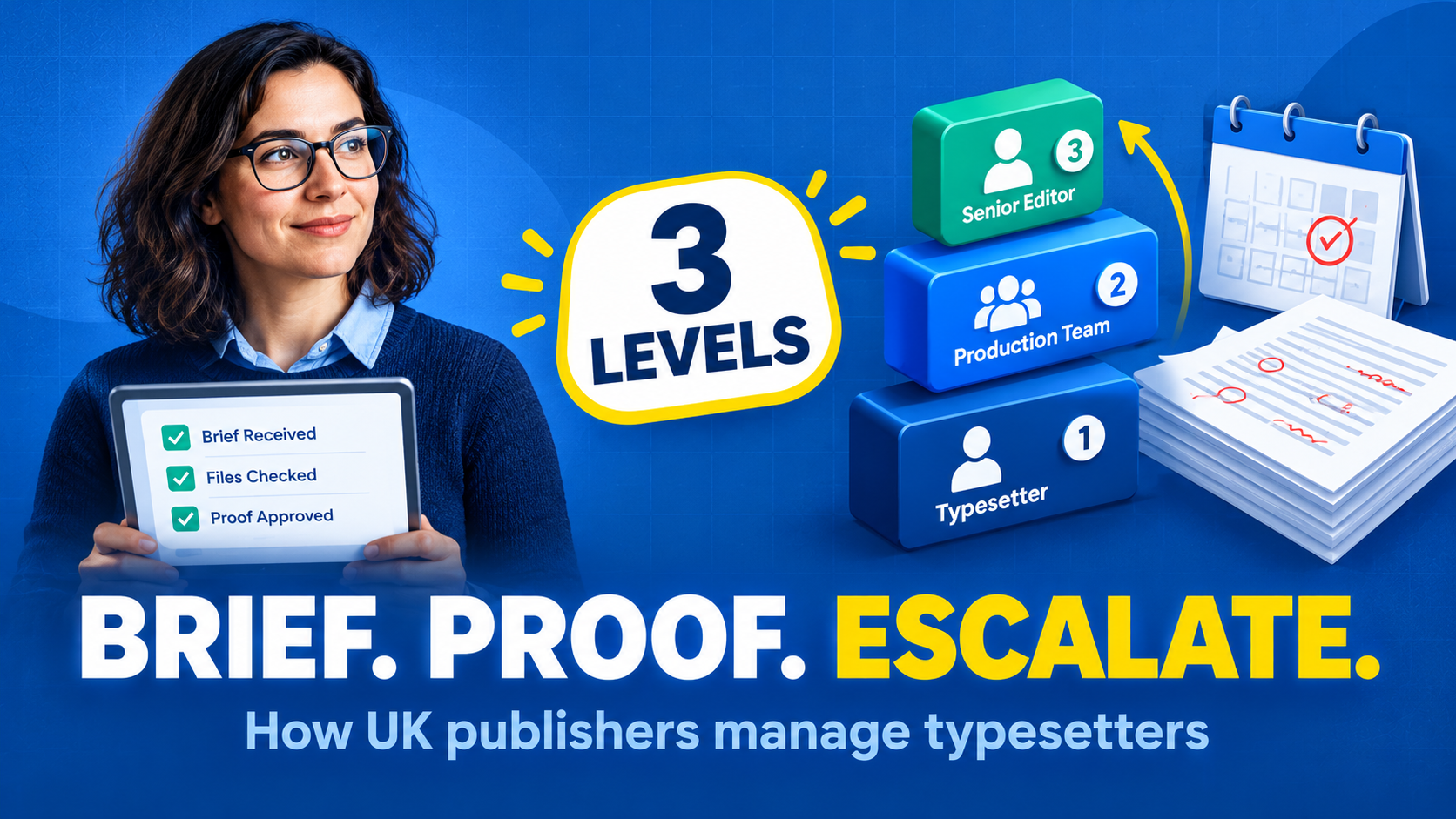
Publishing companies UK-wide, from independents to large groups, manage typesetters and production suppliers with five habits: a written brief, an agreed schedule, defined proof rounds, one clear line of communication and a route for escalation. Small and large publishers use the same habits at different scale. This guide explains each one, shows how they differ by publisher size, and links to published UK client stories that show them in practice.
How UK Publishers Brief a Typesetter or Production Supplier
A good brief tells the supplier what to produce, to what standard, by when and who decides. It is a short document attached to the quote, not a long manual. Most problems blamed on suppliers trace back to something the brief left unsaid.
- Trim size, page extent and design template, with sample pages
- House style sheet and spelling conventions, such as British English and quotation style
- Source file requirements: format, consistent styles and one master file per title
- Image specification: resolution, colour mode, file naming, and who supplies captions and credits
- Output formats: print-ready PDF, EPUB, accessible PDF and any metadata needed
- Accessibility expectations, particularly for ebooks sold to EU customers
- Number of proof rounds included, and what counts as an author alteration
- Dates for each hand-off and who approves each stage
- Named contacts on both sides, and the escalation route
- File delivery and confidentiality terms, including native files, with fonts and links where licences allow
Treat the first title as a pilot and revise the brief from what you learn. For the stages a title passes through, see our book and journal production guide.
Setting Schedules and Proof Rounds
Work backwards from the printer slot or ebook release date, then give every stage a date and an owner. Build in time for your own reviews, because approvals waiting on either side hold up every later stage. Agree proof rounds up front so nobody argues about them later.
| Stage | What to agree | Owner |
|---|---|---|
| Hand-over of final text | Locked files, style sheet and images supplied together | Publisher |
| First proofs | Delivery date and the format for queries | Supplier |
| Corrections | One consolidated list, with a return date | Publisher |
| Revised proofs | Check that corrections were applied; no new changes | Supplier and publisher |
| Index and final checks | Final page-proof date and a last read of the PDF | Publisher and indexer |
| Final files | Print-ready PDF, EPUB and native files | Supplier |
Late author changes are the usual cause of overruns. Lock the text before layout starts, and agree in advance how changes after typesetting are charged. Our proofreading services and typesetting services are scoped around these defined rounds.
Communication and Escalation That Work
Name one contact on each side, keep queries in a shared log and agree response times in the brief. Escalate by level rather than by volume of email: day-to-day issues stay with project contacts, repeat issues go to managers, and contract-level concerns go to directors. This keeps the publisher vendor relationship calm when pressure rises.
| Level | Trigger | Who is involved | Aim |
|---|---|---|---|
| 1 | A single query, minor error or small delay | Production editor and supplier project manager | Resolve within the agreed response time |
| 2 | Repeated errors, a missed date or unclear scope | Production manager and supplier account lead | Agree a recovery plan in writing |
| 3 | Persistent failure, a charging dispute or risk to publication | Head of production or managing director and supplier director | Decide whether to fix, re-scope or change supplier |
- Use one shared query log so every question and answer is recorded
- Confirm verbal decisions by email the same day
- Agree response times for queries and for corrections
- Hold a short check-in call during busy periods, and skip it when quiet
- Record what went wrong at Level 2 and update the brief with the lesson
Reviewing Performance: Publishing Supplier Management in Practice
Publishing supplier management does not need heavy software. Review each title on a few measurable points, and look at the pattern once a year. Share the results with the supplier, because problems cannot be fixed if the supplier never sees them.
- On-time delivery against the agreed dates
- Errors found at each proof round, and whether the supplier introduced them
- Speed and clarity of responses to queries
- File checks: print preflight and EPUB validation, for example with EPUBCheck and Ace by DAISY
- Accuracy of invoices against the quote
- Willingness to flag risks early rather than late
Practical Tips for Small and Large Publishers
The habits stay the same; the weight changes. Independents gain most from one reusable template and a quick debrief, while larger groups need consistency across imprints and many titles at once.
| Area | Small and independent publishers | Large and multi-imprint publishers |
|---|---|---|
| Brief | One short template reused for every title | Standard briefs by imprint or series, signed off by production |
| Contacts | Founder or production lead works directly with the supplier | Named production controller per imprint and a supplier account lead |
| Schedule | Shared calendar with a buffer before the printer slot | Portfolio schedule across imprints, with capacity planned in advance |
| Review | Short debrief after each title | Scorecards and a formal annual review |
| Main risk | Reliance on one person’s memory or one supplier | Inconsistency across many titles and suppliers |
| Contract | Simple terms: scope, proof rounds, file ownership | Framework agreement with service levels |
If you are weighing whether to bring suppliers in at all, our in-house vs outsourced cost model and our guide to what UK book publishers outsource cover that decision.
What Published UK Client Stories Show
The stories below are published by Siliconchips in clients’ own context. They show long-running supplier relationships rather than guarantees, and each illustrates one of the habits above.
Head of Zeus: entering ebooks without in-house know-how
Head of Zeus needed to convert around 60 titles into ebooks in 2012 with little ebook experience. The relationship began with a fast ebook service and has continued for over a decade, with the supplier acting as an extension of the team. Read the Head of Zeus client story.
Collins Learning: flexible capacity for complex titles
Collins Learning, the education division of HarperCollins UK, has worked with Siliconchips since 2017 on high-volume, technically complex educational and reference titles. The published story highlights support that can be scaled up or down, which eased pressure on internal resources. Read the Collins Learning client story.
Whittles Publishing: an independent moving from print to ebooks
Whittles Publishing, an independent publisher in Scotland, moved into ebooks in 2015 and looked for a supplier that shared its values and understood the production steps. The relationship has run for years on a collaborative basis. Read the Whittles Publishing client story.
Glossa: fast, accurate query handling
The editor of a scholarly journal publishing 140 articles a year reports that queries are answered within 24 hours and incorporated accurately in the final proofs. See the Glossa journal client story.
One production head quoted on the Siliconchips site says the team came to know their requirements so well they could have worked without a brief. Even then, write the brief down, because new staff and new suppliers will not have that history.
FAQs
How do UK publishers brief a typesetter?
They issue a short written brief with each quote or title. It covers trim size, design template, house style sheet, source file requirements, image specification, output formats, proof rounds, dates, named contacts and file-delivery terms. Reusing one template for every title keeps briefs consistent, and a pilot title shows what to improve.
How many proof rounds should a typesetting quote include?
There is no fixed number. Many publishers agree a first proof, a revised proof to check corrections and a final file check, but the scope should be written into the quote. Also agree what counts as an author alteration, since changes after typesetting are the usual reason costs rise.
What should a publisher do when a supplier misses a deadline?
First confirm the facts and ask for a recovery plan in writing from the supplier’s project contact. If the date is missed again or publication is at risk, escalate to the managers on both sides using the route set out in the brief. Record the cause and update the brief.
Do small publishers need formal supplier management?
They need the basics, not heavy systems: a reusable brief, a shared calendar, a query log and a short debrief after each title. This takes little time and protects against the main risks, which are unclear scope, late changes and reliance on one person’s memory.
How often should publishers review production suppliers?
Review lightly after every title and more formally once a year. Look at on-time delivery, errors per proof round, query response times, file validation results and invoice accuracy, then share the results with the supplier so problems can be fixed before the next list.
Should a UK publisher use one production supplier or several?
Both models work. One main supplier gives consistency and learns your house style, while several suppliers spread risk and allow specialist choices, such as separate typesetting and ebook conversion. Many publishers use one main supplier plus a backup, and keep the brief portable so they can switch if needed.
Start Small, Then Refine
Good supplier management is mostly good paperwork and good habits: a specific brief, a schedule with owners, defined proof rounds, one clear line of communication and a ladder for when things go wrong. Write one brief, run it on a pilot title, hold a debrief afterwards and improve from there. Our eBook conversion services and the services above can be quoted against your own brief.
Discuss Your Production Brief With Our Team
Tell us about your next title or list and how you like to work with suppliers. We will quote against your brief, so schedules, proof rounds and contacts are clear from the start.