
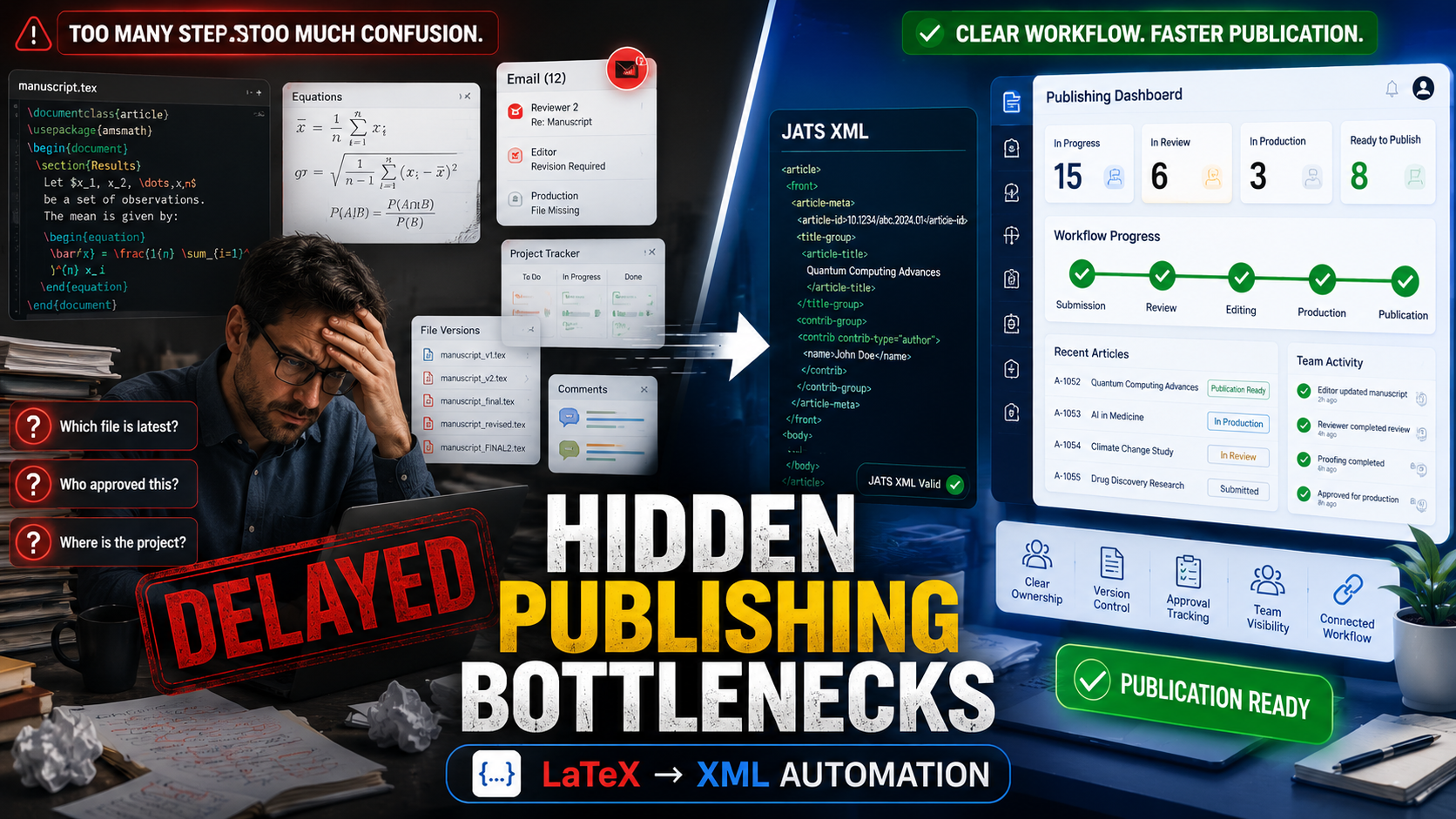
Academic publishing bottlenecks rarely start with peer review. The hidden delays that keep groundbreaking research offline for months are almost always in production: LaTeX conversion errors, manual typesetting rework, citation validation, and sequential format delivery. In STM publishing, a single technical manuscript can lose 4–8 weeks to formatting alone. Digital publishing automation — specifically LaTeX to XML conversion, automated content cleanup, and XML-first workflows — eliminates these bottlenecks at source.
The five hidden bottlenecks in academic publishing are: 1) LaTeX to XML conversion done manually post-typesetting, 2) complex mathematical notation and multi-language symbols requiring hand correction, 3) citation and reference validation against CrossRef / PubMed, 4) sequential multi-format delivery, and 5) in-house teams without STM-specific infrastructure. Automated content conversion services with JATS XML-first workflows resolve all five, cutting time-to-publication by 40–60%.
The Hidden Bottlenecks in Academic Publishing | 2026
Why Academic Publishing Workflows Break Standard Publishing Tools
Academic content requires a significantly higher level of scrutiny and technical expertise than standard trade publishing. It is a structural requirement enforced by indexing databases, not a formatting preference.
- Peer-review integration — manuscripts cycle through 2–3 rounds of revision with tracked changes that must be preserved in production XML
- Mathematical and scientific notation — LaTeX-encoded formulas, chemical structures, and multi-language symbols that standard word processors cannot render correctly
- Citation standards enforcement — references must validate against CrossRef, PubMed, and ORCID, with structured metadata for every author affiliation and funder
- Open-access compliance — funder mandates from UKRI, NIH, and Horizon Europe require machine-readable JATS XML and accessible EPUB 3 as a condition of publication
- Multi-format simultaneous delivery — PubMed Central requires JATS XML, libraries require BITS XML, readers require EPUB 3 / PDF/UA, repositories require HTML5 — all from one source
Standard publishing tools fail because they were built for narrative text, not structured scholarly content. This is where academic publishing services with STM-specific infrastructure become essential.
The 5 Hidden Bottlenecks Slowing Academic Journals in 2026
Most academic publishing delays occur after peer review acceptance, during production. The five critical choke points are LaTeX conversion, mathematical notation, citation validation, sequential format delivery, and lack of STM automation infrastructure. Each adds days to weeks per article.
| Bottleneck | What Goes Wrong | Time Cost | 2026 Fix |
|---|---|---|---|
| 1. LaTeX conversion | Manual LaTeX to XML post-typesetting introduces structural errors, broken MathML, lost equation numbering | 5–12 days | Automated LaTeX to XML conversion, schema-valid JATS / TEI at first pass |
| 2. Mathematical notation | Complex formulas and multi-language symbols render incorrectly or become images in standard tools | 2–5 days | MathML encoding at XML source, preserved across EPUB 3, HTML5, PDF |
| 3. Citation validation | References manually checked against CrossRef / PubMed; DOI mismatches caught late | 1–3 days | Automated reference linking with CrossRef API validation during XML structuring |
| 4. Sequential format delivery | PDF approved first, then EPUB, then JATS XML — each stage introduces new errors | 2–4 days | XML-first: EPUB 3, PDF/UA, JATS XML, HTML5 generated simultaneously |
| 5. In-house infrastructure gap | University presses lack dedicated LaTeX engineers, XML specialists, and accessibility validators | 30–50% slower throughput | Publishing outsourcing services with STM-specialist teams |
Bottleneck #1 Deep Dive: The LaTeX Dilemma in STM Publishing
LaTeX is brilliant for writing scientific formulas. It is the standard across mathematics, physics, computer science, and engineering. The problem is what happens after submission.
In a traditional print-first pipeline, a LaTeX manuscript is typeset into a print PDF first. XML is then generated by parsing that PDF. This destroys structural integrity:
- Mathematical notation becomes images — equations are rasterized instead of MathML. Fails WCAG 2.1 AA and EAA compliance
- Equation numbering is lost — cross-references to Eq. (3), Fig. 2, Table 4 break and must be manually reconstructed
- Author affiliations flatten — ORCID, ROR IDs, and funder metadata become plain text, failing CrossRef validation
- Multi-language symbols corrupt — Greek, Cyrillic, CJK characters require manual character-entity correction
Modern content conversion services transform LaTeX source directly into schema-valid JATS XML before typesetting begins. MathML is encoded at source, citations are validated against CrossRef during conversion, and all output formats inherit the same structured data. Result: error-free, publication-ready output that saves 5–12 days per article.
Manual vs Automated Academic Publishing: A Direct Comparison
For STM journal editors and university press production managers, the choice between manual in-house production and automated digital publishing services determines time-to-publication, cost per article, and indexing compliance.
| Production Stage | Manual / Print-First | Automated / XML-First |
|---|---|---|
| Manuscript intake | LaTeX / Word files opened manually, complex elements flagged by eye | Automated analysis identifies MathML, tables, figures, citations before production |
| LaTeX cleanup | Editors manually correct LaTeX errors — 2–5 days | Automated LaTeX cleanup — error-free manuscripts in hours |
| XML structuring | XML from typeset PDF, structural errors corrected manually — 5–12 days | LaTeX to XML conversion produces schema-valid JATS XML at first delivery |
| Multi-format output | Sequential: PDF → EPUB → XML → HTML5. 2–4 days per format | Simultaneous: EPUB 3, PDF/UA, JATS XML, HTML5 from one XML source |
| Validation | Manual checks, schema errors reach PubMed / CrossRef submission | EPUBCheck 5.x, JATS schema, WCAG 2.1 validation built into pipeline |
| Time to publication | 4–8 weeks post-acceptance | 7–14 days post-acceptance |
Academic Publishing Automation: 5 Best Practices for 2026
- 1. Move to XML-first production — create JATS XML / BITS XML before typesetting. All output formats generate simultaneously from one structured source
- 2. Automate LaTeX cleanup — use content conversion services to transform LaTeX manuscripts into error-free, schema-valid XML. Manual intervention should be the exception
- 3. Implement digital publishing automation software — editorial workflow tools where an operator clicks submit to notify editors, trigger XML validation, and route files to typesetting automatically
- 4. Outsource to STM-specialist production partners — handling LaTeX, MathML, and JATS XML entirely in-house without dedicated infrastructure leads to delays and staff burnout
- 5. Validate accessibility at XML source — EPUB Accessibility 1.1 metadata, MathML for equations, and WCAG 2.1 AA compliance must be encoded in the XML source, not retrofitted. The European Accessibility Act is enforceable from June 2025
Is LaTeX conversion bottlenecking your journal production?
Siliconchips Services delivers end-to-end digital pre-press publishing services specifically tailored for academic, STM, and open-access publishers worldwide — with automated LaTeX to XML conversion, US/UK copy editors, and a London-managed / India-delivery hybrid model.
Talk to a Publishing Production Expert
View Academic Publishing Services
Scaling Smarter: How Siliconchips Services Fixes Academic Publishing Bottlenecks
Publishers implementing digital publishing automation with Siliconchips Services combine innovative technology with deep open-access workflow expertise to deliver precise, efficient, and right-sized solutions for STM journals, university presses, and open-access platforms.
What makes the approach reliable:
- Hybrid delivery model — London-based management team with a skilled delivery centre in India
- US/UK copy editors — linguistic accuracy built into the workflow, ensuring native-level editorial quality
- InDesign and LaTeX typesetting — perfect page layout, design, and typesetting through dedicated specialist teams
- End-to-end digital pre-press — manuscript intake, LaTeX to XML conversion, copyediting, typesetting services, accessibility remediation, and multi-format output under one coordinated workflow
By embracing automated content conversion and professional editorial support, publishers transform static text into globally accessible knowledge — and cut time-to-publication from months to days.
Frequently Asked Questions: Academic Publishing
What is the biggest bottleneck in academic publishing?
LaTeX to XML conversion done manually post-typesetting. This single step introduces broken MathML, lost equation numbering, and flattened author metadata, costing 5–12 days per article. Automated LaTeX to XML conversion producing schema-valid JATS XML at first delivery eliminates this bottleneck entirely.
How long does academic publishing take in 2026?
With manual print-first workflows: 4–8 weeks post-acceptance for STM articles. With automated XML-first digital publishing services: 7–14 days post-acceptance. The difference is LaTeX automation, simultaneous multi-format output, and validated JATS XML at first delivery.
What is LaTeX to XML conversion and why does it matter?
LaTeX to XML conversion transforms LaTeX-encoded scientific manuscripts into structured JATS XML with MathML-encoded notation, preserving equation numbering and citation metadata. It matters because PubMed, CrossRef, DOAJ, Scopus, and Web of Science all require JATS XML for indexing — and manual conversion is slow, expensive, and error-prone.
Can academic publishing be automated?
Yes. Digital publishing automation covers manuscript analysis, automated LaTeX cleanup, LaTeX to XML conversion, automated typesetting, citation validation against CrossRef, and simultaneous EPUB 3 / PDF/UA / JATS XML / HTML5 output. Editorial judgment remains human; repetitive formatting does not need to be.
What are digital publishing services for academic journals?
End-to-end production including LaTeX to XML conversion, copyediting by US/UK editors, InDesign / LaTeX typesetting, accessibility remediation to WCAG 2.1 AA / EPUB Accessibility 1.1, and multi-format output — JATS XML, EPUB 3, PDF/UA, HTML5 — from a single XML source. Designed specifically for STM, university presses, and open-access platforms.
How do I choose an academic publishing services partner?
Look for: 1) proven LaTeX to XML automation with JATS schema validation reports, 2) STM-specific editorial team (US/UK copy editors), 3) XML-first workflow with simultaneous multi-format delivery, 4) EAA / WCAG 2.1 accessibility compliance built-in, 5) transparent per-article pricing and 7–14 day turnaround SLAs. Request a sample conversion of your own LaTeX manuscript.
Conclusion: Fix the Bottleneck, Not the Research Timeline
Groundbreaking scientific research should not wait months to appear online because of formatting. The five hidden bottlenecks in academic publishing — LaTeX conversion, mathematical notation handling, citation validation, sequential format delivery, and infrastructure gaps — are all solvable with digital publishing automation and XML-first workflows.
Publishers who move from manual print-first production to automated LaTeX to XML conversion cut time-to-publication by 40–60%, meet EAA accessibility compliance automatically, and deliver structured, AI-discoverable content to PubMed, CrossRef, and open-access repositories on first submission.
Upgrade your academic publishing workflow
Explore tailored digital publishing automation solutions for STM journals, university presses, and open-access platforms. Request a quote and get a free LaTeX conversion sample for your next manuscript.
Request a Quote / Talk to a Publishing Expert
Explore Publishing Services