
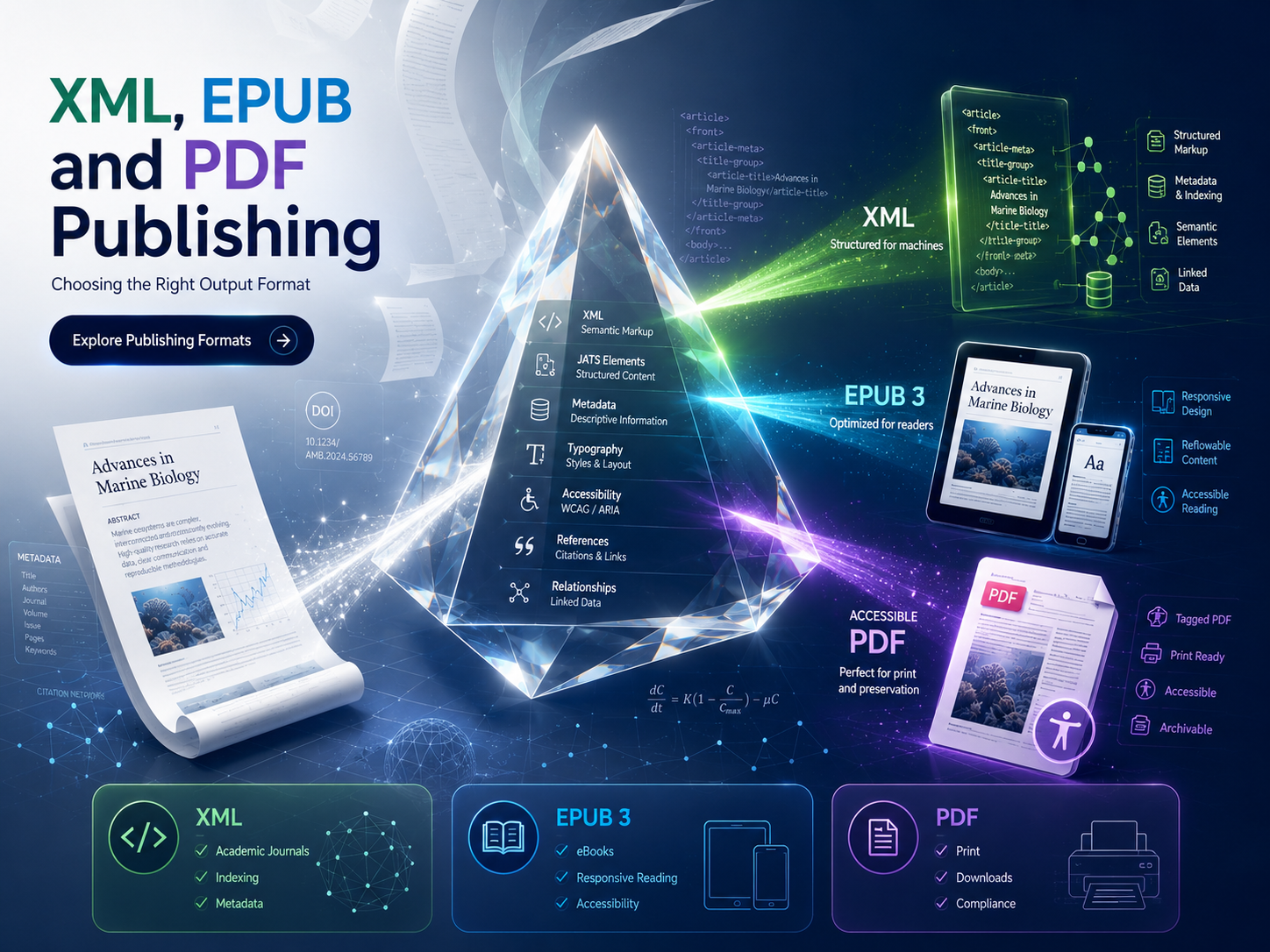
Choosing the wrong digital publishing format costs more than a rework cycle — it means content that fails indexing validators, ebooks rejected by retailers, and articles invisible to citation databases. The three core digital publishing formats — XML, EPUB, and PDF — each serve a distinct purpose, and no single format does everything. XML structures content for indexing and multi-format generation. EPUB 3 delivers reflowable, accessible ebooks to readers. PDF preserves a fixed visual layout for print and formal documents. Understanding when each format is the right choice — and when all three are required simultaneously — is the decision this guide is built to support.
For academic journals: JATS XML is mandatory for database indexing; PDF is the readable article format; EPUB 3 is required for accessibility compliance. For books: EPUB 3 is the primary retail distribution format; PDF is for print. The most efficient approach is an XML-first workflow that generates all formats simultaneously from one structured source — eliminating sequential conversion delays and format inconsistencies.
The Three Core Digital Publishing Formats at a Glance
The most common format decision mistake publishers make is treating XML, EPUB, and PDF as alternatives. They are not competing options — they serve different functions in the same production chain. XML is the source structure. EPUB is the reading format. PDF is the presentation format. A modern digital publishing workflow produces all three from a single XML source, simultaneously, in one production cycle.
| Format | Primary Function | Best For | Not Suited For | 2026 Status |
|---|---|---|---|---|
| XML (JATS / BITS) | Structured content source; database indexing; multi-format generation | Academic journals (JATS), books for library aggregators (BITS), content reuse across formats | Direct reader distribution — not a reading format | Mandatory for PubMed, CrossRef, DOAJ indexing; XML-first production now standard |
| EPUB 3 | Reflowable ebook distribution; accessible reading | Trade books, academic books, journals requiring accessibility compliance; retail distribution | Fixed-layout illustrated books (use fixed-layout EPUB 3); print production | Required by Amazon KDP, Apple Books, Google Play Books; EPUB 2 fails platform validation |
| PDF (Accessible) | Fixed-layout presentation; print-ready file; formal document distribution | Journal articles for publisher websites; illustrated books; print production; reports | Mobile reading of text-heavy content; content requiring accessibility compliance (without tagging) | Mandatory alongside JATS XML for journals; EAA requires tagged accessible PDF for EU distribution |
XML Publishing: JATS, BITS, and Why XML Must Come First
XML is not a reading format. Readers do not open XML files on their devices. XML is a production format — the structured source from which every other distribution format is derived. This is why the sequence matters: XML must be created first, not last.
JATS XML: What Journals Need and Why
JATS XML is the format that determines whether a journal article appears correctly in PubMed, CrossRef, Scopus, DOAJ, and Web of Science. Every structural element of an article — contributor affiliations, funding statements, reference DOIs, figure captions, supplementary data links — must be correctly tagged in JATS for database systems to ingest, index, and link it accurately. A visually correct PDF alongside an invalid or incomplete JATS file means an article that is present in the journal but missing or incorrectly represented in the databases where researchers actually search for it.
What must be correctly tagged in JATS XML:
- Contributor affiliations — structured with ROR (Research Organization Registry) identifiers, not plain text. Plain-text affiliations cannot be matched to institutional records in Scopus author profiles.
- ORCID identifiers — tagged in
<contrib-id contrib-id-type="orcid">elements for each named author. Missing ORCID tagging affects author disambiguation across citation databases. - Funding statements — tagged in
<funding-group>elements for CrossRef Funder Registry and open access compliance reporting. Funding data present only in the PDF and absent from JATS XML is invisible to funder compliance systems. - Reference DOIs — each cited reference tagged with a live DOI in
<pub-id pub-id-type="doi">. Unlinked references cannot be tracked by CrossRef Cited-by and do not contribute to citation metrics. - Mathematical notation — encoded in MathML within the XML, not converted to images. MathML is searchable, accessible to screen readers, and correctly rendered by modern platforms. Image-based equations are unsearchable and fail accessibility checks.
- Abstract structure — tagged with correct
<abstract>elements includingabstract-typeattributes for structured abstracts. Untagged abstracts are not correctly extracted by PubMed for display in search results.
BITS XML: What Books and Monographs Need
BITS (Book Interchange Tag Suite) is the book-level equivalent of JATS, designed for structured encoding of monographs, edited collections, and reference works. It is used by institutional library aggregators — ProQuest Ebook Central, EBSCO eBook Collection, and similar platforms — for metadata ingestion, chapter-level indexing, and access management. Publishers supplying content to these platforms without valid BITS XML either cannot be ingested at all or are represented with incomplete chapter and metadata records.
XML-First vs PDF-First: Why the Sequence Is the Decision
Key Distinction PDF-first: Content is typeset into a visual layout first. XML is then generated by parsing the finished PDF — a process that infers structure from font sizes and positions, frequently producing incorrect heading levels, image-based equations, and plain-text affiliations. Schema errors discovered at this stage require the typeset file to be reopened and the XML regenerated.
XML-first: Structured XML is created from the manuscript source before typesetting begins. PDF, EPUB 3, HTML5, and other formats are all generated from the XML simultaneously. Schema errors are caught at the XML stage — before any typesetting resource is applied — and corrected in minutes rather than hours.
The practical consequence: XML-first production eliminates the most expensive class of rework in digital publishing — late-stage XML errors — and allows simultaneous multi-format delivery. Siliconchips Services operates XML-first production as standard across its digital publishing services, with JATS and BITS XML created as primary production files and schema validation reports provided alongside every delivery.
EPUB Publishing: EPUB 3, EPUB 2, Fixed Layout, and When Each Applies
EPUB 3 is the current required format for all major retail and library distribution platforms. EPUB 2 fails validation on Amazon KDP, Apple Books, and Google Play Books — it is not an acceptable submission format in 2026. For text-heavy content, use reflowable EPUB 3. For illustrated, design-intensive content where layout cannot reflow, use fixed-layout EPUB 3. EPUB 2 has no valid use case for new publications.
content.opf) that lists all resources and metadata, and a navigation document (nav.xhtml) for the table of contents. EPUB 3, the current version, supports semantic HTML5, CSS3, MathML for mathematical notation, SVG graphics, audio and video embedding, and the EPUB Accessibility 1.1 metadata required by the European Accessibility Act.EPUB 3 Reflowable vs Fixed-Layout: Choosing Correctly
EPUB 3 exists in two structural variants. Choosing the wrong one creates a poor reader experience that cannot be corrected by styling alone — it requires rebuilding the file structure.
Reflowable EPUB 3 — text and images reflow to fit any screen size, font size setting, or orientation. The reader controls their preferred reading experience. This is the correct format for all text-heavy content: novels, academic monographs, humanities titles, self-help, business books, and most STM titles where prose and equations are the primary content. The global eBook market is expected to reach $56.51 billion in 2026 and $87.43 billion by 2030, with reflowable EPUB 3 as the dominant distribution format across this growth.
Fixed-layout EPUB 3 — content is positioned at pixel-precise coordinates, maintaining exact layout regardless of screen size. Required for illustrated children’s books, art books, photography titles, and cookbooks where the spatial relationship between text and image is integral to the reading experience. Fixed-layout EPUB 3 does not provide a good reading experience on small screens — the reader must zoom and pan — so it is inappropriate for text-heavy content regardless of how complex the formatting appears in the InDesign source.
EPUB 2 vs EPUB 3: Why EPUB 2 Has No Valid Use Case in 2026
| Capability | EPUB 2 | EPUB 3 |
|---|---|---|
| HTML standard | XHTML 1.1 only | Semantic HTML5 — headings, sections, articles, figures structurally defined |
| Mathematical notation | Not supported — equations rendered as images | MathML natively supported — equations searchable and screen-reader accessible |
| Audio / video | Not supported | HTML5 audio and video embedding supported |
| Accessibility metadata | Not supported — no EPUB Accessibility standard | EPUB Accessibility 1.1 supported — required for EAA compliance |
| Navigation | NCX (toc.ncx) only |
Semantic nav.xhtml document plus optional NCX for backwards compatibility |
| Amazon KDP | Rejected at upload | Accepted — converted to Kindle format internally by Amazon |
| Apple Books | Fails platform validation | Required format for submission |
| European Accessibility Act | Non-compliant | Compliant when EPUB Accessibility 1.1 metadata is correctly implemented |
What a Valid EPUB 3 File Must Include
- Passes EPUBCheck 5.x validation with zero errors and zero warnings.
- EPUB Accessibility 1.1 metadata present in
content.opf:schema:accessMode,schema:accessibilityFeature, andschema:accessibilitySummarypopulated correctly. - Semantic navigation in
nav.xhtmlwith a complete table of contents linked to all chapters and major sections. - All images have descriptive alt text — not empty attributes (
alt="") or filenames (alt="figure1.png"). - Mathematical content encoded in MathML for STM and academic titles — not rendered as images.
- File tested on minimum three environments: Kindle (via Send-to-Kindle), Apple Books, and a desktop EPUB reader such as Adobe Digital Editions.
- Metadata block complete: ISBN, language, publication date, subject classification (BISAC or Thema codes), publisher, and rights statement.
Siliconchips Services provides EPUBCheck 5.x validation reports as a standard deliverable alongside every EPUB file — not available on request. Full-scope EPUB conversion services cover reflowable and fixed-layout EPUB 3, with accessibility metadata and device testing included.
Not sure which format your content needs — or whether your current files would pass validation?
Our team can assess your source files and existing digital output, identify format gaps, and provide a clear production scope before any work begins.
Talk to a Format Specialist
View Digital Publishing Services
PDF Publishing: Accessible PDF vs Print PDF — and When PDF Is the Right Choice
PDF is the correct format for content where precise visual layout must be preserved exactly across devices and contexts: journal articles displayed on publisher websites, print-ready book files, technical manuals, illustrated books, and formal reports. PDF is the wrong format as the sole digital distribution format for text-heavy books — reflowable EPUB 3 provides a substantially better reader experience on phones and tablets, and PDF does not meet EPUB Accessibility 1.1 standards for ebook retail distribution.
Accessible PDF vs Untagged PDF: The Structural Difference That Determines Compliance
The majority of PDFs in academic publishing are not accessible — they are visually correct but structurally empty. An untagged PDF has no semantic hierarchy: a screen reader encounters a stream of text with no indication of what is a heading, what is a caption, what is body copy, or what order elements should be read in. For readers using assistive technologies, an untagged PDF of a journal article is effectively unreadable.
The European Accessibility Act, enforceable from June 2025, requires PDFs distributed in EU markets to meet WCAG 2.1 AA standards — which requires tagged structure. Publishers who have not audited their PDF output for accessibility tagging are distributing non-compliant content in their most important institutional markets.
Common Accessible PDF Failures
- Missing document language declaration. The PDF language must be declared in the document properties — not inferred by readers. Missing language declaration fails PAC 2024 validation and prevents screen readers from selecting the correct voice and language rules.
- Untagged figures. Images without tagged alt text in the PDF structure are invisible to screen readers. Every figure, table, chart, and decorative image must be tagged — decorative images with empty alt attributes, content images with descriptive text.
- Incorrect reading order. In multi-column PDF layouts, the logical reading order (left column top to bottom, then right column top to bottom) frequently differs from the visual layout order. Screen readers follow the tag tree order, not the visual order — an incorrectly tagged PDF reads column text in the wrong sequence.
- Equations as images without MathML. Mathematical notation rendered as images in PDF is inaccessible to screen readers. Tagged accessible PDF for STM content should include an ActualText attribute on equation images, or MathML delivered via an associated HTML version.
- Missing or incorrect heading structure. PDFs exported from typesetting software frequently flatten all headings to the same visual style without maintaining H1/H2/H3 hierarchy in the tag tree. A reader using screen reader navigation by heading level encounters a structurally flat document where no headings are distinguishable.
Print PDF vs Accessible PDF: Key Differences
| Attribute | Print PDF | Accessible PDF |
|---|---|---|
| Purpose | Sent to printer or print-on-demand service | Distributed digitally on publisher websites, repositories, open access platforms |
| Colour profile | CMYK with printer marks (bleed, crop, registration) | RGB or sRGB; no printer marks |
| Tag structure | Not required — printers do not read tag trees | Required — heading hierarchy, figure alt text, reading order, language declaration |
| Validator | Preflight check (Acrobat or printer’s preflight profile) | PAC 2024 (PDF Accessibility Checker); Adobe Acrobat Accessibility Checker |
| EAA compliance | Not applicable | Required for digital distribution in EU markets from June 2025 |
| File size | Larger — high-resolution images at 300+ dpi | Optimised for digital delivery — compressed images, no printer marks |
Accessibility Standards: What Each Format Must Meet in 2026
Accessibility is not a format preference in 2026 — it is a legal requirement for content sold in EU markets (European Accessibility Act, June 2025), a platform requirement for major ebook retailers, and an institutional procurement requirement for library and university buyers. Each digital format has a different compliance standard and a different validator. Meeting WCAG 2.1 AA in HTML does not make an EPUB file compliant with EPUB Accessibility 1.1, and an accessible PDF requires different tagging than either.
| Format | Accessibility Standard | Validator Tool | Key Requirements | Compliance Risk if Missed |
|---|---|---|---|---|
| EPUB 3 | EPUB Accessibility 1.1 + WCAG 2.1 AA | EPUBCheck 5.x; Ace by DAISY | Accessibility metadata in content.opf; descriptive alt text; MathML for equations; logical reading order; language declared |
EAA non-compliance; library platform rejection; excluded from accessible catalogue listings |
| Accessible PDF | WCAG 2.1 AA + PDF/UA-1 | PAC 2024; Adobe Acrobat Accessibility Checker | Tagged heading structure; figure alt text; reading order defined; document language declared; no colour-only information | EAA non-compliance for EU distribution; Section 508 non-compliance for US federal content; institutional procurement exclusions |
| HTML5 | WCAG 2.1 AA | W3C HTML Validator; WAVE; axe DevTools | Semantic heading hierarchy; ARIA landmarks; keyboard navigability; contrast ratio ≥4.5:1; alt text on all informational images | EAA non-compliance; WCAG audit failure; inaccessible to screen reader users |
| JATS XML | MathML; structured tagging per JATS spec | JATS 1.2 schema validator; CrossRef and PubMed submission validators | MathML for all equations; complete affiliation and funding tagging; reference DOI linking | Indexing database rejection; incomplete citation tracking; funder compliance reporting failures |
Format Selection Checklist: How to Choose the Right Output for Your Content
For Academic Journal Articles
- Will this article be submitted to PubMed, CrossRef, DOAJ, Scopus, or Web of Science? → JATS XML required.
- Will this article be available on the journal’s website for reader download? → Accessible PDF required.
- Is this journal subject to open access funder mandates (UKRI, NIH, Horizon Europe)? → JATS XML with machine-readable metadata required.
- Is this article being distributed in EU markets? → Accessible PDF meeting WCAG 2.1 AA required (EAA).
- Does this article contain mathematical notation? → MathML in JATS XML required; image-based equations are insufficient.
- Will article be hosted on an online reading platform (HTML)? → HTML5 from JATS XML source required.
For Academic and STM Books
- Will this book be distributed through Amazon KDP, Apple Books, Google Play Books, or Kobo? → EPUB 3 (reflowable) required; EPUB 2 will be rejected.
- Is this an illustrated, art, or design-intensive title where layout cannot reflow? → Fixed-layout EPUB 3 required instead of reflowable.
- Will this book be supplied to ProQuest Ebook Central, EBSCO, or institutional library aggregators? → BITS XML required alongside EPUB 3.
- Is this book being sold in EU markets? → EPUB 3 must meet EPUB Accessibility 1.1 (EAA compliance).
- Will a print edition be produced? → Separate print PDF with CMYK colour profile and printer marks required.
- Does the book contain LaTeX source with complex equations? → XML-first production with MathML encoding required; post-PDF XML conversion will produce image-based equations.
For Trade and Consumer Books
- Is this a text-heavy narrative title (novel, memoir, self-help, business)? → Reflowable EPUB 3 is the correct primary digital format. PDF should not be the sole ebook format.
- Is this being distributed across multiple platforms? → A single EPUB 3 file distributes to Apple Books, Google Play, Kobo, and Nook; Amazon converts EPUB to their internal format on upload.
- Is accessibility required for institutional or library sales? → EPUB Accessibility 1.1 metadata required in
content.opf.
Full Format Comparison Table: XML vs EPUB vs PDF
The table below provides a complete side-by-side reference across the decision dimensions that matter most for academic, STM, and book publishers evaluating their digital publishing format requirements.
| Decision Dimension | JATS / BITS XML | EPUB 3 (Reflowable) | EPUB 3 (Fixed-Layout) | Accessible PDF |
|---|---|---|---|---|
| Primary use | Database indexing; multi-format source | Retail ebook distribution; digital reading | Illustrated / design-led books | Journal articles; formal documents; print |
| Reader-facing? | No — production format only | Yes — primary reading format | Yes — on tablets and colour devices | Yes — download and desktop reading |
| Reflowable? | N/A | Yes — adapts to any screen | No — fixed pixel layout | No — fixed layout |
| MathML support | Yes — native in JATS | Yes — HTML5 MathML | Limited — layout constraints apply | Via ActualText tag or linked HTML |
| Accessibility standard | JATS schema; MathML | EPUB Accessibility 1.1 + WCAG 2.1 AA | EPUB Accessibility 1.1 (limited) | WCAG 2.1 AA + PDF/UA-1 |
| Validator | JATS 1.2 schema; CrossRef/PubMed validators | EPUBCheck 5.x; Ace by DAISY | EPUBCheck 5.x | PAC 2024; Acrobat Accessibility Checker |
| Amazon KDP | Not applicable | Accepted — converted internally | Accepted for fixed-layout Kindle titles | For print-on-demand only |
| PubMed / CrossRef | Required — primary submission format | Not used for indexing | Not used for indexing | Not used for indexing |
| EU EAA compliance | Not directly applicable | Compliant when EPUB Accessibility 1.1 implemented | Partial — limited accessibility for text content | Compliant when WCAG 2.1 AA + tagging implemented |
| Generated from XML-first? | Is the source | Yes — generated from JATS/BITS | Partial — InDesign source preferred | Yes — generated from XML or InDesign with tagging |
For publishers working across all three format types, Siliconchips Services provides fully integrated content conversion services covering JATS XML, BITS XML, EPUB 3 (reflowable and fixed-layout), and accessible PDF — with all validation reports provided as standard deliverables alongside every finished file.
Frequently Asked Questions: Digital Publishing Formats
What is the difference between XML, EPUB, and PDF in publishing?
XML is a structured data format used as the production source — JATS XML for journals, BITS XML for books — from which all other formats are generated. EPUB 3 is the primary distribution format for ebooks across retail and library platforms; it is reflowable and accessibility-compliant. PDF preserves a fixed visual layout and is used for print-ready files, journal articles on publisher websites, and formal documents. In a modern XML-first workflow, a single JATS or BITS XML file generates EPUB, PDF, and HTML simultaneously.
Which digital publishing format should academic journals use?
Academic journals need JATS XML as their primary format — it is required for indexing by PubMed, CrossRef, DOAJ, Scopus, and Web of Science. Accessible PDF is produced alongside it as the reader-download version. EPUB 3 is increasingly required for accessibility compliance under the European Accessibility Act for journals distributing in EU markets. The most efficient workflow produces all three formats from a single JATS XML source simultaneously, without sequential conversion.
Is EPUB better than PDF for book publishing?
For most book distribution, EPUB 3 is the better format. It is reflowable — text adapts to any screen size — supports EPUB Accessibility 1.1 compliance, and is accepted by all major retail platforms including Amazon KDP, Apple Books, Google Play Books, and Kobo. PDF works well as an ebook format only for content requiring fixed layout: academic papers with complex equations, technical manuals with precise diagrams, and sheet music. For text-heavy academic, STM, and trade titles, EPUB 3 is the correct primary digital format; PDF is appropriate as a companion download, not as the sole ebook offering.
What is JATS XML and when is it required?
JATS (Journal Article Tag Suite) is an XML standard maintained by NISO that defines the semantic structure of journal article content. It is required for submission to PubMed, CrossRef, DOAJ, and most major academic indexing databases. Without valid JATS XML, articles may be incorrectly indexed, incompletely represented in citation databases, or excluded from aggregator platforms entirely. JATS XML is not optional for any journal publishing to indexed databases — it is the format that determines whether published research is discoverable.
What accessibility standards apply to digital publishing formats in 2026?
Three standards apply. WCAG 2.1 Level AA covers web-based and HTML content. EPUB Accessibility 1.1 covers ebooks distributed through retail and library platforms — it requires specific metadata in the content.opf file, descriptive alt text on all images, and MathML for equations. The European Accessibility Act (EAA), enforceable from June 2025, requires digital publications sold in EU markets to meet these accessibility requirements. For PDF, WCAG 2.1 AA and PDF/UA-1 apply, verified through the PAC 2024 validator. Meeting one standard does not guarantee compliance with the others.
Can a single source file produce XML, EPUB, and PDF at the same time?
Yes — through an XML-first production workflow. When content is structured as JATS XML (for journals) or BITS XML (for books) at the start of the production cycle, EPUB 3, accessible PDF, and HTML5 can all be generated simultaneously from that single source. This eliminates sequential format conversion — the largest source of additional production time and format inconsistency in multi-format publishing. Publishers using PDF-first workflows generate XML as a derivative output, which introduces schema errors that require rework at the most expensive point in the production cycle.
Choosing the Right Digital Publishing Format: The Decision in Summary
The format decision for digital publishing is not a single choice — it is a combination determined by content type, distribution channel, and compliance obligations. Academic journal articles need JATS XML for database indexing, accessible PDF for reader download, and HTML5 for online hosting. Academic and STM books need EPUB 3 for retail distribution, BITS XML for library aggregators, and accessible PDF as a companion format. In all cases, an XML-first production workflow — where structured XML is the source from which all formats are simultaneously generated — is the most efficient and compliant approach available in 2026.
If your current production model generates XML after typesetting, delivers formats sequentially, or lacks EPUBCheck and JATS schema validation reports as standard deliverables, you are operating against a production standard that creates avoidable rework costs and compliance risks.
Ready to Produce the Right Formats — Validated, Accessible, and Delivered Simultaneously?
Siliconchips Services provides XML-first digital publishing services for academic, STM, and book publishers — JATS XML, BITS XML, EPUB 3, accessible PDF, and HTML5 delivered in a single production cycle. London-based account management, dedicated delivery centre in India.