
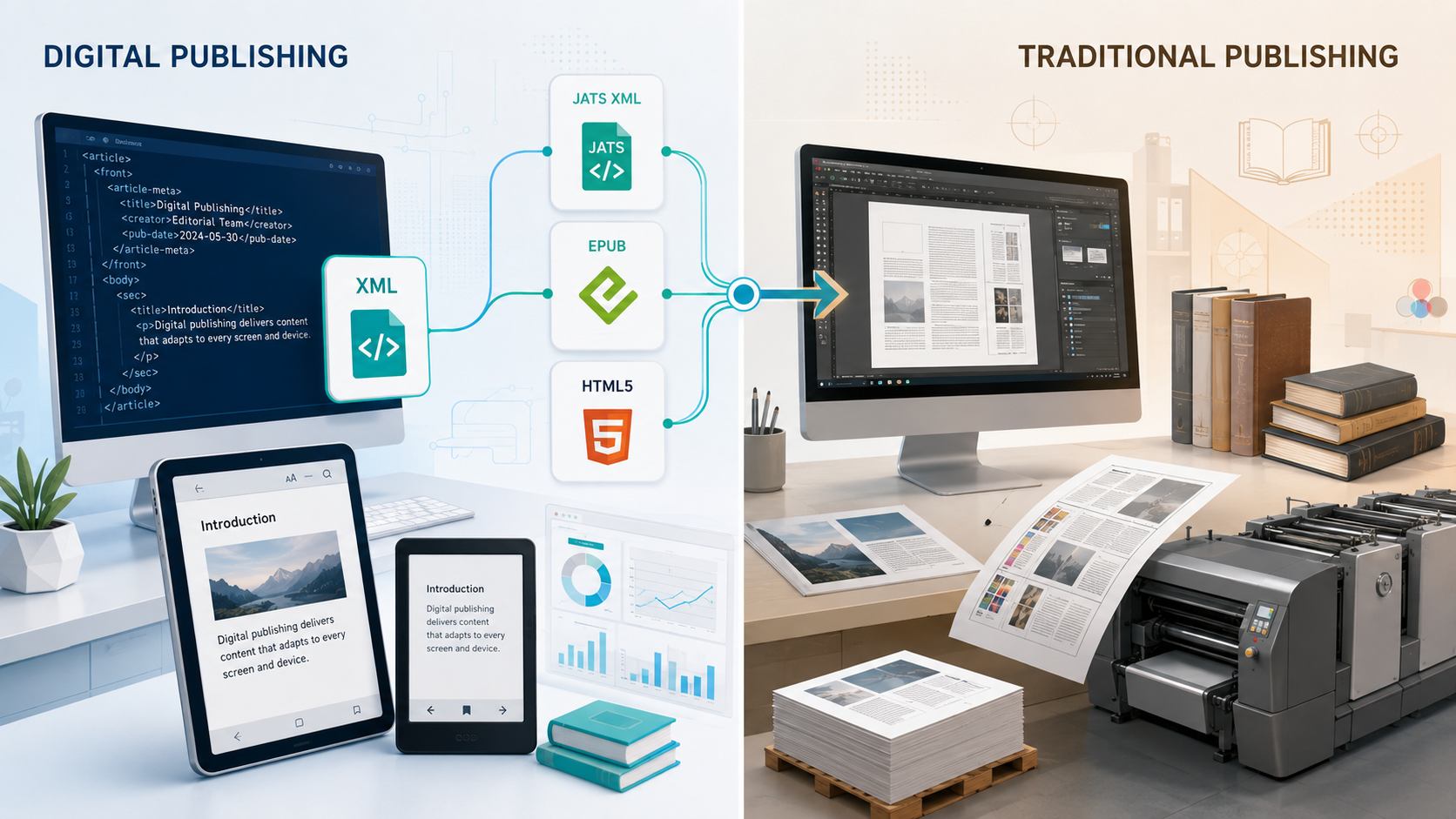
Digital publishing vs traditional publishing comes down to one structural decision: do you produce from a structured XML source for multi-format digital output, or from a print-first layout for physical distribution? Digital publishing delivers EPUB 3, JATS XML, accessible PDF, and HTML5 simultaneously from a single source. Traditional publishing delivers print first, with digital formats converted afterwards — if at all. For publishers in 2026, this choice directly affects cost per title, time to market, EAA accessibility compliance, and AI discoverability.
Digital publishing produces structured, multi-format output — EPUB 3, JATS/BITS XML, accessible PDF, HTML5 — simultaneously from an XML-first workflow, with built-in WCAG 2.1 / EPUB Accessibility 1.1 compliance. Traditional publishing produces print-first via typesetting, with digital formats generated sequentially afterwards. Digital publishing is faster, lower cost per format, and required for EAA compliance in EU markets. Traditional print remains necessary for specific trade, art, and institutional markets.
Format Differences: What Each Publishing Model Actually Produces
The format gap is not just print versus screen. It is structured versus visual. A properly produced EPUB 3 file encodes semantic heading hierarchy, accessibility metadata, and reflowable text that adapts to any screen size. A print PDF encodes visual positioning. That structural difference determines whether your content passes platform validation, meets the European Accessibility Act, and gets cited by AI Overviews.
| Output Attribute | Digital Publishing | Traditional Publishing |
|---|---|---|
| Primary source file | JATS XML / BITS XML — structured, schema-valid | InDesign / LaTeX print layout — visually structured |
| eBook format | EPUB 3 reflowable / fixed-layout, EPUBCheck 5.x validated | EPUB 2/3 converted post-typesetting, often with structural errors |
| Journal / academic XML | JATS XML 1.2 generated first, submitted to PubMed / CrossRef / DOAJ | XML generated from typeset PDF, requires manual correction |
| Accessibility | EPUB Accessibility 1.1 + WCAG 2.1 AA built into source XML | Accessibility tagging added post-production, often incomplete |
| Print output | Print-quality PDF generated from the same XML source | Print-quality PDF is the primary deliverable |
| Reflow / device adaptability | Yes — EPUB 3 reflows on Kindle, Apple Books, Kobo, mobile | No — print PDF is fixed-layout only |
| AI / search discoverability | Semantic HTML5, entity-rich metadata — directly extractable by AI Overviews | Print PDF content is largely invisible to AI citation systems |
Publishers using digital publishing services receive all formats — EPUB 3, accessible PDF, JATS/BITS XML, and HTML5 — simultaneously from a single XML source, with guaranteed content consistency across every output.
Workflow Differences: XML-First vs Print-First Production
Digital publishing uses an XML-first workflow: JATS/BITS XML is created before typesetting, and all formats are generated simultaneously from that single source. Traditional publishing uses a print-first workflow: typesetting happens first, and XML/eBook files are derived from the finished print layout. XML-first is now standard across academic and STM publishing.
The workflow direction changes everything downstream — cost, speed, error rate, and accessibility compliance.
Digital publishing workflow: XML-first
- Manuscript analysis and XML structuring first — peer-reviewed manuscript is converted to JATS XML / BITS XML before any typesetting begins. Semantic hierarchy, metadata, references, and MathML are encoded at source.
- Simultaneous multi-format generation — EPUB 3, accessible PDF, HTML5, and XML are all produced from the same XML file in one production cycle. Content is consistent across every format by construction.
- Validation built in — files pass EPUBCheck 5.x, JATS schema validation, and WCAG 2.1 checks before delivery. Schema validation reports are provided as standard.
- Content reuse enabled — structured XML components can be repurposed for open access repositories, eLearning modules, and future editions without re-editing the source.
Traditional publishing workflow: Print-first
- Typesetting is the production anchor — manuscript goes directly to InDesign / LaTeX for print layout. Visual appearance drives structural decisions.
- Digital formats are derivative — EPUB and XML are generated by parsing the typeset PDF. Mathematical notation becomes images instead of MathML. Heading levels are inferred from font size, not encoded semantics.
- Sequential delivery adds time — PDF is approved first, then EPUB conversion, then XML generation. Each step adds 2–4 days per title compared to parallel XML-first delivery.
- Rework costs accumulate — structural errors introduced during PDF-to-XML conversion require manual correction. Schema errors frequently reach indexing platform submission before they are caught.
For academic journals, books, and eLearning content at volume, academic publishing services operating an XML-first architecture eliminate the rework cycle that print-first pipelines create.
Still receiving PDF-first production with XML as an afterthought?
We can audit your current workflow against 2026 production standards and show you the specific rework costs and format inconsistencies a print-first model is generating for your titles.
Talk to a Publishing Production Expert
View Digital Publishing Services
Cost and Speed: What Publishers Pay Per Title in 2026
Digital publishing reduces per-title production cost when two or more output formats are required, because all formats are generated from a single XML source in one cycle. Traditional print-first publishing is cost-competitive for print-only titles, but becomes significantly more expensive once EPUB, XML, and accessibility compliance are added as sequential conversions.
Cost comparison depends entirely on how many output formats you need. Single-format print: traditional workflows are mature and efficient. Multi-format digital + print: XML-first digital publishing is faster and cheaper per format delivered.
| Cost / Speed Factor | Digital Publishing (XML-First) | Traditional Publishing (Print-First) |
|---|---|---|
| Production time per title | All formats delivered simultaneously in one cycle | Sequential: PDF → EPUB → XML. Adds 2–4 days per title |
| Cost for 2+ output formats | Lower — single XML source generates all outputs | Higher — each format is a separate conversion with manual rework |
| Accessibility compliance cost | Included — EPUB Accessibility 1.1 / WCAG 2.1 AA built into XML source | Add-on — PDF/UA tagging and EPUB remediation billed separately |
| Rework / error correction | Minimal — structural decisions made correctly once at XML stage | Recurring — PDF-to-XML conversion introduces structural errors requiring manual correction |
| Volume scaling | Linear — XML pipeline scales with automation; ideal for journal issue batches | Manual — each title requires individual typesetting attention |
| Print unit cost | Print-quality PDF generated from XML; POD-ready | Optimised for offset print; lower unit cost at high print runs |
Publishers outsourcing full production through publishing outsourcing services typically see the strongest cost advantage in digital publishing workflows when producing 20+ titles per year across multiple formats, or when managing journal issues on fixed deadlines with mandatory JATS XML submission.
Discoverability in 2026: Print Distribution vs AI and Platform Indexing
In 2026, content discoverability is dominated by AI systems. Google AI Overviews appear in ~48% of all queries, with the #1 organic result pushed ~1,674 pixels below the fold. Content with semantic structure, entity-rich metadata, and correct heading hierarchy is preferentially extracted and cited. Print-only content is invisible to this layer entirely.
Traditional publishing discoverability relies on print distribution networks, bookstore placement, and library acquisition — all valid, all physical. Digital publishing discoverability operates in three additional layers that did not exist when most print workflows were designed:
- Platform indexing — EPUB 3 files with correct accessibility metadata are accepted by Amazon KDP, Apple Books, Google Play Books, and Kobo. EPUB 2 files fail validation on all four in 2026. JATS XML is required for PubMed, CrossRef, Scopus, and Web of Science indexing.
- AI Overview citation — structured HTML5 content with semantic headings and entity relationships is extracted by Google AI Mode and other LLM systems. 63% of all LLM citations come from listicle / structured content formats. Print PDFs contribute essentially zero AI citations.
- Accessibility-driven discovery — the European Accessibility Act, enforceable from June 2025, requires EPUB Accessibility 1.1 metadata for digital publications sold in EU markets. Non-compliant titles face platform rejection and regulatory risk, which directly removes them from discoverable inventory.
A title that ranks #1 organically but earns no AI citation is buried 1,674 pixels below the AI Overview fold. A structured digital edition ranking #18 that earns an AI citation gets 35% more CTR. This is why end to end publishing services with XML-first structuring now include AI discoverability as a production requirement, not a marketing afterthought.
Which Publishing Model Fits Your Content? A Decision Guide
Choose digital publishing when you need multi-format output, accessibility compliance, fast time to market, or AI / platform discoverability. Choose traditional print-first when your primary market is physical retail, art / illustrated books requiring fixed print layout, or high-volume offset print runs. Most publishers in 2026 operate a hybrid: XML-first digital production with print-quality PDF generated from the same source.
Use this decision framework to match your content type to the right production model:
| Your Situation | Recommended Model | Why |
|---|---|---|
| Academic journals / STM articles | Digital publishing — XML-first | JATS XML required for PubMed / CrossRef / DOAJ. Open access mandates require machine-readable output. Non-negotiable in 2026. |
| Trade books, fiction, non-fiction for retail | Digital publishing with print PDF output | EPUB 3 for Amazon KDP / Apple Books distribution. Print-quality PDF from same XML source for POD. Maximum market reach. |
| Art books, illustrated, children’s, fixed-layout | Hybrid — fixed-layout EPUB 3 + print | Fixed-layout EPUB 3 preserves design fidelity on tablets. Print remains primary sales channel. Both from structured source. |
| eLearning / training content | Digital publishing — SCORM / xAPI | LMS delivery requires SCORM packaging, not print. Content segmentation and instructional metadata are digital-native. |
| High-volume offset print runs (10,000+ units) | Traditional print-first, with digital conversion | Offset print cost optimization requires print-specific typesetting. Add EPUB conversion if retail digital distribution is needed. |
| EU market distribution | Digital publishing — EAA compliant | European Accessibility Act requires EPUB Accessibility 1.1 + WCAG 2.1 AA. XML-first is the only cost-effective compliance path. |
Most global publishers in 2026 have moved to digital publishing solutions with XML-first production as the default, generating print-quality PDF from the same structured source. This hybrid approach delivers the broadest distribution — retail eBook platforms, academic indexing databases, accessible editions, and print-on-demand — from a single production investment.
Frequently Asked Questions: Digital Publishing vs Traditional Publishing
What is the main difference between digital publishing and traditional publishing?
Digital publishing produces structured digital formats — EPUB 3, JATS XML, accessible PDF, HTML5 — simultaneously from an XML-first source, with built-in accessibility compliance. Traditional publishing produces print-first via typesetting, with digital formats converted afterwards as a secondary step, which introduces structural errors and adds 2–4 days per title.
Is digital publishing cheaper than traditional publishing?
For multi-format output, yes. Digital publishing generates EPUB, PDF, XML, and HTML5 from a single XML source in one cycle, reducing per-format cost. Traditional print-first publishing is cost-competitive for print-only titles, but becomes significantly more expensive once EPUB, XML, and accessibility remediation are added as sequential conversions.
Can I do both digital and print publishing from the same workflow?
Yes. An XML-first digital publishing workflow generates print-quality PDF from the same structured XML source used for EPUB 3 and JATS XML output. This is the standard hybrid model in 2026: one XML source, all formats delivered simultaneously, with guaranteed content consistency across print and digital editions.
Do I need digital publishing for EAA accessibility compliance?
Effectively, yes for EU market distribution. The European Accessibility Act, enforceable from June 2025, requires EPUB Accessibility 1.1 metadata, tagged PDF/UA, and descriptive alt text for all images. XML-first digital publishing builds these requirements into the source file. Retrofitting accessibility into a print-first PDF is significantly more expensive and frequently incomplete.
Which publishing model is better for academic journals?
Digital publishing with XML-first production. JATS XML is mandatory for submission to PubMed, CrossRef, DOAJ, Scopus, and Web of Science. Funder mandates from UKRI, NIH, and Horizon Europe require machine-readable, accessible outputs. Print-first workflows with post-typesetting XML conversion cannot reliably meet schema validation requirements at journal issue volume.
Will traditional print publishing disappear?
No. Print remains essential for art books, illustrated titles, children’s books, collector editions, and specific institutional markets. The shift is in production order: publishers increasingly use XML-first digital workflows that generate print-quality PDF from the same structured source, rather than print-first workflows with digital as an afterthought.
Digital Publishing vs Traditional Publishing: What 2026 Requires
The choice between digital publishing vs traditional publishing is no longer print versus eBook. It is structured, multi-format, accessibility-compliant production versus sequential format conversion with rework costs. XML-first digital publishing delivers EPUB 3, JATS XML, accessible PDF, and HTML5 simultaneously, meets EAA compliance requirements, and produces content that AI systems can extract and cite. Traditional print-first publishing remains the right choice for offset print runs and design-intensive illustrated titles — ideally generated from the same XML source rather than as a separate pipeline.
Publishers who last reviewed their production model before 2024 are likely operating against a standard that has already moved. An XML-first production audit typically identifies 2–4 days of recoverable time per title, plus accessibility compliance gaps affecting EU market distribution.
Need a production model assessment for your titles?
Our team maps your current workflow against 2026 digital publishing standards — format output, accessibility compliance, time to market, and AI discoverability — with specific per-title cost comparisons for digital vs print-first production.
Request a Quote / Talk to a Publishing Expert
Explore Digital Publishing Services