
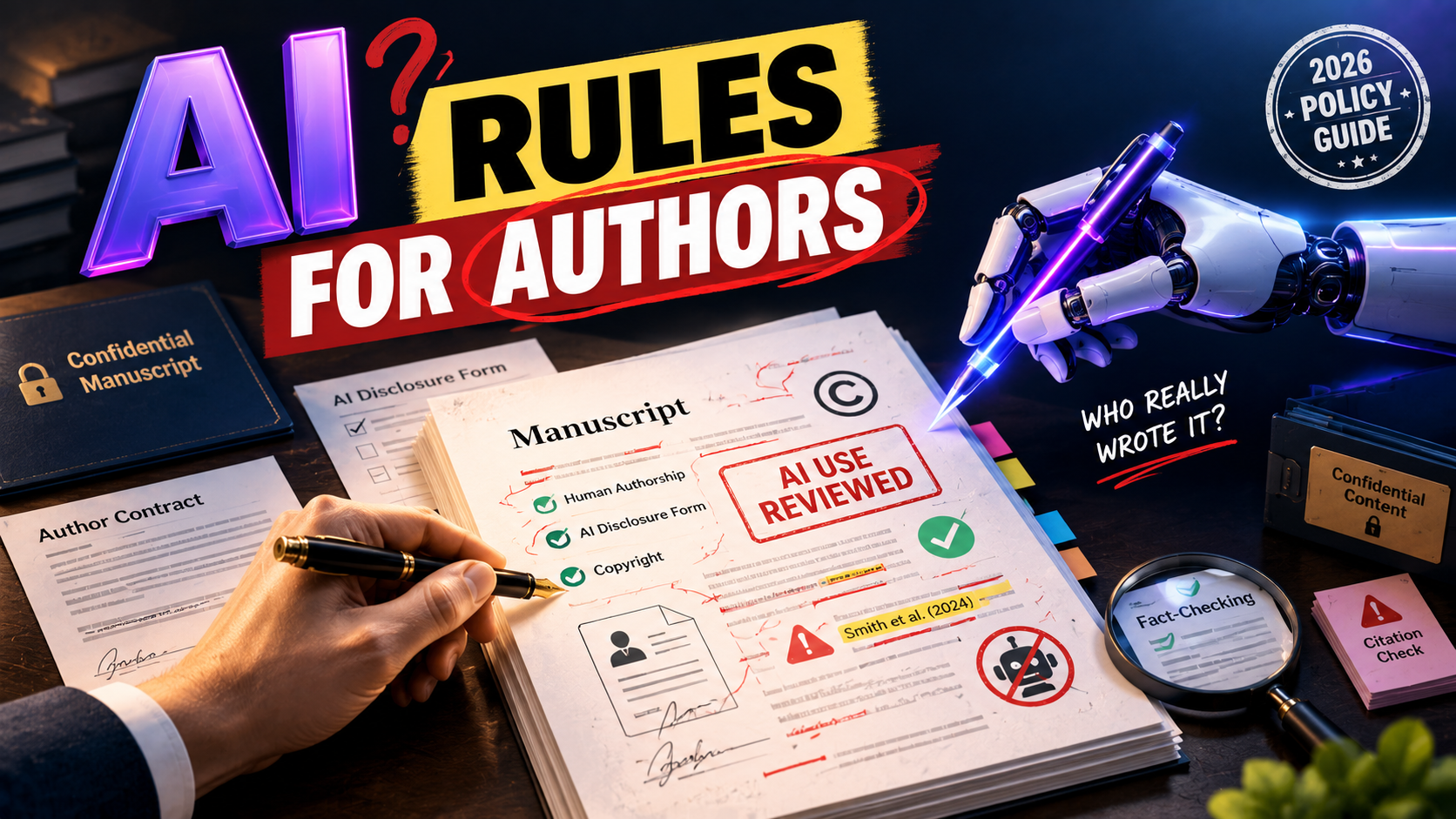
Publishers are writing AI-use policies for authors around five controls: human authorship, permitted uses, disclosure, verification, and protection of confidential or copyrighted material. Strong policies do not treat every tool identically. They distinguish routine spelling support from generative text, research analysis, images, translation, narration, and editorial evaluation—then state who remains accountable for the submitted work.
A publisher’s AI-use policy should define allowed, disclosure-required, restricted, and prohibited uses. It should state that AI cannot be credited as an author; human authors remain responsible for accuracy, originality, sources, bias, permissions, and contracts. The policy should also explain disclosure format, confidential-content rules, image restrictions, enforcement, and how updates will be communicated.
What Should AI-Use Policies for Authors Cover?
An effective policy covers text generation, language assistance, research, references, data, code, images, translation, audio, and third-party tools. It defines authorship and disclosure, protects unpublished material, addresses intellectual property and personal data, requires human verification, explains publisher review, and identifies consequences for inaccurate or undisclosed use.
The Authors Guild’s 2026 best-practice guidance emphasises human voice, fact-checking, copyright registration, contract warranties, disclosure, confidentiality, and respect for other creators. These are guidelines from an author organisation rather than a universal legal code, but they identify risks publishers should address clearly.
Elsevier’s July 2026 policy for books and commissioned content permits supportive author use with human control and disclosure, excludes basic spelling and punctuation checks from its declaration rule, rejects AI authorship, restricts generated images, and prohibits editors or reviewers from uploading confidential manuscripts to generative tools.
Use a Risk-Based AI Policy Instead of One Blanket Rule
Publishers should classify AI use by what the tool contributes and the risk it creates. Correcting punctuation is different from generating paragraphs, inventing citations, analysing confidential data, or creating cover art. A tiered model gives authors clearer answers, makes disclosure proportional, and helps editors apply the policy consistently across titles and disciplines.
| Policy Category | Examples | Typical Publisher Control |
|---|---|---|
| Routine assistance | Spelling, punctuation, non-generative grammar checks, formatting support | Usually allowed; disclose only if publisher rules require it |
| Assisted development | Brainstorming, outlining, readability suggestions, research leads, reference organisation | Allowed with verification; disclosure depends on contribution and policy |
| Generated manuscript material | Sentences, paragraphs, summaries, dialogue, translations, code, or exercises inserted into the book | Disclosure and human revision required; may be limited or prohibited |
| High-risk material | Research interpretation, legal or medical claims, data analysis, citations, identifiable people, or confidential inputs | Special approval, detailed methods, evidence checks, or prohibition |
| Generated creative assets | Cover art, interior images, narration, translation, or imitation of a living author’s style | Contractual consent, provenance and rights review, or prohibition |
Human Authorship and AI Disclosure
Publisher policies increasingly reserve authorship for people because authors must approve the manuscript, accept responsibility, answer integrity questions, and grant rights. When disclosure is required, authors should identify the tool, version where relevant, purpose, affected material, and their review. The disclosure location should be stated in the submission guidance.
A disclosure rule should be specific enough to produce consistent statements. “AI was used” reveals little. A useful declaration explains whether the tool suggested an outline, edited language, generated text, translated passages, analysed data, or helped locate sources. It should also confirm that the author checked the output and remains responsible.
Recommended author declaration fields
- Tool and provider — identify the service and version when that information affects reproducibility
- Purpose — state the task rather than using a broad phrase such as “writing support”
- Extent — identify chapters, passages, images, data, or research stages affected
- Human review — confirm fact-checking, source verification, editing, and final approval
- Methods detail — describe AI used in research or analysis in the appropriate methods section
- Permissions and rights — confirm authority to upload inputs and include outputs
Sample disclosure: “During manuscript preparation, the author used [tool and version] to [specific purpose] in [identified material]. The author reviewed and revised the output, verified factual claims and sources, and accepts responsibility for the final text.” Publishers should adapt this wording to their own legal and editorial requirements.
Copyright, Contracts, and Confidentiality
AI policies should require authors to check tool terms, manuscript warranties, licences, privacy, and rights before uploading or using material. Unpublished manuscripts, previous editions, interviews, personal data, licensed images, and third-party text may be confidential or restricted. Authors should not assume that a consumer chatbot preserves secrecy or grants publication rights.
Under current US Copyright Office guidance, purely machine-generated expression is not protected by US copyright, while qualifying human-authored selection, arrangement, or modification may be protected case by case. Prompts alone generally do not establish sufficient human control. Policies serving global authors should state that copyright outcomes vary by jurisdiction and require specialist advice where necessary.
Contracts also matter. Authors commonly warrant originality, non-infringement, accuracy, and authority to grant rights. If an author includes generated material without telling the publisher, the submission may conflict with those warranties or make copyright registration inaccurate. The Authors Guild recommends discussing substantial use with the publisher and reflecting approved use in the contract.
Confidentiality and rights checklist
- Read tool terms — check input retention, training use, output rights, indemnity, and commercial-use limits
- Do not upload restricted material — protect unpublished drafts, third-party works, personal data, and licensed assets
- Keep records — retain tool details, prompts where required, outputs, edits, sources, and approvals
- Verify originality — check generated text for copied phrases, style imitation, fabricated quotations, and infringement risk
- Align the contract — ensure disclosure, warranties, registration, translation, audio, and artwork clauses agree
Text, Images, References, Translation, and Style
A complete policy treats media and tasks separately. Text may be permitted with disclosure while generated images are prohibited. Reference tools may organise sources but cannot replace source verification. Translation may require rights and accuracy review. Style clauses should forbid deceptive imitation and require the book to represent the human author’s authentic contribution.
| Content Area | Policy Question | Minimum Safeguard |
|---|---|---|
| Manuscript text | Can generated wording appear, and how much? | Disclosure, substantial human revision, fact-checking, and originality review |
| References | May AI suggest, select, or edit sources? | Open and verify every source; never cite an unconfirmed reference |
| Images and covers | Are generated or altered visuals accepted? | Rights, provenance, consent, disclosure, and publisher approval |
| Translation and narration | Does the contract permit non-human production? | Author consent, qualified review, voice and likeness protection, and quality checks |
| Author style | May a tool imitate a named writer? | Prohibit deceptive or harmful imitation and preserve authentic voice |
Good AI content-writing style guidelines should not focus only on tone. They should require evidence, attribution, traceable quotations, consistent terminology, and human revision. A polished sentence can still contain a false claim, hidden bias, copied expression, or invented source.
How Publishers Can Write a Practical Author AI Policy
Publishers should draft the policy around actual author tasks, then align editorial, legal, contracts, rights, data protection, and production teams. Define terms, classify uses, set disclosure rules, protect confidential inputs, address each content type, explain review and consequences, provide examples, and schedule regular updates as tools and law change.
- Define the scope. State which books, journals, commissioned content, contributors, editors, reviewers, translators, and vendors are covered.
- Define key terms. Explain generative, assisted, generated, substantive use, and routine spelling support.
- Create use categories. Mark activities allowed, disclosure-required, approval-required, restricted, or prohibited.
- Set human-accountability rules. Reserve authorship and final approval for people.
- Specify disclosure. Give a required location, fields, model wording, and exceptions.
- Protect content and data. State what may not be uploaded and which approved tools may handle confidential material.
- Address contracts and rights. Align originality warranties, licences, copyright registration, images, translation, and audio.
- Explain review. Describe queries, correction requests, rejection grounds, records, and appeal or clarification contacts.
- Use examples. Show acceptable brainstorming, language editing, reference assistance, and unacceptable direct generation or imitation.
- Update visibly. Add an effective date, version, change summary, and author notification method.
Need editorial support that protects author voice?
Siliconchips Services can apply your approved author guidance during copyediting, proofreading, style control, query management, and publication preparation while keeping human editorial responsibility clear.
Talk to an Editorial Production Expert
Explore Editorial Support Services
Frequently Asked Questions About Authors Using AI
Authors want to know whether AI can help write a book, whether generated books may be published, what must be disclosed, and who owns the result. The answer depends on the publisher, contract, platform, jurisdiction, tool terms, and degree of human contribution. Always check the applicable policy before submission.
Can you publish a book written by AI?
Some self-publishing platforms permit AI-generated content if it is disclosed and meets their rules. Amazon KDP, for example, requires disclosure of generated text, images, or translations but not merely assisted content. A traditional publisher may restrict or reject generated material. Copyright, originality warranties, accuracy, rights, and reader disclosure still require careful review.
Can an AI be named as the author of a book?
Major publishing and scholarly policies generally reserve authorship for humans because an author must approve the work, accept responsibility, answer integrity questions, and grant rights. AI should be identified as a tool where disclosure is required, not credited as an author or co-author. Check the publisher’s exact terminology before preparing the title page or metadata.
Do authors use AI to help them write?
Yes. Authors use AI for brainstorming, outlining, language suggestions, research leads, and organisation, but acceptable uses vary. The Authors Guild recommends preserving human voice, checking every output, protecting confidential material, and disclosing substantial generated text. Publishers may impose stricter rules, particularly for commissioned, educational, scientific, medical, legal, or children’s content.
How do I use AI to write something responsibly?
Use it as limited assistance rather than a substitute for your judgement and voice. Do not upload material you lack permission to share. Verify facts, quotations, references, originality, bias, and rights. Rewrite and approve the result yourself, keep records, and disclose the tool’s contribution when required by your publisher, contract, platform, or field.
Must authors disclose AI used for spelling and grammar?
Not always. Elsevier’s book policy excludes basic spelling, grammar, and punctuation checks from its declaration requirement, while other publishers may define the boundary differently. Generative rewriting can exceed routine correction even when marketed as editing. Authors should check whether the tool created substantive wording and follow the specific submission guidance.
Who is responsible for errors in AI-assisted writing?
The human author remains responsible for the submitted manuscript. AI systems can produce inaccurate facts, fabricated references, biased wording, copied expression, or misleading summaries. Publishers should require authors to verify source material and final text. Disclosure does not transfer responsibility to the tool provider, editor, platform, or reader.
Clear AI Rules Protect Authors, Publishers, and Readers
The best author AI policies are specific, proportionate, and easy to apply. They preserve human authorship, classify uses by risk, require meaningful disclosure, protect confidential and copyrighted material, and address text, references, images, translation, and audio separately. Regular updates and concrete examples help authors comply before submission rather than guess.
Publishers do not need to choose between banning every tool and accepting every use. They need rules that match their editorial values, contracts, genres, legal exposure, and reader expectations. Siliconchips Services supports publishers through professional copyediting services, proofreading, style application, author queries, and publication-ready editorial preparation.
Apply your author guidance consistently across every title
Discuss your editorial standards, author instructions, copyediting levels, disclosure checks, and publication requirements with Siliconchips Services.
Request an Editorial Consultation
View Editorial Support Services