
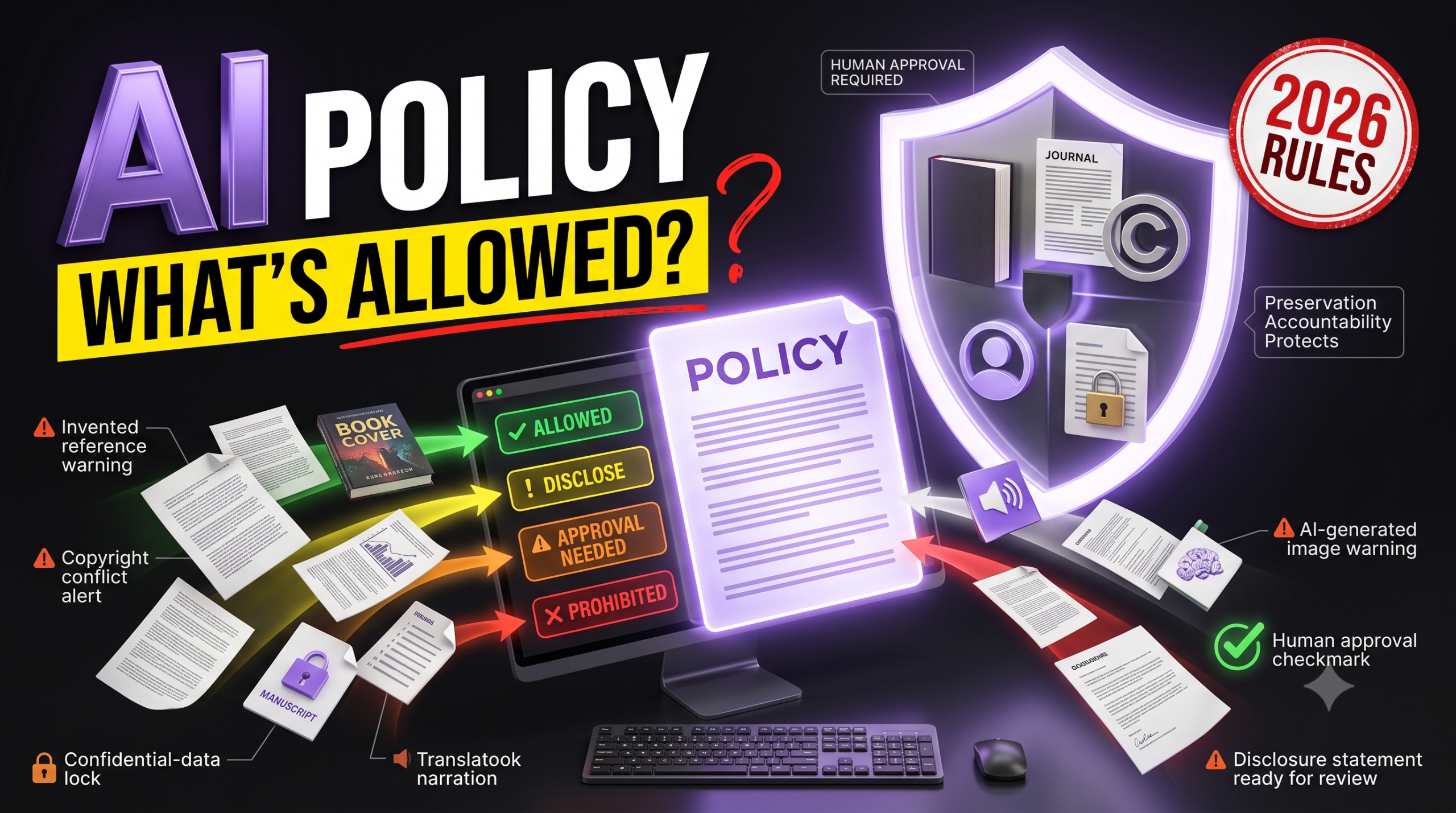
Generative AI policies for digital publishing should define permitted uses, disclosure, human accountability, confidentiality, intellectual property, image rules, and verification. The strongest policies separate authors, editors, reviewers, production teams, and publisher-owned systems because each role carries different risks. They also distinguish routine assistance from generated content rather than applying one unclear rule to every AI-enabled tool.
A complete publishing policy should reserve authorship and final decisions for people, require disclosure of substantive AI use, prohibit confidential manuscript uploads to unapproved tools, require fact and source checks, and set separate rules for text, images, data, translation, references, and audio. Approved publisher systems also need governance, testing, security, and human oversight.
Policy note: This article offers editorial and production guidance, not legal advice. Publishers should align each policy with their contracts, jurisdictions, data obligations, rights position, genres, platforms, and professional standards.
Why Digital Publishers Need a Generative AI Policy
Digital publishers need an AI policy because generated material can affect originality, copyright, confidentiality, accuracy, attribution, contracts, reader trust, and product metadata. The same tool may be low risk for punctuation but high risk for drafting, editorial evaluation, confidential review, image alteration, or translation. Clear rules prevent inconsistent decisions.
Elsevier’s policy for books and commissioned content, updated in July 2026, illustrates a role-based model. It addresses authors separately from editors and reviewers, requires human responsibility, limits confidential uploads, sets disclosure expectations, and treats generated images differently from text assistance.
Rules for Authors and Contributors
Author rules should state what assistance is allowed, when publisher approval or disclosure is required, and which uses are prohibited. Authors must remain responsible for the manuscript, verify outputs, protect confidential and copyrighted inputs, preserve an authentic contribution, and ensure that AI use does not conflict with warranties, licences, or submission requirements.
| Use Category | Examples | Recommended Policy Treatment |
|---|---|---|
| Routine assistance | Spelling, punctuation, non-generative grammar, file formatting | Generally permitted; state whether disclosure is unnecessary |
| Development support | Brainstorming, outlining, topic clustering, readability suggestions | Permit with verification and a clear boundary around generated manuscript text |
| Generated content | Paragraphs, summaries, dialogue, questions, code, translations, or exercises | Require disclosure and human revision; limit or prohibit by publication type |
| Research or evidence use | Data analysis, literature synthesis, research-gap identification, clinical or legal material | Require methods detail, expert verification, and any discipline-specific approval |
| High-risk creative assets | Images, covers, voice replicas, narration, or imitation of an identifiable creator | Require rights and consent review; prohibit where publisher policy demands |
Minimum author responsibilities
- Human authorship — only people receive author credit and approve the submitted work
- Accuracy — verify claims, quotations, references, calculations, code, and data against reliable sources
- Originality — review output for copied expression, style imitation, plagiarism, and third-party rights
- Transparency — disclose substantive use in the location and format required by the publisher
- Data protection — do not upload confidential, personal, licensed, or unpublished material without authority
- Contract compliance — check warranties, exclusivity, permissions, copyright, and platform declarations
Editors, Reviewers, and Manuscript Confidentiality
Editors and reviewers should not place confidential manuscripts, proposals, correspondence, or personal information into public generative tools. Publishers must specify approved secure systems, allowed tasks, retention, training use, and human review. Editorial evaluation remains a human responsibility because generated assessments can be inaccurate, incomplete, biased, or impossible to audit adequately.
Elsevier’s reference policy bars editors and reviewers from uploading manuscript material or related communications to generative tools and keeps critical evaluation with people. It distinguishes those public tools from protected, publisher-controlled technology designed around security and responsible-use principles.
Publisher controls for confidential content
- Approved-tool register — list services permitted for each role, task, content type, and risk level
- Input restrictions — define confidential, personal, copyrighted, embargoed, and contractually controlled material
- Vendor terms — examine retention, training, model improvement, subprocessors, location, deletion, and breach handling
- Access controls — restrict systems and data according to role and publishing need
- Human decision rule — prevent automated acceptance, rejection, review, or substantive editorial judgement
- Incident route — explain how staff report accidental uploads, exposed data, or policy breaches
Separate Policies for Text, Images, Data, References, and Translation
One general disclosure sentence cannot govern every content type. Publishers should set distinct rules for generated prose, images, research data, references, code, translation, covers, graphical abstracts, and narration. Each area has different accuracy, reproducibility, copyright, consent, bias, and quality risks, so permissions and evidence should be specified separately.
| Content Type | Primary Risk | Policy Requirement |
|---|---|---|
| Text | False claims, copied language, generic voice, or unclear human authorship | Disclosure threshold, human revision, fact-checking, and originality review |
| References | Invented, incomplete, mismatched, or misrepresented sources | Open and verify every cited source; describe generative selection or editing where required |
| Images and artwork | Manipulated evidence, uncertain rights, biased depiction, or unauthorised likeness | Separate permission, provenance, consent, and alteration rules |
| Research data and code | Non-reproducible analysis, exposed data, hidden errors, or changed results | Methods disclosure, validation, privacy safeguards, and expert review |
| Translation and audio | Changed meaning, voice replication, performer displacement, or rights conflict | Contractual authority, qualified review, consent, disclosure, and quality testing |
The reference policy takes a particularly restrictive position on generated or AI-altered images for submitted book content, with a research-method exception requiring detailed documentation. Other publishers may choose different boundaries, but they should state them before commissioning or submission.
Disclosure, Authorship, and Record-Keeping
Disclosure should identify the tool, relevant version, purpose, affected content, and human review. AI should not receive author credit because it cannot approve publication or accept responsibility. Publishers should retain enough information to investigate questions, correct the record, support rights administration, and keep manuscript declarations consistent with contracts and platform metadata.
Disclosure template
“During preparation of this publication, the author used [tool and version] to [specific purpose] in [identified content or stage]. The author reviewed and revised the output, verified relevant facts and sources, and accepts responsibility for the final publication.”
The template should be adapted to the publisher’s legal, editorial, disciplinary, and contractual requirements. A checkbox without explanatory detail may be insufficient for generated chapters, images, translations, or research analysis.
Rules for the Publisher’s Own Use of Generative AI
Publisher policies must govern internal use as carefully as author use. Staff may encounter AI in editing, metadata, marketing, accessibility, search, customer service, and production. Each application needs a lawful data source, approved tool, accountable owner, human review, bias and accuracy testing, security controls, and a clear author-consent position where appropriate.
- State publisher uses — identify internal and customer-facing applications rather than relying on broad contractual language
- Separate evaluation from assistance — preserve human commissioning, editorial, review, and integrity decisions
- Obtain necessary consent — address manuscript analysis, translation, narration, artwork, publicity, and training uses
- Validate public outputs — check marketing copy, summaries, metadata, accessibility descriptions, and support responses
- Monitor vendors — review system changes, model versions, incidents, performance, and contract terms
Generative AI Policy Implementation Checklist
Implement the policy by mapping uses, roles, tools, data, contracts, and content risks. Publish clear author guidance, update agreements and submission forms, train staff, provide disclosure examples, establish review and incident routes, and record policy versions. Test the rules with realistic cases before applying them across lists, journals, and digital products.
- Map current use. Identify tools already used by authors, editors, reviewers, freelancers, vendors, and staff.
- Classify risk. Separate routine assistance, generated content, research, confidential material, and creative assets.
- Align departments. Involve editorial, legal, rights, data protection, contracts, technology, accessibility, and production.
- Update documents. Revise author guidelines, contracts, submission forms, contributor agreements, and vendor terms.
- Create examples. Show permitted, disclosure-required, approval-required, and prohibited uses.
- Train users. Explain verification, confidentiality, rights, bias, records, and escalation.
- Establish review. Define who examines disclosures, exceptions, suspected breaches, and correction needs.
- Version the policy. Publish an effective date, change log, owner, review interval, and contact point.
Apply publisher-approved AI rules consistently
Siliconchips Services can support editorial checks, style application, author queries, proofreading, metadata, and digital production under your approved policy while keeping human responsibility visible.
Talk to a Digital Publishing Expert
Explore Digital Publishing Services
Frequently Asked Questions About Generative AI Publishing Policies
Publishers commonly ask whether generated content is allowed, when authors must disclose tools, whether AI can be credited as an author, and how confidential manuscripts should be protected. The answers depend on the publisher and publication type, but human accountability, verification, rights control, and clear disclosure are recurring principles.
Should publishers ban all generative AI use?
Not necessarily. A blanket ban may treat low-risk spelling support like generated chapters or image alteration. A tiered policy can permit defined assistance while restricting high-risk uses. Publishers may still prohibit particular applications where confidentiality, research integrity, reader expectations, rights, or brand standards justify a stricter position.
When should an author disclose AI use?
Disclosure is generally appropriate when a generative tool contributes substantive wording, images, translation, analysis, code, research selection, or other publishable material. Routine spelling and punctuation checks may be excluded by some policies. The publisher should define thresholds, required details, location, and exceptions so authors do not have to guess.
Can an AI tool be credited as an author?
No under major current publishing policies. Authorship requires a person who can approve the final work, accept responsibility, address integrity concerns, and grant rights. The tool should instead be disclosed according to policy. Human contributors remain responsible for accuracy, originality, permissions, sources, and the submitted publication.
Can editors upload a manuscript to a public AI service?
They should not do so without explicit authority and an approved service that protects confidentiality, rights, personal data, retention, and training use. Editors receive manuscripts in confidence. Even using a public tool for summarisation or language improvement can expose protected content and communications or conflict with author and publisher agreements.
Are AI-generated references safe to use?
No reference should be trusted because a tool presents it confidently. Authors must locate the source, confirm that it exists, read it, verify bibliographic details, and ensure it supports the claim. Policies should distinguish traditional reference management from generative selection, synthesis, or editing and state when disclosure is required.
How often should an AI publishing policy be updated?
Review it on a scheduled basis and whenever law, contracts, platform rules, technology, or publisher practice changes materially. Every version should show its effective date and owner. Authors, staff, reviewers, and vendors need notice of changes that affect permitted tools, disclosure, confidentiality, rights, records, or enforcement.
A Useful AI Policy Is Clear, Proportionate, and Enforceable
Generative AI policies should protect human responsibility without pretending every use creates the same risk. Separate roles and content types, define permitted and prohibited activities, require meaningful disclosure, protect confidential material, verify outputs, and govern publisher use as well as author use. Concrete examples make ethical principles practical at submission and production stages.
Digital publishing companies need policies that authors can understand and teams can apply consistently. Siliconchips Services supports editorial preparation, academic publishing services, and digital production under publisher-defined standards, with qualified people responsible for the final content.
Connect your AI policy to everyday publishing practice
Discuss your editorial requirements, author guidance, style standards, disclosure checks, metadata, and digital outputs with Siliconchips Services.
Talk to a Publishing Production Expert
View Digital Publishing Services