
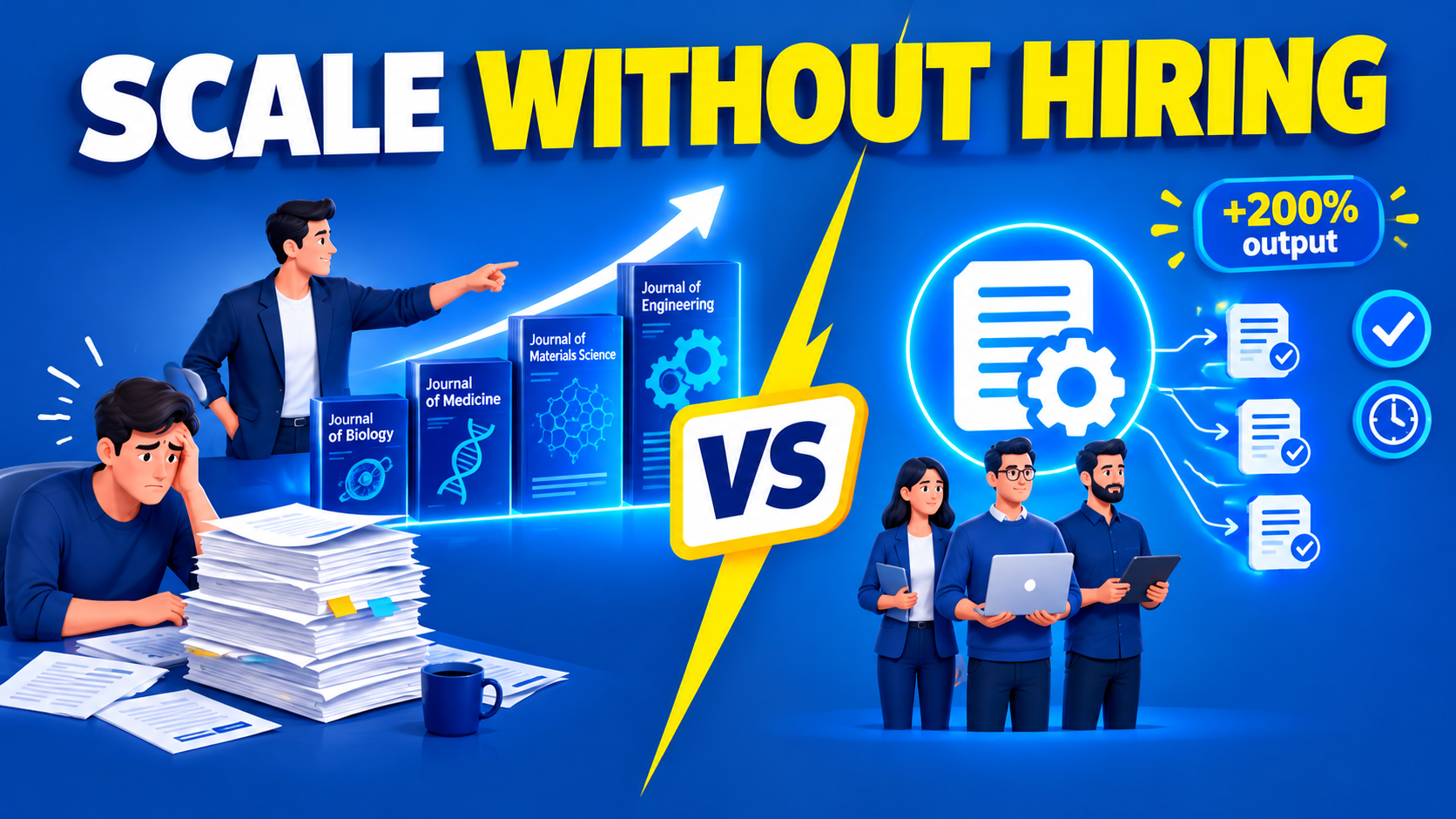
Submission volumes at STM and academic journals grew significantly between 2022 and 2025, driven by open access mandates, preprint culture, and the expansion of author-pays publishing models. For many mid-size publishers, the result is a familiar problem: more articles accepted, same production team, same deadlines.
The choice is not simply between hiring more staff and buying automation software. It is a more nuanced decision about where specialist expertise, variable capacity, and quality control are genuinely needed — and where repeatable processes can be systematised. This article maps that decision clearly for production managers and publishing directors evaluating their options in 2026.
Why Submission Volumes Are Outpacing Production Capacity
The structural pressures on journal production have compounded over the past three years. Open access mandates from major funders — Plan S signatories, NIH, and Wellcome Trust — pushed more titles towards continuous publication models where articles publish individually rather than in batched issues. This increases the throughput demand on production teams without increasing the time available to process each article.
At the same time, author expectations for time-to-publish have shortened. Preprint servers have raised the baseline: researchers now compare acceptance-to-publication timelines in weeks, not months. A production bottleneck that once disappeared into a quarterly issue schedule is now visible and measurable.
The three most common STM production bottlenecks in 2026:
| Bottleneck | Typical Cause | Impact on Publisher |
|---|---|---|
| Proof turnaround delays | Typesetting team at capacity; no overflow route | Author complaints; delayed indexing; missed issue dates |
| JATS XML quality failures | XML generated by non-specialist tools without QA | PubMed Central rejection; CrossRef metadata errors |
| Seasonal volume spikes | Special issues, year-end submissions, conference proceedings | Backlogs that affect the following quarter’s schedule |
| Complex manuscript handling | LaTeX with custom macros; equation-heavy STEM articles | Errors in proofs; extended correction cycles |
| Multi-format output gaps | PDF production only; no HTML5 or accessible PDF | Platform non-compliance; accessibility failures |
Hiring additional in-house staff addresses the headcount problem but not the expertise gap. A new typesetter needs months to learn journal-specific styles, equation handling, JATS XML requirements, and the correction management process. A specialist production partner brings that expertise from day one.
Outsourcing Production vs Building In-House Automation
These two approaches are not mutually exclusive. The most effective scaling strategy for mid-size publishers typically combines both — outsourcing specialist or volume-dependent tasks and automating the genuinely repeatable ones. But the starting-point trade-offs are significantly different.
| Criterion | Outsourcing | In-House Automation |
|---|---|---|
| Time to capacity | ✔ Weeks — partner onboards to your spec | ✖ Months — build, test, train, deploy |
| Upfront cost | ✔ Low — pay per article or per project | ✖ High — software, integration, staff training |
| Specialist expertise | ✔ Immediate — LaTeX, JATS, MathML, accessibility | ✖ Must hire or develop — often the hardest gap to fill |
| Scalability for volume spikes | ✔ Flexible — absorbs peaks without overhead | ~ Limited — automation scales, but QA does not |
| Per-unit cost at high volume | ~ Moderate — cost per article is consistent | ✔ Lower long-term — once infrastructure is built |
| Quality control | ✔ Built in — specialist QA at each stage | ✖ Requires separate QA layer |
| Handling complex content | ✔ Strong — human expertise for macros, equations, tables | ✖ Automation fails on exceptions |
| Risk if requirements change | ✔ Low — partner adapts to new spec | ✖ High — rebuild or rework tooling |
| Internal knowledge retention | ~ Moderate — depends on SLA and communication | ✔ High — stays within the organisation |
The critical insight is timing. In-house automation is a long-term investment that pays off at sustained, high volume with relatively uniform content. Outsourcing is the right choice when you need capacity now, when your content is technically complex, or when your volume is variable enough that permanent infrastructure would sit underused for months at a time.
Cost and Quality Trade-offs: What Publishers Often Underestimate
The cost comparison between outsourcing and automation is rarely as straightforward as a per-article price. Publishers who have built in-house automation systems frequently report that the true cost includes the initial development contract, ongoing maintenance, the technical staff needed to manage exceptions, and the cost of quality failures that automated tools generate on complex content.
Hidden costs of in-house automation that are often underestimated:
- Exception handling: Automation tools fail predictably on non-standard LaTeX, complex tables, unusual reference styles, and multi-panel figures. Someone has to catch and fix these — and that person needs specialist knowledge.
- JATS XML validation failures: A technically valid XML file can still fail PubMed Central ingestion if the journal’s specific JATS profile is not correctly implemented. Fixing a batch of rejected deposits takes more time than building the XML correctly the first time.
- Accessibility compliance: WCAG 2.1 and PDF/UA requirements affect both HTML article pages and downloadable PDFs. Automated tools frequently produce documents that pass basic validation but fail real-world accessibility testing. Remediation is expensive.
- Version drift: Platform requirements change — PubMed Central, CrossRef, and journal hosting platforms update their specifications regularly. In-house tools need corresponding updates, and those updates cost development time.
What quality looks like at each stage — and who delivers it:
| Production Stage | Automation Reliability | Where Expert Oversight Is Essential |
|---|---|---|
| Manuscript intake and preflight | High for standard Word submissions | LaTeX files with custom packages; missing assets |
| Copyediting | Low — AI tools flag issues but cannot resolve them | STM terminology, units, citation accuracy, declarations |
| Typesetting and composition | Moderate for template-based articles | Equation rendering, complex tables, multi-panel figures |
| JATS XML generation | Moderate for clean structured input | MathML accuracy, reference linking, custom DTD requirements |
| Proof management | Low — author communication requires human judgement | Substantive corrections, late author changes, escalation |
| Accessibility and multi-format output | Moderate for HTML; low for PDF/UA | Alt text, reading order, table structure, screen reader testing |
For books and journals production at mid-size publishers, the cost of quality failure — a rejected PubMed deposit, an inaccessible PDF flagged by a library consortium, an author escalation over a proof error — often exceeds the cost of using a specialist partner in the first place.
A Hybrid Model That Works for Mid-Size Publishers
The practical version of this model looks different for every publisher depending on their manuscript mix, their existing tools, and their team structure. But the underlying logic applies consistently: automation works best when the input is predictable and the rules are fixed. Human expertise works best when the input is variable, the content is technically complex, or the consequences of error are significant.
A practical task allocation for a mid-size STM journal publisher:
| Task | Recommended Handling | Reason |
|---|---|---|
| Manuscript intake from submission system | Automated ingestion | Repeatable, low-risk, high volume |
| Preflight and completeness check | Automated + expert review | Automation flags issues; expert resolves them |
| Copyediting (STM content) | Outsource to specialist editors | Requires discipline knowledge; AI tools unreliable |
| LaTeX composition (maths, physics) | Outsource to LaTeX specialists | Macro management requires expert oversight |
| Word-based typesetting (standard articles) | Template automation + QA | Predictable input; rules-based styling |
| JATS XML generation | Outsource with validation | MathML and profile-specific requirements need expert QA |
| Proof management and author corrections | Outsource with defined SLA | Requires human communication and version control |
| CrossRef and repository deposit packaging | Automated from validated XML | Repeatable once XML quality is confirmed |
| Accessibility review (PDF/UA, WCAG) | Outsource specialist review | Automated tools miss real-world accessibility failures |
Publishers working with production automation services alongside a specialist production partner can reduce per-article cost on the repeatable elements while maintaining the quality that complex or high-stakes content demands. The key is defining the boundary between the two clearly before implementation — not discovering it through a batch of rejected deposits or author complaints.
For publishers managing multi-format delivery requirements — HTML5 article pages, accessible PDFs, EPUB, and JATS XML for multiple repositories — end-to-end digital publishing services coordinate all output formats within a single production engagement, eliminating the format-by-format vendor management that adds cost and coordination overhead.
Why Publishers Choose Siliconchips Services
Scaling journal production is not simply a capacity problem — it is a quality and continuity problem. A production partner that grows your throughput while introducing errors, missing deadlines, or obscuring their process creates more problems than it solves. Siliconchips Services is built around a different model: UK-based project management with direct client communication, backed by a high-capacity production centre in India that handles volume without compromising the specialist expertise each article requires.
Over 14 years serving academic and STM publishers. We understand journal production cycles, indexing requirements, and platform standards because we have worked through every iteration of them.
Every project has a named UK-based contact. You know who is managing your content, where it is in production, and what the QA results show — always.
We do not cut corners to hit a turnaround target. If a JATS XML file fails validation, we fix it before delivery — not after deposit rejection.
Copyediting, LaTeX typesetting, JATS XML, MathML, accessible PDF, EPUB, metadata, and repository packaging — all from one partner, one specification, one quality standard.
We absorb seasonal volume spikes, special issues, and portfolio growth without requiring publishers to renegotiate contracts or recruit additional vendor relationships.
Our longest client relationships span more than a decade. Publishers stay because the quality is consistent, the communication is direct, and the team learns their content over time.
Signs It Is Time to Bring in a Production Partner
Many publishers delay engaging a specialist partner until a crisis point — a PubMed deposit failure, a missed issue deadline, or an author escalation that reaches the editor-in-chief. The more productive approach is to recognise the signals earlier, before quality begins to slip.
Act now if you are experiencing any of the following:
- Your internal typesetting team is regularly working at or above capacity, with no overflow route for volume spikes
- Proof turnaround times have extended beyond your stated SLA without a documented recovery plan
- JATS XML files are being rejected by PubMed Central or failing CrossRef validation at a rate above 5% per batch
- LaTeX manuscripts with custom macros are sitting in a queue because no one on the team can process them reliably
- You are publishing PDF-only and have no clear plan for HTML5 article pages or accessible PDF compliance
- Author complaints about proof quality or correction handling are increasing relative to submission volume
- A special issue or conference proceedings volume is approaching and you have no additional capacity to absorb it
- Your journal is growing its submission volume by more than 15% year-on-year with no corresponding growth in production resource
A production capacity review — an assessment of your current article volume, content complexity, output requirements, and quality benchmarks — typically takes less than a week and gives publishers a clear picture of where the pressure points are and what a specialist engagement would address.
Request a Free Production Capacity Review
Tell us your article volume, content types, and output requirements. We will map where your production process is under pressure and what a specialist engagement would address — at no cost and no obligation.
Frequently Asked Questions
Is outsourcing journal production better than building in-house automation?
For most mid-size publishers managing between 200 and 2,000 articles per year, outsourcing is faster to implement, lower in upfront cost, and
more reliable for complex content than building in-house automation from scratch. In-house automation delivers a lower per-unit cost at high
sustained volume with uniform content — but requires significant development time, ongoing maintenance, and specialist technical staff to
manage exceptions. The right answer depends on your volume, content complexity, and timeline.
How quickly can a production partner scale to absorb increased volume?
A specialist partner with established production capacity and a clear understanding of your journal’s style, content type, and XML requirements
can typically absorb increased volume within two to four weeks of a new engagement starting. The onboarding phase — where the partner learns
your templates, quality standards, and communication preferences — is the key investment. Once that is established, volume increases are
absorbed without structural change on the publisher’s side.
What production tasks should never be fully automated?
Copyediting, complex LaTeX composition, JATS XML QA for equation-heavy content, proof communication with authors, accessibility review, and the
resolution of any exception that falls outside the automation tool’s defined parameters should always involve trained human oversight.
Automation handles predictable, rule-governed tasks well. The tasks where errors have significant downstream consequences — a rejected PubMed
deposit, an author escalation, an accessibility failure — are where specialist expertise pays for itself.
How do you manage quality when outsourcing to a partner in a different time zone?
The time zone difference between a UK-based management team and an India-based production centre — which is the model Siliconchips Services
operates — is typically managed through a structured handoff process: queries resolved in the UK morning, production completed during the
India working day, outputs reviewed before the next UK morning. This model supports 24-hour turnaround cycles without requiring publishers to
change their own working hours or communication habits.
What is a production capacity review and what does it cover?
A production capacity review is an assessment of your current journal production setup against your article volume, content complexity, output
format requirements, and quality benchmarks. It identifies where your production process is under pressure, where errors are most likely to
occur, and what a specialist engagement would address. A review typically covers your manuscript intake process, typesetting capacity, JATS
XML generation quality, proof management cycle, and multi-format output requirements. It takes less than a week and gives publishers a clear,
specific picture of their options.
Why choose Siliconchips Services Ltd. for journal production outsourcing?
Siliconchips Services has delivered end-to-end digital publishing services with integrity, transparency, and trust since 2012. Our model
combines UK-based project management — a named contact who knows your journal and communicates directly — with a high-capacity specialist
production centre in India. We cover the full production chain: copyediting, LaTeX typesetting, JATS XML with MathML, accessible PDF, EPUB,
metadata, and repository delivery. Publishers choose us because the quality is consistent, the communication is honest, and our team learns
your content rather than processing it anonymously. With over 14 years and more than 2,000 titles in our portfolio, we bring institutional
knowledge that a newly built in-house tool or a generic outsourcing vendor cannot replicate.
Can Siliconchips Services handle both books and journals production?
Yes. Siliconchips Services covers the full spectrum of academic and STM publishing output — from individual journal articles through complete
book titles, reference works, and multi-volume series. Our team handles Word and LaTeX source, InDesign typesetting, JATS and BITS XML, EPUB3,
accessible PDF, and multi-format delivery. Publishers managing mixed portfolios of journals and books benefit from working with a single
partner who maintains consistent quality standards and institutional knowledge across both content types.
Scaling Production Is a Strategic Decision, Not Just an Operational One
The question of how to scale journal production without increasing permanent headcount is ultimately a question about where you want to invest your organisation’s resources. Building in-house automation is an investment in infrastructure. Engaging a specialist production partner is an investment in expertise, flexibility, and quality assurance — with the capacity to absorb volume from day one rather than from the end of a development cycle.
For publishers facing submission growth now, the most practical path forward is a clear assessment of where your production process is under pressure, followed by a targeted decision about which tasks to automate and which to place with a partner who has spent over a decade doing them reliably.
Talk to Our Journal Production Team
Siliconchips Services has supported publishers of all sizes since 2012 — with integrity, transparency, and the specialist expertise to handle your most complex content. Start with a free production capacity review.