
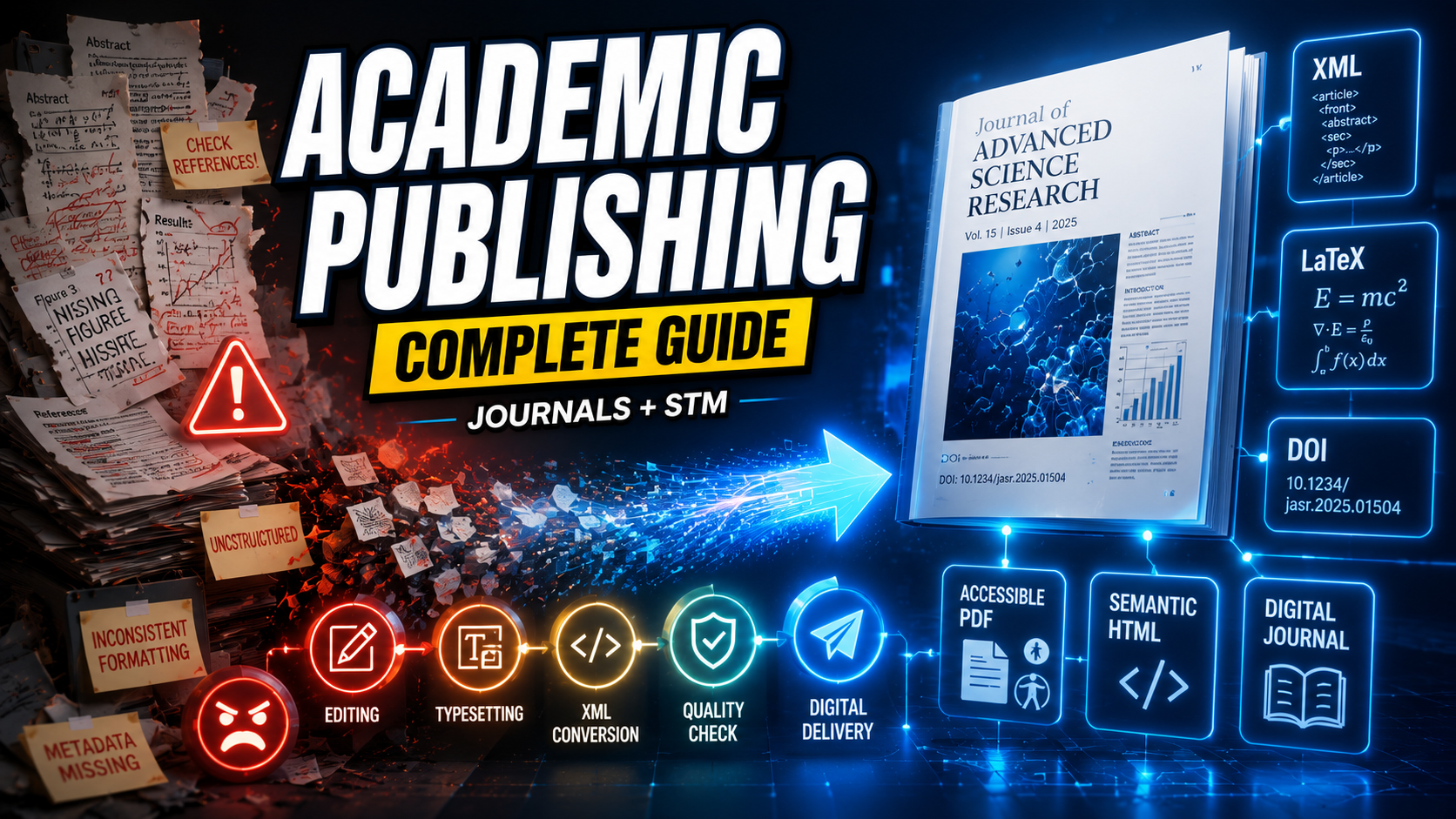
Academic publishing services take accepted research manuscripts through editorial preparation, typesetting, proofreading, structured-content production, accessibility, and final delivery for journals, repositories, and digital platforms. For journal and STM publishers, the right service partner protects scholarly meaning while controlling complex equations, references, figures, metadata, XML, and multiple output formats. This guide explains what is included, how journal production works, and how to evaluate a provider.
Academic publishing services typically include manuscript intake, copyediting, technical editing, reference checks, LaTeX or InDesign typesetting, proof management, author corrections, JATS XML, metadata, accessibility, and multi-format delivery. A specialist partner supports the publisher’s workflow and standards; journal editors retain responsibility for peer-review decisions, editorial policy, and the scholarly record.
What Do Academic Publishing Services Include?
Academic publishing services cover the production work required after manuscript submission or acceptance, depending on the publisher’s scope. They can include submission checks, editorial coordination, copyediting, technical editing, typesetting, proofreading, XML conversion, metadata preparation, accessibility, issue assembly, platform delivery, and quality assurance for journals, books, conference proceedings, and open-access content.
The exact scope varies. Some publishers need a complete production programme from accepted manuscript to online publication. Others retain editorial management in-house and outsource copyediting, typesetting, XML, or accessibility. A clear statement of work should define the starting file, responsibilities, turnaround stages, quality criteria, outputs, and escalation process.
An academic publishing company may own or manage journals and make publishing decisions. An academic publishing services provider usually works on the company’s behalf, supplying production capacity and specialist expertise without replacing editorial independence. This distinction is especially important in peer-reviewed publishing, where acceptance, rejection, corrections, and retractions must follow the journal’s governance.
| Service Area | Typical Activities | Primary Output |
|---|---|---|
| Manuscript intake | File inventory, completeness checks, specification review, artwork and permission checks | Production-ready manuscript package and query log |
| Editorial preparation | Copyediting, language polishing, technical editing, style application, reference review | Edited manuscript with author or editor queries |
| Typesetting and composition | LaTeX or InDesign layout, equation handling, tables, figures, citations, journal templates | First proof and subsequent corrected proofs |
| Proof and correction management | Proofreading, author correction collation, version control, cross-format synchronisation | Approved final content and audit trail |
| Structured and digital production | JATS XML, MathML, semantic HTML, accessible PDF, EPUB, metadata packaging | Validated multi-format delivery package |
| Publication support | Issue compilation, continuous-publication support, platform upload, DOI metadata preparation | Platform-ready article, issue, or book package |
Content types supported by specialist providers
- Peer-reviewed journals — research articles, reviews, editorials, corrections, supplementary material, and special issues
- STM and STEM publications — mathematics, physics, engineering, medicine, life sciences, technology, and data-rich research
- Scholarly books — monographs, edited collections, handbooks, textbooks, and reference works
- Conference and society content — proceedings, abstracts, posters, standards, reports, and member publications
- Open-access programmes — article-level publishing, licence metadata, repository-ready files, and platform workflows
- Legacy archives — scanned or PDF backfiles reconstructed as searchable, structured, and accessible content
Siliconchips Services provides academic publishing services for journals, STM publishers, scholarly books, and open-access programmes, with workflows tailored to each publisher’s style, platform, content complexity, and output requirements.
Journal Production: From Accepted Manuscript to Publication
Journal production converts an accepted manuscript into accurate, discoverable, and platform-ready content. The workflow normally moves through intake, copyediting, typesetting or XML composition, proof review, author corrections, final quality control, metadata delivery, and online publication. Strong journal publishing services maintain version control and clear ownership at every handoff.
Production begins with a technical intake, not simply with opening the manuscript. The team confirms that source files, figures, tables, supplementary material, author information, permissions, and editorial decisions are complete. Missing assets or unclear instructions should be queried before typesetting, because unresolved inputs create expensive correction cycles later.
Typical journal production workflow
| Stage | Production Work | Quality Gate |
|---|---|---|
| 1. Intake and preflight | Check files, metadata, figures, tables, licences, supplementary items, and journal specifications | Complete package accepted or queries raised |
| 2. Editorial preparation | Apply style, edit language, review references, standardise terminology, and resolve inconsistencies | Edited content and queries reviewed |
| 3. Composition | Create structured content and page or online layout; process equations, artwork, tables, and citations | First proof passes structural and visual checks |
| 4. Proof review | Collect editor and author corrections, answer queries, and control proof versions | Corrections approved and no unresolved production queries |
| 5. Finalisation | Apply final changes consistently to source, XML, HTML, PDF, and metadata | Content comparison, validation, and final package audit |
| 6. Delivery or publication | Supply article, issue, repository, and DOI metadata packages to required platforms | Ingestion confirmed and publication record checked |
Continuous publication and article-based publishing add a scheduling requirement: each article may need to be finalised independently while volume, issue, or collection metadata remains accurate. Traditional issue workflows require pagination, table-of-contents assembly, cover data, front matter, and issue-level checks. The provider should support the journal’s chosen model rather than force every publication into one template.
Journal production intake checklist
- Accepted manuscript and editorial decisions — confirm the approved version and any changes required after peer review
- Complete contributor metadata — names, affiliations, corresponding author, ORCID iDs, and contribution roles where supplied
- Figures, tables, and supplementary files — verify file integrity, captions, callouts, permissions, resolution, and accessible descriptions
- Journal specification — house style, reference style, template, language, article type, licence, and platform rules
- Technical content — identify LaTeX, equations, MathML, chemical structures, code, datasets, and specialist symbols
- Required outputs — define JATS XML, HTML, PDF, EPUB, image renditions, metadata, and repository packages
- Schedule and contacts — assign proof recipients, query owners, escalation routes, and approval deadlines
Editorial Support for Academic and Scientific Content
Editorial support improves clarity, consistency, and compliance without changing the research claim or author’s intended meaning. Depending on the brief, it can include language polishing, copyediting, technical editing, reference checks, style enforcement, proofreading, and author queries. The correct level should be agreed before work begins and applied consistently.
Academic editing differs from general business editing because content is governed by disciplinary conventions, evidence, citations, technical vocabulary, and journal policy. An editor must know when to correct an obvious error, when to preserve specialised usage, and when to ask the author or journal editor. Silent rewriting can be as damaging as missed errors.
A scientific publishing company or production partner may provide technical editorial support, but it should not make unsupported scientific judgements. Questions involving data interpretation, authorship, conflicts, image integrity, ethics, or substantive claims need to follow the publisher’s editorial and research-integrity procedures.
| Editorial Level | What It Covers | What It Should Not Do |
|---|---|---|
| Language polishing | Grammar, syntax, readability, idiom, and clarity for authors writing in an additional language | Alter results, claims, evidence, or disciplinary meaning |
| Copyediting | House style, consistency, spelling, punctuation, terminology, abbreviations, tables, and captions | Resolve substantive ambiguity by guessing |
| Technical editing | Scientific notation, units, equations, figure references, terminology, and discipline-specific presentation | Replace peer review or validate research conclusions |
| Reference checking | Citation-reference matching, style, order, completeness, links, and identifiers where available | Assume a cited source supports the author’s claim without a defined verification service |
| Proofreading | Errors introduced or missed after composition, including layout, text, cross-references, and corrections | Introduce broad rewriting at the final proof stage |
What good editorial support looks like
- Publisher-specific instructions — the journal’s style, terminology, spelling, article types, and exception rules are documented
- Qualified allocation — complex medical, mathematical, engineering, or linguistic material reaches appropriately experienced editors
- Transparent queries — queries state the problem, preserve context, and request a decision rather than hiding uncertainty
- Author voice protection — clarity improves without flattening disciplinary nuance or international author expression
- Correction traceability — editorial decisions can be followed from source manuscript through final publication
- Escalation for integrity concerns — suspected duplication, missing declarations, image issues, or inconsistent data go to the publisher
Typesetting for Journals, STM, and STEM Publishing
Academic typesetting transforms edited content into structured, readable, and technically accurate pages or digital articles. Journals and STEM publications require precise handling of equations, symbols, references, tables, figures, and hierarchical content. LaTeX suits mathematics-heavy material, InDesign supports design-led composition, and XML-based systems enable scalable multi-format production.
Good typesetting is not decoration. It helps readers distinguish headings, arguments, examples, data, citations, and notes. In STM content, it also protects research meaning. A changed minus sign, detached superscript, substituted Greek character, misplaced decimal, or incorrectly aligned table can create a substantive error.
STEM publishing services must therefore combine subject-aware quality control with tools designed for complex content. The choice of composition technology depends on manuscript sources, publication design, automation goals, output formats, and the density of equations or structured data.
| Production Method | Best Suited To | Key Strength | Quality Consideration |
|---|---|---|---|
| LaTeX | Mathematics, physics, computer science, engineering, equation-heavy journals | Precise mathematical composition, cross-references, bibliographies, and repeatable templates | Macros, packages, fonts, source quality, and conversion rules require specialist control |
| Adobe InDesign | Humanities, social sciences, books, illustrated content, design-led journals | Fine visual control over typography, images, complex pages, and print layouts | Structured output and cross-format synchronisation need a planned workflow |
| XML-first composition | High-volume journals, continuous publication, multi-format and platform delivery | One structured source can generate HTML, PDF, EPUB, metadata, and repository outputs | Schema, transformations, templates, and exception handling must be validated |
| Hybrid workflow | Publishers combining legacy tools, specialist manuscripts, and new digital outputs | Supports transition without forcing every title into the same production route | A canonical source and correction process must prevent version drift |
Academic typesetting quality checklist
- Equation fidelity — operators, limits, matrices, superscripts, subscripts, numbering, and in-text references match the source
- Figure and table integrity — captions, callouts, labels, legends, units, footnotes, and accessible relationships remain accurate
- Reference consistency — citations and bibliography entries match, links resolve where required, and style is applied predictably
- Template compliance — fonts, spacing, hierarchy, running heads, article information, and page elements follow the journal specification
- Character coverage — Greek, phonetic, chemical, mathematical, multilingual, and specialist symbols render without substitution
- Cross-format consistency — the approved content is identical in PDF, HTML, XML, EPUB, and metadata records
Explore Siliconchips Services’ professional typesetting services for books and journals, including LaTeX, InDesign, complex technical composition, and scalable journal workflows.
XML, Metadata, Accessibility, and Digital Delivery
Modern academic publishing must deliver more than a visual PDF. Structured XML, rich metadata, semantic HTML, accessible documents, and persistent identifiers support indexing, repositories, citation links, assistive technology, AI-assisted discovery, and long-term reuse. These elements work best when planned during production instead of added as separate post-publication conversions.
JATS XML can identify article metadata, contributors, abstracts, sections, figures, tables, formulas, citations, funding, licences, and related content. It also supports transformations into platform HTML and delivery packages. For books and monographs, BITS extends structured publishing to book-level hierarchies.
Metadata should connect research entities rather than repeat text mechanically. DOI identifies the research object; ORCID distinguishes contributors; ROR identifies research organisations; CRediT can describe contributor roles. Crossref deposits, repository packages, journal platforms, and article pages should carry consistent names, dates, titles, relationships, licences, and identifiers.
| Digital Component | Publishing Purpose | Production Check |
|---|---|---|
| JATS or BITS XML | Structured interchange, transformation, indexing, archiving, and content reuse | Schema validation, publisher rules, hierarchy, references, MathML, and metadata completeness |
| Semantic HTML | Accessible online reading, linking, search discovery, and responsive presentation | Heading structure, landmarks, tables, links, equations, language, and visible content |
| Persistent identifiers | Reliable connections among articles, books, authors, institutions, data, and corrections | Identifier syntax, ownership, relationship type, and consistency across outputs |
| Accessible PDF or EPUB | Inclusive reading through assistive technology and supported distribution channels | Tags, reading order, alt text, tables, navigation, language, and accessibility metadata |
| Repository or platform package | Submission to hosting systems, archives, libraries, and discovery services | File names, manifests, required assets, metadata mapping, links, and ingestion results |
Siliconchips Services’ digital publishing solutions connect XML, typesetting, eBook conversion, accessibility, metadata, validation, and multi-format delivery for academic and STM programmes.
How to Choose an Academic Publishing Services Company
Choose an academic publishing services company by matching its evidence to your content and workflow. Review editorial expertise, STM typesetting, XML and metadata capability, accessibility, quality reporting, platform experience, security, communication, and scalable capacity. A strong provider should explain how exceptions are handled and demonstrate performance with representative sample content.
Price and turnaround matter, but they should be compared against an equivalent scope. One quote may include copyediting, author queries, XML, accessibility, proof management, metadata, and final validation; another may cover only PDF composition. Publishers should compare deliverables, responsibilities, correction rounds, acceptance criteria, and excluded work before comparing totals.
| Evaluation Area | Question to Ask | Evidence to Request |
|---|---|---|
| Editorial capability | Who edits each discipline, and how are ambiguous or integrity-related issues escalated? | Sample edit, editor allocation model, query examples, and quality criteria |
| Technical composition | Can the team handle our most difficult equations, symbols, tables, figures, and templates? | Representative LaTeX or InDesign sample and corrected proof |
| Structured content | Which XML schemas, metadata deposits, identifiers, and platform packages are supported? | Validated XML, metadata sample, and ingestion report |
| Accessibility | How are accessibility requirements built into source, HTML, EPUB, and PDF production? | Accessibility checklist, validation output, and manual review process |
| Quality management | How are errors measured, corrected, prevented, and reported? | Quality report, root-cause method, service levels, and escalation path |
| Scalability and communication | How will volume peaks be staffed without reducing standards or visibility? | Capacity plan, named contacts, status reporting, and publisher-specific training process |
Academic publishing partner selection checklist
- Define your production boundary — state where the provider begins and where editorial or platform responsibility remains in-house
- Test difficult content — include equations, tables, multilingual text, figures, references, metadata, and accessibility requirements
- Agree a canonical source — identify which file controls corrections and how every output stays synchronised
- Document acceptance criteria — specify validators, tolerances, proof stages, metadata requirements, and final checks
- Review communication design — assign named contacts, query categories, priorities, escalation routes, and reporting frequency
- Plan for peaks and continuity — confirm trained backup capacity, knowledge transfer, and publisher-specific documentation
- Start with a pilot — use representative articles or titles, review results, refine rules, and then scale
Planning a journal or STM production programme?
Siliconchips Services can review your manuscript types, editorial scope, typesetting complexity, XML, metadata, accessibility, platforms, and publication schedule before recommending a tailored academic production workflow.
Frequently Asked Questions About Academic Publishing Services
Publishers commonly ask which services can be outsourced, how journal production differs from peer review, when to use LaTeX or XML, and how to assess quality. The answers below explain the typical scope of academic publishing support and the controls required for reliable scholarly, scientific, technical, medical, and open-access production.
What are academic publishing services?
Academic publishing services are specialist editorial and production activities that prepare scholarly manuscripts for publication. They can include manuscript checks, copyediting, technical editing, reference review, LaTeX or InDesign typesetting, proofreading, author corrections, JATS XML, metadata, accessibility, issue compilation, and multi-format delivery. The precise scope depends on the publisher’s in-house workflow and platforms.
What is included in journal publishing services?
Journal publishing services may include submission administration, post-acceptance intake, copyediting, typesetting, XML, proof management, author communication, correction handling, issue or continuous-publication support, DOI metadata preparation, accessibility, platform packages, and final quality assurance. Peer-review decisions and editorial policy normally remain with the journal, even when workflow administration is supported by an external provider.
What is the difference between STM and STEM publishing services?
STM means scientific, technical, and medical publishing and is the more established publishing-sector term. STEM means science, technology, engineering, and mathematics and is widely used in education and research contexts. Both require specialist handling of equations, symbols, figures, tables, references, data, technical terminology, structured content, and accessibility. Medical content can add specific editorial and compliance requirements.
When should journals use LaTeX typesetting?
LaTeX is well suited to mathematics, physics, engineering, computer science, and other publications containing complex equations, cross-references, bibliographies, and repeatable technical structures. It can also support automated workflows. However, source macros, packages, fonts, templates, accessibility, and conversion to MathML or XML still require specialist review and quality control.
Why is JATS XML important for academic journals?
JATS XML represents article content and metadata in a structured, machine-readable form. It identifies sections, contributors, abstracts, figures, tables, formulas, citations, funding, licences, and related content. Publishers can use it for platform HTML, repository delivery, archiving, metadata transformation, accessibility, and content reuse. Schema validity alone is not enough; publisher-specific structure and metadata must also be checked.
Can an academic publishing company outsource its full production workflow?
Yes. A publisher can outsource post-acceptance production, including copyediting, typesetting, proof management, XML, accessibility, metadata, and final delivery. It can also outsource selected stages. The agreement should preserve editorial control, define data and security responsibilities, identify the authoritative source, establish service levels, and document how corrections, exceptions, and research-integrity concerns are escalated.
How is quality measured in academic publishing services?
Quality should be measured against the agreed specification and the risks of the content. Useful controls include editorial accuracy, equation and symbol fidelity, citation matching, template compliance, XML validation, metadata completeness, accessibility testing, cross-format comparison, correction accuracy, delivery completeness, and turnaround adherence. Strong providers also analyse root causes and document preventive actions.
How do academic publishing services support open-access journals?
Academic publishing services can support open access through article-level production, licence and funding metadata, JATS XML, accessible HTML and PDF, DOI deposit preparation, repository-ready packages, continuous publication, and rapid correction workflows. The production provider applies the publisher’s open-access policy; it should not independently determine licence eligibility, funder compliance, waivers, or editorial acceptance.
What should publishers provide when requesting a quote?
Provide representative manuscripts, annual or monthly volume, article or book types, average and peak schedules, editorial scope, reference style, sample layouts, equation and artwork complexity, required XML or metadata, accessibility standards, platforms, proof rounds, delivery formats, and quality expectations. A detailed brief produces a more accurate quote and a more useful pilot workflow.
Academic Publishing Services Connect Quality, Technology, and Scale
Effective academic publishing services connect editorial care, technical typesetting, structured content, accessibility, metadata, and final delivery as one accountable workflow. Journal and STM publishers should select a partner that understands scholarly meaning as well as production technology, demonstrates quality with representative content, and can scale without weakening standards or communication.
The visible PDF or article page is only one result of academic production. Behind it sit editorial decisions, queries, equations, references, contributor metadata, structured XML, identifiers, accessibility information, proof corrections, and platform packages. When these elements are managed separately, inconsistencies and delays multiply. When they share one controlled process, the publication becomes easier to produce, discover, use, correct, and preserve.
Siliconchips Services combines UK-based management, UK and US editorial expertise, and scalable production delivery in India. Its teams support copyediting, proofreading, LaTeX and InDesign typesetting, XML, metadata, accessibility, eBook conversion, and multi-format production for academic, scientific, technical, medical, and scholarly publishing programmes.
Build an academic publishing workflow around your journal
Discuss your editorial requirements, content complexity, production volume, typesetting, XML, metadata, accessibility, and delivery platforms with Siliconchips Services.