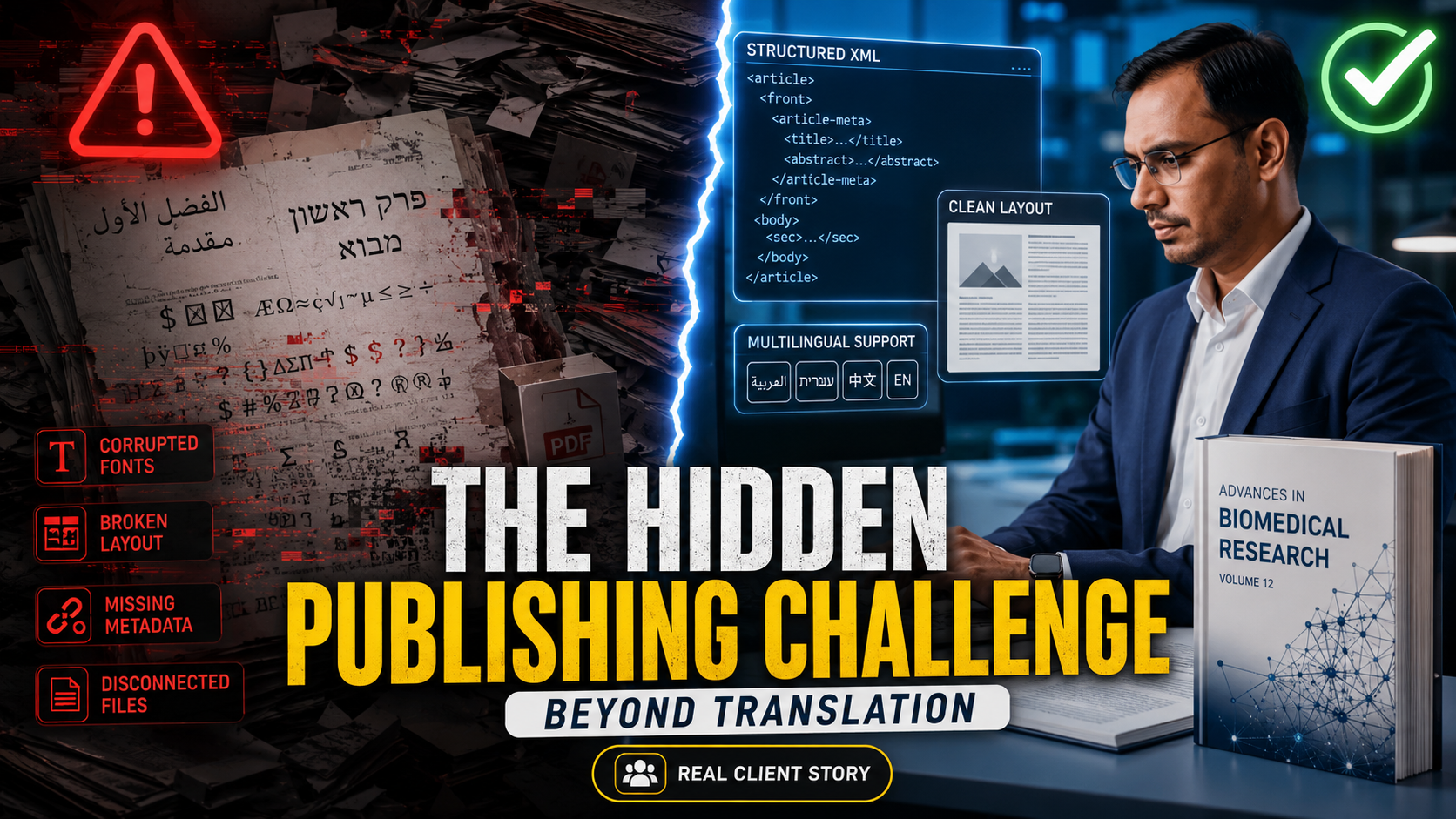
Multilingual publishing is more complex than translating words because every language must also work correctly within the publication’s typography, structure, reading direction, metadata, and digital formats. Right-to-left text, non-Latin scripts, specialist fonts, equations, tables, and mixed-language passages can all fail during production. Successful delivery requires linguists and publishing technicians to work from one customised, quality-controlled workflow.
The hidden challenge of multilingual publishing is preserving linguistic meaning while rebuilding the content for print and digital delivery. Translation alone cannot control bidirectional text, glyph coverage, font shaping, line breaks, technical symbols, page progression, or accessible reading order. Publishers need language expertise, specialist typesetting, structured content, format validation, and coordinated human quality assurance.
What Is Multilingual Publishing?
Multilingual publishing is the editorial and production process of preparing content in two or more languages for accurate print and digital publication. It includes translation or language editing, script-aware typesetting, font management, semantic tagging, metadata, accessibility, proofreading, and output validation. The objective is equivalent meaning and usability—not merely equivalent words.
A translated manuscript may be linguistically correct and still be unpublishable. Its font may not contain the required characters. Numbers and punctuation may move to the wrong side of a sentence. A table may expand beyond the page after translation. An equation may lose a symbol during font substitution. An EPUB may display the correct words but turn pages in the wrong direction.
This is why multilingual production must be planned as a publishing workflow. The source, language, script, document structure, output formats, platforms, accessibility requirements, and visual design all influence one another. A decision made during translation can affect page composition; a technical limitation can require a linguist to review line breaks, abbreviations, or alternatives.
| Area | Translation-Only Approach | Multilingual Publishing Approach |
|---|---|---|
| Primary objective | Transfer meaning between languages | Transfer meaning and produce a usable, publication-ready experience |
| Typography | Often left to default software behaviour | Tests script shaping, font coverage, spacing, line breaking, and emphasis |
| Layout | Translated text is inserted into an existing template | Template rules adapt to text expansion, direction, tables, figures, and page flow |
| Digital structure | May deliver an unstructured document or PDF | Encodes language, direction, hierarchy, navigation, metadata, and accessibility |
| Quality control | Focuses mainly on terminology and grammar | Combines linguistic, typographic, structural, accessibility, and platform QA |
Why Multilingual Publishing Requires More Than Translation
Translation determines what the content says; publishing determines whether readers can use it correctly. A multilingual title must preserve the translated meaning while adapting typography, direction, layout, navigation, metadata, and accessibility to the target script. Without that production layer, accurate language can still appear broken, ambiguous, unreadable, or incompatible with distribution platforms.
Languages do not occupy identical space or follow identical visual rules. A short source phrase may become much longer in another language. Some scripts join or reshape letters according to context. Others use combining marks, vertical forms, specialised punctuation, or line-breaking conventions that differ from English. Mixed-language academic content may include Latin abbreviations, Arabic text, mathematical notation, URLs, DOI strings, and numbered citations in one paragraph.
Academic and STM content increases the risk because linguistic elements interact with technical ones. Figure labels, equations, chemical names, phonetic notation, glossed examples, citations, and tables must remain accurate after translation and typesetting. A compositor cannot safely guess whether a character is a visual alternative or a different scholarly symbol.
What must remain aligned across every language
- Meaning and terminology — approved vocabulary, subject-specific usage, names, abbreviations, and author intent
- Document hierarchy — headings, lists, notes, captions, quotations, references, and parallel language relationships
- Typography — font family, glyph coverage, script shaping, emphasis, kerning, leading, and fallback behaviour
- Layout — text expansion, column width, tables, figure labels, margins, page breaks, and mirrored elements
- Technical content — equations, scientific symbols, phonetic characters, code, identifiers, units, and cross-references
- Digital behaviour — language tags, text direction, navigation, page progression, search, copy and paste, and screen-reader output
- Metadata — translated titles, contributor names, language codes, subjects, descriptions, rights, and format information
Right-to-Left Typesetting and Bidirectional Text
Right-to-left typesetting requires more than right-aligning paragraphs. Arabic, Hebrew, and other RTL content needs an explicit base direction, correct character shaping, logical reading order, mirrored page behaviour where appropriate, and controlled handling of embedded left-to-right elements such as numbers, equations, URLs, citations, and Latin-script names.
The most visible error in right-to-left publishing is reversed layout, but the difficult problems are often smaller. Parentheses can appear on the wrong side. A numbered citation can detach from its reference. A DOI or web address can become visually confusing. Table columns may retain left-to-right order while the surrounding text flows right to left. Headers, footers, folios, captions, and navigation can require separate decisions.
For web and EPUB content, language and direction serve different purposes. The language declaration supports pronunciation, hyphenation, fonts, and assistive technology; the direction declaration controls visual flow. Accessible digital files should encode both rather than relying only on CSS or the appearance of the text. EPUB production must also test page progression and reading-system behaviour.
| RTL Production Element | Common Failure | Required Control |
|---|---|---|
| Paragraph direction | Text is right-aligned but punctuation and mixed runs remain incorrect | Declare the semantic base direction and test bidirectional rendering |
| Numbers and citations | Digits, brackets, or reference markers shift position | Isolate direction-sensitive inline sequences and verify them visually |
| Tables | Column order, headers, alignment, or reading order becomes ambiguous | Define table direction and review both visual and accessible structure |
| EPUB navigation | Page turns or navigation order feel reversed | Set language, direction, spine progression, and test on target reading systems |
| Figures and page furniture | Labels, callouts, folios, or decorative elements mirror incorrectly | Distinguish meaningful content from elements that should or should not mirror |
Specialised Fonts, Technical Symbols, and Complex Layouts
Multilingual typography succeeds only when fonts contain the required characters and support the target script’s shaping and positioning rules. Publishers must also protect equations, phonetic marks, diacritics, chemical symbols, and specialist notation from substitution or corruption. Font selection, embedding, fallback testing, and visual comparison are therefore core production controls.
A font name is not proof of language support. Two fonts that look similar in Latin text may have very different character coverage, OpenType behaviour, diacritic placement, or bold and italic variants. A fallback font may preserve a missing character but create inconsistent weight, spacing, or baseline alignment. In scholarly work, a visually similar replacement may represent the wrong symbol entirely.
Complex layouts add another layer. Translation can expand headings, captions, table cells, callouts, and index entries. Arabic shaping or stacked diacritics may need different leading. CJK scripts use distinct punctuation and line-breaking expectations. Linguistics publications may combine International Phonetic Alphabet characters, interlinear glosses, trees, examples, and equations that must align precisely.
| Content Type | Typical Risk | Publishing Response |
|---|---|---|
| Non-Latin scripts | Missing glyphs, incorrect shaping, weak font fallback | Script-aware font selection, character inventory, embedding, and rendered proof checks |
| Combining marks and diacritics | Marks collide, detach, disappear, or alter line spacing | Use appropriate Unicode encoding and fonts, then inspect language-specific samples |
| Equations and technical symbols | Substitution changes scholarly meaning or breaks alignment | Preserve LaTeX or MathML structure where applicable and compare against the approved source |
| Tables and figures | Expanded text overflows, labels detach, or direction becomes unclear | Adapt layout rules and perform linguistic plus visual review |
| EPUB and web fonts | Reading systems substitute fonts or render scripts inconsistently | Test embedding rights, CSS, language tags, fallback order, and representative devices |
Why a Customised Publishing Workflow Is Essential
A customised workflow translates each project’s linguistic and technical risks into defined production rules. It establishes approved fonts, language codes, direction handling, templates, file formats, responsibilities, query routes, and quality checks before volume production begins. This prevents teams from repeatedly solving the same problem and makes complex delivery predictable and scalable.
Standard templates are designed around standard assumptions. They may expect one language, left-to-right paragraphs, familiar Latin fonts, short headings, and simple page furniture. A multilingual project can violate every assumption at once. Customisation does not mean creating an uncontrolled manual process; it means defining repeatable rules for the actual content.
The workflow should connect linguists, editors, typesetters, XML specialists, accessibility reviewers, and project managers. Each role sees different risks. Linguists know whether a line break, abbreviation, or character changes meaning. Production specialists know whether a font, layout engine, or reading system can support the intended result. Project managers make sure queries reach the right person before they block the schedule.
A practical multilingual production sequence
- 1. Profile the content — identify languages, scripts, direction changes, equations, symbols, tables, figures, file types, and target platforms
- 2. Build a character and font plan — confirm glyph coverage, shaping behaviour, weights, embedding rights, and fallback rules
- 3. Define structural rules — specify language tagging, direction, parallel versions, metadata, hierarchy, reading order, and XML requirements
- 4. Create representative samples — test the hardest pages and mixed-language combinations before processing the full project
- 5. Establish query ownership — route linguistic, editorial, technical, and rights questions to named decision-makers
- 6. Produce from controlled templates — apply validated InDesign, LaTeX, XML, HTML, EPUB, and PDF rules consistently
- 7. Run dual quality assurance — combine native-language or qualified linguistic review with technical and visual QA
- 8. Validate final formats — test fonts, links, metadata, accessibility, navigation, reading order, and platform compatibility
| Workflow Stage | Linguistic Responsibility | Production Responsibility |
|---|---|---|
| Discovery | Confirm languages, variants, terminology, and reviewer requirements | Audit scripts, fonts, layouts, formats, tools, and platform constraints |
| Sample development | Review text accuracy, direction-sensitive runs, and language-specific conventions | Build templates, test fonts, encode structure, and resolve rendering issues |
| Full production | Answer queries and inspect high-risk language elements | Apply controlled composition, conversion, and version management |
| Quality assurance | Proofread meaning, terminology, punctuation, and language presentation | Check layout, symbols, fonts, tags, accessibility, and output validation |
| Delivery | Approve language corrections and final exceptions | Synchronise corrections and audit every delivery package |
Quality Control for Multilingual Publishing Projects
Multilingual quality control must verify language, typography, structure, and format behaviour together. A proof can be grammatically correct but technically broken, or visually polished but linguistically wrong. Reliable QA uses approved source comparison, qualified language review, automated validation, visual inspection, device testing, and correction tracking across every final output.
Quality assurance should be risk-based. A simple bilingual cover does not need the same testing as an RTL academic journal containing equations, IPA characters, nested tables, and multiple digital formats. The project specification should identify high-risk features and define how they will be checked, by whom, and at which stage.
Multilingual publishing QA checklist
- Language accuracy — terminology, names, punctuation, capitalisation, quotations, abbreviations, and regional conventions are approved
- Character integrity — no missing glyphs, replacement characters, decomposed marks, symbol substitutions, or encoding corruption
- Direction and reading order — paragraphs, inline runs, tables, lists, notes, navigation, and assistive technology follow the intended order
- Typography — shaping, line breaks, spacing, emphasis, diacritics, fallback fonts, and script-specific conventions are correct
- Layout — text expansion, overset text, page breaks, captions, figures, cross-references, headers, and footers are controlled
- Structured content — language codes, direction attributes, XML hierarchy, metadata, and alternate-language relationships validate
- Accessibility — pronunciation, heading structure, table headers, alternative text, links, and reading order work in the target language
- Format consistency — approved corrections appear in XML, HTML, EPUB, PDF, and platform metadata without version drift
Automated checks can locate invalid XML, missing fonts, unresolved links, absent language declarations, overset text, and common file defects. Human reviewers must decide whether the words, symbols, direction, and layout communicate the intended meaning. Neither layer is sufficient on its own.
Behind the Project: Siliconchips Services and Glossa
The Glossa project demonstrates how communication and technical precision work together in linguistic publishing. Complex typefaces, language examples, tables, graphs, and specialist symbols require more than a generic production template. Siliconchips Services aligned editorial understanding with technical typesetting so demanding manuscripts could move through a consistent, publication-ready workflow.
The video explores the production challenge behind a real linguistics publishing relationship. The source content brought together diverse languages, specialised fonts, intricate layouts, technical symbols, and direction-sensitive text. Earlier bottlenecks included layout movement and symbol corruption—the kinds of failures that can appear when complex language content is forced into workflows designed primarily for straightforward Latin-script documents.
Siliconchips Services used a two-part response: technical precision and effective communication. Rather than relying on default software behaviour, the team developed project-specific methods for non-Latin scripts, fonts, and layout. Linguistic expertise remained connected to technical design so that production decisions could be reviewed against language meaning.
That connection is essential. A designer may recognise that a line is overflowing but not know where it can safely break. A linguist may know the correct reading but not the limitations of a font or typesetting system. When both work through a shared query and proofing process, problems can be solved without sacrificing either meaning or presentation.
Professor Johan Rooryck, Editor-in-Chief of Glossa: a journal of general linguistics, has highlighted the importance of careful attention to graphs, tables, typefaces, and symbols in the journal’s production. The broader partnership shows how specialist copyediting, typesetting, responsive communication, and technical knowledge reduce workload for an editorial team handling demanding linguistic content. Read the full Glossa multilingual publishing client story.
Facing multilingual typesetting or conversion problems?
Siliconchips Services can assess your languages, scripts, fonts, technical content, layouts, and required digital formats before building a controlled workflow for new titles or complex backlist conversion.
How to Choose a Multilingual Publishing Partner
Choose a multilingual publishing partner by testing production capability, not translation coverage alone. The provider should demonstrate script-aware typesetting, font and symbol control, structured-content expertise, accessible output, qualified linguistic review, transparent queries, and multi-format quality assurance. Ask for representative samples using the most difficult content in your programme.
Publishers should begin with a sample that includes mixed direction, technical notation, tables, figures, diacritics, long headings, and the required output formats. A simple page can hide limitations that appear only when language and design interact. The supplier should explain how the sample was produced, which checks were automated, which required human judgement, and how corrections will be synchronised.
- Script expertise — can the team explain shaping, direction, line breaking, punctuation, and language-specific typography?
- Technical production — can it work with InDesign, LaTeX, XML, MathML, HTML, EPUB, accessible PDF, and your platform packages?
- Font governance — does it verify glyph coverage, licensing, embedding, fallback, and output behaviour?
- Linguistic collaboration — are qualified reviewers connected directly to editorial and production queries?
- Quality evidence — are validation results, correction logs, error categories, and acceptance criteria visible?
- Scalable workflows — can the same approved rules be applied consistently during volume increases?
- Publisher alignment — will the team learn your style guide, terminology, platforms, accessibility policy, and escalation process?
For journals and scholarly books, academic publishing services should connect language handling with references, equations, figures, tables, JATS or BITS XML, and repository delivery. For multi-channel programmes, digital publishing solutions should preserve language and direction across semantic HTML, EPUB, accessible PDF, and structured metadata.
The right publishing outsourcing services operate as an extension of the in-house team. They do not simply accept files and return pages; they identify hidden risks, raise useful queries, document decisions, and improve the workflow as new language combinations and content types appear.
Frequently Asked Questions About Multilingual Publishing
Publishers most often ask how multilingual production differs from translation, why RTL scripts fail, how fonts and symbols are protected, and which quality checks are required. The answers below focus on the practical controls needed to convert linguistically accurate manuscripts into accessible, platform-ready print and digital publications.
What is the difference between translation and multilingual publishing?
Translation transfers meaning from one language to another. Multilingual publishing turns that language content into a complete publication by controlling fonts, script behaviour, direction, layout, metadata, accessibility, navigation, technical symbols, and output formats. A translation may be correct as text but still require substantial typesetting, structural tagging, proofreading, and platform validation before publication.
Why is right-to-left publishing difficult?
Right-to-left publishing must handle more than paragraph alignment. Arabic or Hebrew text may contain left-to-right numbers, formulas, citations, URLs, or names. Punctuation and neutral characters can move unexpectedly, while tables, page progression, navigation, and reading order need explicit control. Correct results depend on Unicode-aware tools, semantic direction markup, appropriate fonts, and human proofing.
How do specialised fonts affect multilingual publishing?
A font must contain the required glyphs and support the target script’s shaping, positioning, diacritics, weights, and styles. Automatic fallback can introduce visual inconsistency or replace a specialist character with the wrong symbol. Publishers should inventory characters, confirm licensing and embedding, test representative content, and inspect the actual PDF, EPUB, and web outputs.
How are technical symbols protected during translation and typesetting?
Technical symbols should remain linked to an approved source and use stable Unicode, LaTeX, MathML, or specialist artwork as appropriate. Production teams should avoid uncontrolled font substitution and compare equations, phonetic notation, chemical symbols, units, labels, and cross-references after conversion. Automated character checks help, but expert visual review is required to protect scholarly meaning.
Can one layout template support every language?
Usually not without adaptation. Templates can provide a shared design system, but text expansion, script direction, shaping, line breaking, vertical spacing, page progression, tables, and font metrics vary. A robust multilingual template uses controlled language-specific rules and exceptions. Representative sample pages should be approved before the full title or journal issue enters production.
What quality checks are required for multilingual eBooks?
Multilingual eBooks need language and direction declarations, correct navigation and page progression, font and fallback testing, semantic headings, accessible reading order, descriptive alternative text, usable tables, valid metadata, and EPUB validation. They should also be tested on representative reading systems because script shaping, embedded fonts, fixed layouts, and bidirectional content can behave differently across devices.
Can publishing outsourcing services handle multilingual academic content?
Yes, when the provider combines qualified language review with academic and technical production expertise. A suitable partner should manage copyediting, right-to-left and non-Latin typesetting, equations, references, figures, XML, EPUB, accessible PDF, and format validation through one documented workflow. The publisher should confirm reviewer qualifications, sample quality, query handling, and language-specific acceptance criteria.
Why must linguists and production specialists collaborate?
Linguists understand meaning, terminology, and language conventions; production specialists understand fonts, layout engines, structured formats, accessibility, and platform constraints. Either team working alone may solve one problem while creating another. Collaboration allows technical options to be reviewed against linguistic intent, producing a result that is accurate, readable, stable, and appropriate for every delivery format.
Multilingual Publishing Turns Linguistic Complexity Into Reliable Delivery
Successful multilingual publishing brings translation, typography, structured content, accessibility, and quality control into one coordinated process. The difficult work happens behind the finished page: resolving direction, fonts, symbols, layouts, metadata, and platform behaviour. A customised workflow makes that complexity manageable while preserving the meaning and professional quality of every language version.
For academic publishers, university presses, STM publishers, and content production managers, multilingual growth cannot depend on inserting translated words into an English-first template. Each script and format introduces technical decisions that must be anticipated, tested, and reviewed by the right specialists.
Siliconchips Services combines linguistic care with pre-press and digital production expertise. By connecting editors, typesetters, XML specialists, and quality teams, complex manuscripts can move from difficult source files to polished publication-ready content without treating precision as an afterthought.
Build a multilingual publishing workflow around your content
Tell Siliconchips Services about your languages, scripts, fonts, layouts, technical notation, output formats, and production volume. Our team will help you plan a controlled workflow for accurate and scalable delivery.