
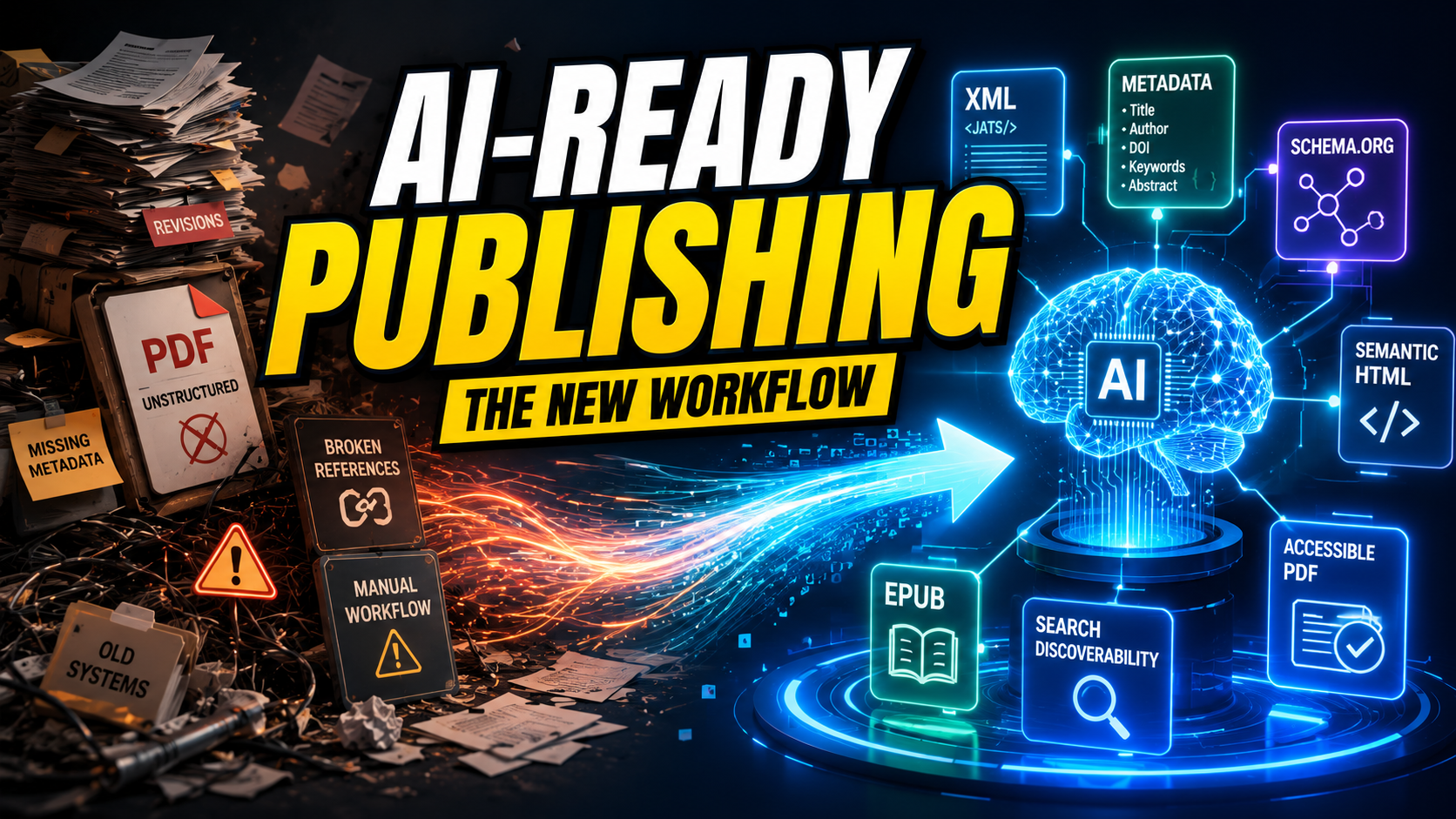
AI-ready digital publishing workflows make digital publishing formats easier for search engines, answer engines, libraries, retailers, and research platforms to discover, interpret, reuse, and attribute accurately. They start with structured source content—not a finished PDF—and connect semantic HTML, reliable metadata, valid schema, modular content, accessible outputs, and human quality assurance in one governed pipeline. For publishers, AI readiness is now part of discoverability, operational resilience, and long-term content value.
Publishers need AI-ready workflows because content discovery is moving beyond traditional result pages into AI-generated answers and conversational search. An effective workflow creates XML-first content, complete entity metadata, semantic HTML, appropriate Schema.org markup, reusable modules, and validated digital outputs. It helps machines understand publications without weakening editorial quality or reader experience.
What Is an AI-Ready Digital Publishing Workflow?
An AI-ready digital publishing workflow creates content that is structured, machine-readable, context-rich, accessible, and governed from source to delivery. It uses XML and semantic tagging to identify meaning, metadata to define entities and relationships, and modular components to support accurate reuse across websites, eBooks, repositories, search systems, and AI-powered interfaces.
AI-ready does not mean AI-written. It describes the condition of the content and the workflow behind it. A carefully edited article can still be difficult for machines to understand if it exists only as an untagged PDF. Conversely, machine-readable content is not trustworthy simply because it has XML or schema. Its claims, authorship, metadata, rights, and version history must also be accurate.
The strongest digital publishing solutions treat XML, HTML, EPUB, and PDF as coordinated outputs from one controlled source. This reduces version drift and allows metadata, corrections, accessibility features, and content relationships to remain consistent across channels.
| Digital Publishing Format | Primary Role | AI-Readiness Value | Main Limitation |
|---|---|---|---|
| JATS or BITS XML | Structured source, interchange, archiving, transformation | Explicitly identifies titles, authors, sections, citations, figures, tables, and other semantic elements | Requires a defined content model, conversion expertise, and schema validation |
| Semantic HTML | Open-web reading and discovery | Crawlable, linkable, passage-level content with meaningful headings and landmarks | Weak templates or client-side rendering can obscure structure and content |
| EPUB 3 | Accessible eBook distribution | Packages semantic HTML, navigation, metadata, and accessibility information | Retail access controls and packaging can limit open-web discovery |
| Tagged PDF or PDF/UA | Fixed-layout reading, print fidelity, and document delivery | Tags and reading order improve extraction and accessibility compared with an untagged PDF | A fixed page remains less reusable and semantically flexible than XML or HTML |
AI Search and Content Structure: Make Meaning Easy to Retrieve
AI search works best with content that is crawlable, clearly organised, and useful for specific questions. Publishers should use descriptive headings, concise answer-first passages, logical internal links, semantic HTML, and visible evidence. These practices support readers and conventional SEO while making individual sections easier for retrieval systems to interpret in context.
Google AI Overviews and AI Mode can use query fan-out, issuing related searches across subtopics before assembling a response. Other answer engines also retrieve passages from multiple sources. This means a single user prompt can create several discovery opportunities: a definition, comparison, process, risk, format decision, or implementation question may each be retrieved separately.
That does not require an artificial “AI writing style”. Google’s guidance for AI features and websites states that no special AI markup or machine-readable file is required for its generative search features. The fundamentals remain crawlability, indexability, helpful people-first content, internal linking, page experience, and clear information architecture. Structure matters because it improves meaning and usability—not because headings or short paragraphs guarantee an AI citation.
Content structure checklist for AI and human discovery
- Answer the main question early — state the conclusion before adding background, qualification, or examples
- Use descriptive H2 and H3 headings — each heading should identify a real question, decision, process, or entity
- Create self-contained sections — define pronouns, acronyms, products, standards, and time frames within the relevant passage
- Prefer semantic HTML — use genuine headings, paragraphs, lists, tables, captions, and links instead of visual formatting alone
- Connect related content — internal links should lead to deeper services, definitions, case studies, and supporting expertise
- Show source and author context — identify who created, reviewed, and last updated the information
- Keep important content crawlable — avoid hiding essential text behind scripts, images, or inaccessible interface elements
- Remove duplication and contradiction — competing versions weaken confidence for readers, search systems, and internal AI tools
| Traditional Page-First Practice | AI-Ready Publishing Practice | Operational Benefit |
|---|---|---|
| Long introduction before the answer | Direct summary followed by evidence and detail | Readers and retrieval systems identify the core point quickly |
| Visual headings without semantic tags | Logical H1–H3 hierarchy encoded in HTML | Clear navigation, accessibility, and section relationships |
| Facts embedded in dense prose | Definitions, comparisons, steps, and limitations stated explicitly | More accurate extraction and easier editorial review |
| PDF as the only online version | Semantic HTML plus appropriate downloadable formats | Better web discovery, accessibility, linking, and reuse |
| Disconnected pages and files | Entity-led internal links and consistent identifiers | Stronger context across authors, works, subjects, organisations, and editions |
Metadata: Give Content Identity, Context, and Provenance
Metadata tells discovery systems what a publication is, who created it, when it changed, what it discusses, where it belongs, and how it may be used. AI-ready workflows capture this information once, validate it against controlled rules, and distribute it consistently through XML, web pages, DOI deposits, retailer feeds, library records, and digital files.
Metadata is not a last-minute form completed at upload. It is an operational layer that should travel with the content throughout the workflow. When author names, dates, abstracts, subjects, rights, or identifiers differ across a webpage, EPUB, Crossref deposit, and retailer record, machines encounter conflicting evidence. The same inconsistency can also confuse librarians, readers, authors, and internal support teams.
Metadata fields that improve machine understanding
- Work identity — title, subtitle, abstract, edition, content type, language, and persistent DOI or ISBN
- People and organisations — complete contributor names, roles, ORCID iDs, affiliations, and ROR identifiers where available
- Subject context — controlled vocabulary terms, keywords, classifications, named entities, and audience level
- Publication relationships — journal, issue, book, chapter, series, references, corrections, supplements, and related datasets
- Dates and versions — accepted, published, modified, corrected, retracted, and edition information with clear meanings
- Rights and access — copyright holder, licence, open-access status, territorial rights, permissions, and reuse conditions
- Provenance and responsibility — author, editor, reviewer or updater where appropriate, plus source and change history
- Accessibility metadata — access modes, accessibility features, hazards, and an accessibility summary for relevant formats
| Publishing Context | Relevant Metadata or Identifier | What It Clarifies |
|---|---|---|
| Books and eBooks | ONIX, ISBN, contributor roles, BISAC or Thema subjects | Commercial identity, contributors, markets, formats, availability, rights, and subject classification |
| Journal articles | JATS XML, Crossref metadata, DOI, ISSN | Article identity, journal relationships, references, funding, licences, and version status |
| Researchers and contributors | ORCID and CRediT roles | Contributor identity and the nature of each contribution |
| Institutions | ROR identifier | Which research organisation or affiliation is intended despite name variants |
| Web discovery | HTML metadata, canonical URL, Schema.org, Open Graph | Preferred page, content type, author, publisher, dates, image, and sharing context |
For AI visibility, the aim is not maximum metadata volume. It is complete, accurate, interoperable metadata for the entities and relationships that matter. A smaller validated record is more useful than a large record filled with duplicated, generic, or contradictory terms.
Schema: Make Web Entities Explicit Without Overpromising
Schema.org markup helps search systems identify the entities and relationships already visible on a webpage, including an article, book, person, organisation, publication date, and breadcrumb path. It supports machine understanding and rich-result eligibility, but it does not guarantee ranking or AI citation. Publishers should use accurate, page-specific JSON-LD rather than excessive markup.
There is no special “AI schema” required for Google AI Overviews or AI Mode. Standard structured data still has an important role: it can remove ambiguity and support eligible search features when the markup matches the visible page. Schema should reinforce good content and metadata, not compensate for thin content, inaccessible delivery, or unclear authorship.
| Schema.org Type | Suitable Publishing Use | Important Properties |
|---|---|---|
| Article or BlogPosting | Editorial articles, insight posts, news, and commentary | headline, author, publisher, datePublished, dateModified, image, mainEntityOfPage |
| ScholarlyArticle | Research and scholarly journal content | author, citation, isPartOf, about, identifier, pagination, datePublished |
| Book | Book and monograph landing pages | name, author, isbn, bookEdition, publisher, inLanguage, workExample |
| Person and Organization | Author, editor, researcher, institution, and publisher profiles | name, sameAs, affiliation, identifier, url, publishingPrinciples |
| BreadcrumbList | Site and publication hierarchy | itemListElement, position, name, item |
| FAQPage | Pages containing genuine, visible publisher questions and answers | mainEntity, Question, acceptedAnswer; eligibility does not guarantee a rich result |
Schema implementation quality checks
- Match visible content — never add claims, ratings, authors, or dates that readers cannot verify on the page
- Select the most specific valid type — use ScholarlyArticle for scholarly works and Book for book entities where appropriate
- Connect identifiers — include DOI, ISBN, ORCID, ROR, canonical URLs, and authoritative sameAs links where valid
- Keep entities consistent — names, dates, titles, images, and organisations should align with XML and platform metadata
- Validate before release — test syntax, required properties, warnings, and the rendered page
- Maintain after updates — content corrections and date changes should flow into structured data at the same time
Modular Content: Turn One Trusted Source Into Many Useful Outputs
Modular content breaks a publication into governed, meaningful components such as summaries, definitions, methods, results, FAQs, biographies, figures, and rights statements. Each component carries structure and metadata, can be updated independently, and can be assembled into multiple channels. This improves consistency, reuse, personalisation, accessibility, and machine interpretation.
Traditional page-first production locks meaning inside a finished layout. When a summary, author biography, licence statement, or product description changes, teams may need to locate and edit many separate files. Modular production establishes an approved source of truth and creates channel-specific presentations from it.
For scholarly and professional publishers, XML already provides a strong foundation. JATS can distinguish an abstract, section, citation, figure, table, contributor, funding statement, and related object. BITS supports structured book content. Semantic modules can then feed HTML, EPUB 3, accessible PDF, metadata deposits, discovery pages, and internal knowledge systems.
| Workflow Area | Monolithic Content | Modular AI-Ready Content |
|---|---|---|
| Updates | Edit each page, file, and channel separately | Update the governed source and regenerate affected outputs |
| Reuse | Copy and paste, creating uncontrolled duplicates | Reuse approved components with identity and version control |
| Discovery | Meaning depends heavily on the full page | Components contain explicit headings, entities, and relationships |
| Accessibility | Remediation repeated for individual outputs | Semantic source structure supports accessible downstream formats |
| Governance | Ownership and approval may be unclear | Each component can carry status, owner, rights, and review date |
Modularity should not fragment the reader’s experience. A good workflow preserves narrative flow while giving each component enough context to remain understandable. It also prevents unsupported reuse: rights, territory, version, and attribution metadata should travel with the module.
Implementation Steps for an AI-Ready Publishing Workflow
Implement AI-ready publishing by auditing current files, defining a structured source model, standardising metadata, mapping entities and identifiers, generating semantic outputs, adding appropriate schema, validating accessibility and technical quality, and assigning governance. Start with a representative content set, measure defects and discoverability, then scale the proven workflow across the catalogue.
Eight-step implementation checklist
- 1. Audit sources and outputs — inventory Word, InDesign, LaTeX, XML, EPUB, PDF, HTML, images, metadata feeds, platform requirements, and recurring production defects
- 2. Define the source model — choose JATS, BITS, or another appropriate XML vocabulary, then document publisher-specific tagging, naming, and transformation rules
- 3. Map entities and identifiers — connect works, versions, authors, organisations, journals, series, subjects, citations, and datasets using DOI, ISBN, ORCID, ROR, and canonical URLs
- 4. Standardise metadata — establish required fields, controlled vocabularies, validation rules, ownership, rights data, accessibility metadata, and correction procedures
- 5. Build modular templates — model summaries, sections, FAQs, figures, tables, biographies, licences, and reusable service or product information as governed components
- 6. Generate channel-ready formats — produce semantic HTML, EPUB 3, accessible PDF, metadata feeds, and platform packages from the same structured source where possible
- 7. Validate and review — combine schema, link, XML, EPUB, metadata, and accessibility checks with editorial, visual, and subject-sensitive human QA
- 8. Govern and improve — monitor crawlability, indexing, search queries, AI referrals where available, citation accuracy, conversion errors, accessibility defects, and content freshness
| Implementation Phase | Priority Actions | Deliverable |
|---|---|---|
| Discover | Audit formats, metadata, systems, rights, templates, and target discovery platforms | Current-state map with prioritised structural and metadata gaps |
| Design | Define XML model, taxonomy, identifiers, modular components, outputs, and quality rules | Publishing specification and validated sample package |
| Pilot | Convert a representative set, test transformations, validate accessibility, and review metadata consistency | Production-ready workflow with documented exceptions and acceptance criteria |
| Scale | Train teams, automate repeatable checks, migrate priority backlist content, and monitor performance | Governed multi-format production across new content and selected archives |
Publishers do not need to transform an entire archive at once. Prioritise high-value, frequently accessed, rights-cleared, or strategically important content. A pilot should include straightforward and complex examples so the workflow is tested against equations, tables, images, references, accessibility requirements, and incomplete legacy metadata.
Specialist end to end publishing services can connect source assessment, copyediting, XML conversion, typesetting, metadata enrichment, accessibility, and multi-format quality assurance. For scholarly programmes, experienced academic publishing services are especially important when JATS XML, citations, equations, MathML, figures, tables, and repository requirements must remain aligned.
Is your publishing workflow ready for AI-led discovery?
Siliconchips Services can review your source files, metadata, XML, HTML, EPUB, PDF, accessibility, and platform requirements to identify the practical steps towards a structured, reusable, and AI-ready publishing workflow.
Frequently Asked Questions About AI-Ready Digital Publishing
AI-ready publishing is based on established publishing and web practices: structured source files, accurate metadata, semantic HTML, interoperable identifiers, accessible formats, and governed content. Publishers do not need speculative shortcuts or AI-generated copy. They need authoritative information that remains consistent, understandable, crawlable, and reusable across human and machine channels.
What makes a digital publishing workflow AI-ready?
An AI-ready workflow produces structured, machine-readable, and trustworthy content. It typically uses XML-first production, semantic HTML, complete metadata, persistent identifiers, appropriate Schema.org markup, modular components, accessible digital formats, and documented quality controls. The workflow should also preserve authorship, rights, versions, and provenance so machines can interpret content without losing essential publishing context.
Which digital publishing formats are best for AI discovery?
Structured XML and semantic HTML provide the strongest foundation. JATS or BITS XML captures content meaning and supports transformation, while crawlable HTML makes content available on the open web. EPUB 3 is valuable for accessible eBook distribution, and tagged PDF or PDF/UA supports fixed-layout reading. PDF should not be the only source for discovery and reuse.
Do publishers need special schema for Google AI Overviews?
No. Google states that no special Schema.org markup is required for AI Overviews or AI Mode. Publishers should continue using accurate, relevant structured data for conventional search understanding and eligible rich results. Article, ScholarlyArticle, Book, Person, Organization, and BreadcrumbList can clarify visible entities, but schema does not guarantee ranking, inclusion, or citation in an AI-generated response.
Does an llms.txt file make a publisher’s website AI-ready?
No. llms.txt is a proposed community convention, not a universal publishing or web standard, and support varies. Google says AI-specific text files are not required for its generative search features. Publishers should first prioritise crawlable HTML, XML sitemaps, robots controls, accurate metadata, internal links, canonical URLs, and authoritative content. Any experimental file also requires ownership and maintenance.
How does metadata improve AI visibility for publishers?
Metadata identifies the work, creator, organisation, subject, version, date, licence, and relationships that surround the content. Persistent identifiers such as DOI, ISBN, ORCID, and ROR reduce ambiguity. Consistent records across XML, HTML, Schema.org, Crossref, ONIX, EPUB, and repository feeds give discovery systems clearer evidence about what the publication is and where it belongs.
Can legacy PDFs be converted into AI-ready content?
Yes, but conversion quality depends on the source. Legacy PDFs can be analysed and reconstructed as XML or semantic HTML, with headings, references, figures, tables, equations, metadata, and reading order restored. Optical or automated extraction should be followed by human review and schema validation. Complex layouts, damaged scans, missing fonts, and incomplete metadata require additional remediation.
Does AI-ready publishing mean content should be written by AI?
No. AI readiness concerns structure, context, interoperability, and governance—not who drafted the text. Human-authored and professionally edited content can be fully AI-ready. Generative tools may assist classification, tagging, quality checks, or transformation, but publishers should retain human oversight for factual accuracy, editorial meaning, rights, ethics, accessibility, and approval of final outputs.
How can publishing outsourcing services support an AI-ready workflow?
A specialist partner can audit source files, create JATS or BITS XML, enrich metadata, produce semantic HTML and EPUB, remediate accessible PDFs, map identifiers, apply validation, and maintain consistency across outputs. The best publishing outsourcing services combine automation with editorial and technical review, while following publisher-specific standards, rights rules, security requirements, and escalation procedures.
AI-Ready Publishing Starts With Better Publishing Fundamentals
AI readiness is not a separate format or a one-time SEO technique. It is the result of a structured, metadata-rich, accessible, and well-governed publishing workflow. Publishers that establish XML as a reusable source, deliver semantic HTML, connect trusted entities, and maintain modular content are better prepared for search, AI discovery, distribution, and future channels.
The practical question is not whether one search platform rewards a particular technique today. It is whether a publication can be discovered, understood, attributed, transformed, corrected, and reused without losing meaning. That capability has value across search engines, answer engines, libraries, retailers, repositories, accessibility tools, internal knowledge systems, and products that have not yet emerged.
AI-ready digital publishing therefore builds on durable publishing disciplines: accurate editorial work, structured content, complete metadata, open standards, accessibility, validation, and human accountability. When those elements operate as one workflow, publishers gain more than visibility. They gain a content foundation that can adapt without repeatedly rebuilding the publication from scratch.
Build an AI-ready digital publishing workflow
Discuss your XML, metadata, schema, digital formats, accessibility requirements, and backlist conversion priorities with Siliconchips Services. We will help you plan a scalable workflow around your content, platforms, and publishing standards.