
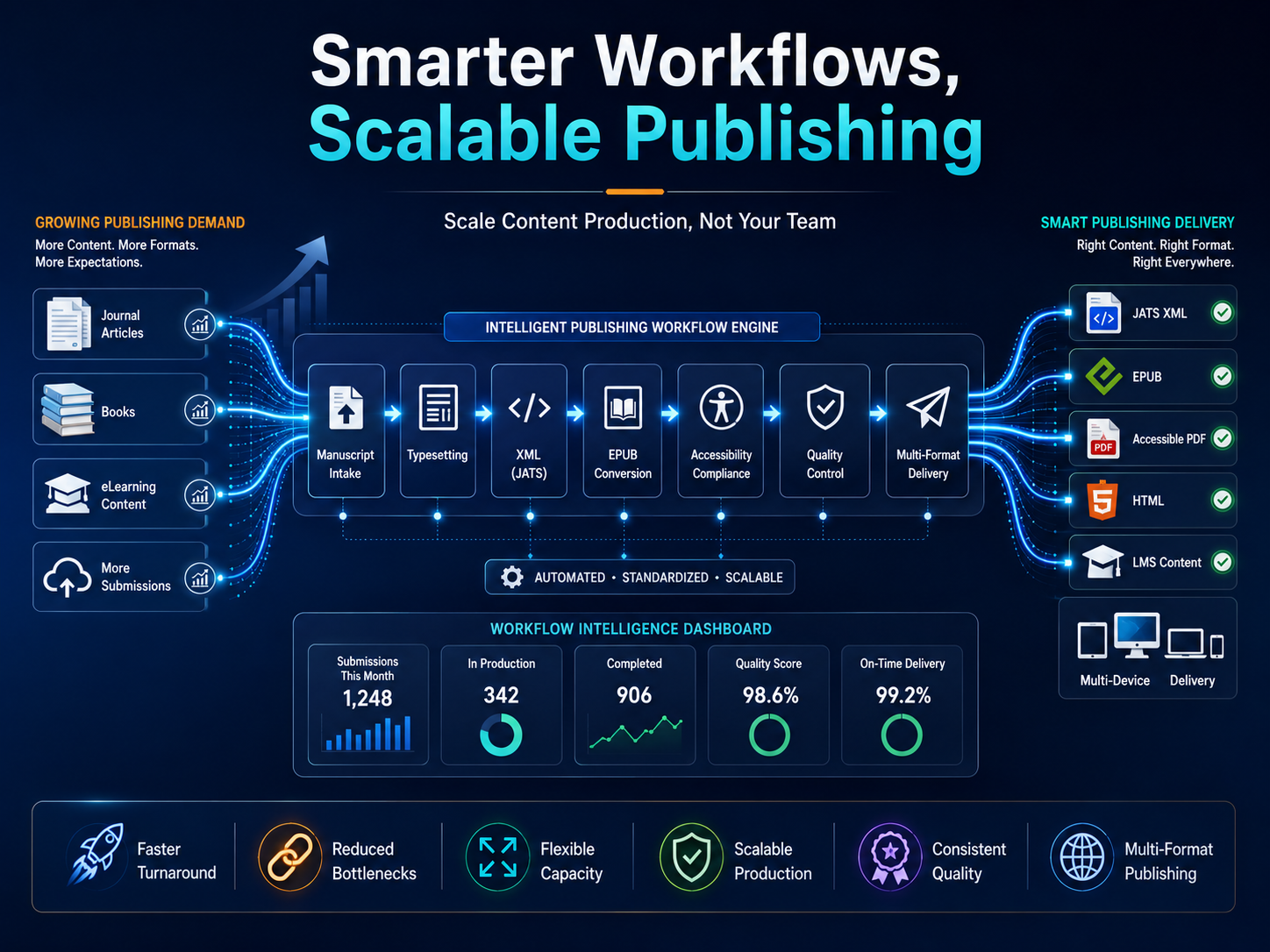
Digital publishing services for publishers solve a specific operational problem: content output is growing faster than in-house production capacity can absorb. When a publishing house increases its annual title count, launches a journal programme, or migrates a backlist to digital, the technical production workload multiplies — and the specialisms required (LaTeX typesetting, JATS XML structuring, EPUB 3 validation, WCAG accessibility compliance) are expensive and difficult to maintain in-house at variable cost.
This guide covers the real scaling bottlenecks publishers face in 2026, how outsourced and automated production workflows resolve them, what a professional QA framework looks like at volume, and how different publisher types are using a full-service partner to grow output without growing headcount.
Digital publishing services help publishers scale content production by replacing fixed in-house capacity with on-demand specialist teams. Outsourced partners handle typesetting, XML conversion, multi-format export, and quality validation simultaneously — enabling publishers to increase annual title output by 5–10× without proportional increases in staffing, tools overhead, or per-title production cost.
6 Scaling Challenges That Digital Publishing Services Solve
-
Format Multiplication Without an XML-First Pipeline
Format operations
Each title now requires delivery across multiple formats simultaneously: a reflowable EPUB 3 for Kindle and Kobo, a fixed-layout EPUB for illustrated content, an accessible PDF for institutional and library distribution, JATS XML for repository deposit, and often an HTML5 web edition for open-access portals. Without an XML-first workflow, each format requires a separate production pass — multiplying labour cost by five for every title. The digital publishing market is growing at 8.12% CAGR through 2031, and content demand is projected to increase fivefold by the end of 2026. Publishers without scalable multi-format pipelines cannot capture that growth.
-
Accessibility Compliance Under the European Accessibility Act
Regulatory compliance
The European Accessibility Act (EAA), enforced from June 2025, mandates WCAG 2.1 compliance for digital publications distributed across EU markets. In practice, this requires alt-text for every image, a validated logical reading order, ARIA landmarks, colour-contrast verification, and screen-reader compatibility testing — all applied before delivery. Most in-house production teams do not have the tools or trained reviewers to audit files at scale, and EPUB files that fail accessibility checks are refused by major library systems, including OverDrive and EBSCO. Accessibility compliance is no longer optional for any publisher serving European institutional or consumer audiences.
-
STEM and Complex Content That Breaks Standard Conversion Tools
Technical content
Mathematical formulae, chemical structures, and engineering tables require LaTeX typesetting and MathML encoding to render accurately across reading environments. Standard conversion pipelines — and most generalist vendors — produce silent rendering errors in this content: incorrect symbol rendering, broken superscript/subscript hierarchies, and MathML that displays correctly in one browser but breaks in Kindle. These errors are difficult to detect at proof stage and expensive to remediate post-delivery. Academic and STM publishers handling high volumes of STEM content need a partner with dedicated LaTeX engineers, not a general-purpose conversion batch process.
-
Seasonal Volume Spikes Against Fixed In-House Capacity
Capacity planning
Academic publishers face predictable submission peaks aligned with academic calendars. Trade publishers face end-of-year retail windows. In both cases, production volume temporarily exceeds what a fixed in-house headcount can absorb without degrading quality or missing schedules. Publishers are increasingly implementing hybrid models — automation reinforced by qualified editors — because fixed staffing cannot respond to variable demand without either overpaying for idle capacity or underpaying for critical periods. Hiring permanent staff for peaks creates structural over-capacity during quieter months; outsourcing production converts that fixed cost into a per-title variable.
-
Retailer Validation Rejections Causing Downstream Delays
Distribution readiness
Amazon KDP, Apple Books, Kobo Writing Life, and library distributors each have distinct technical requirements for EPUB structure, metadata completeness, and file encoding. A file that passes internal review frequently fails platform-specific validation, delaying publication by days or weeks while errors are diagnosed and corrected. Running systematic pre-delivery validation against every target retailer’s schema requires specialist tools and time that most in-house teams cannot allocate on every title. A professional digital publishing services partner runs this pre-flight as standard — not as a reactive fix after rejection.
-
Backlist Digitisation Running in Parallel to New-Title Production
Backlist operations
Publishers holding large print-only backlists face a specific scaling problem: converting legacy content to digital formats is a time-intensive, technically complex project that must run concurrently with ongoing new-title production. Attempting to manage both internally forces production teams to context-switch constantly, degrading quality on both streams. A dedicated outsourced partner absorbs the entire backlist project — manuscript scanning, OCR, editorial cleanup, typesetting, and multi-format conversion — without affecting current-title schedules or team morale.
How Outsourced Publishing Teams Remove Production Bottlenecks
The most effective delivery model for mid-to-large publishers combines onshore project management — providing editorial communication, timeline control, and UK-based accountability — with an offshore production centre that operates across time zones. This hybrid approach enables overnight production cycles: a manuscript accepted in London at 5 pm can be in active typesetting by 6 pm the same evening, ready for editorial review the following morning.
Siliconchips Services operates precisely this model: London-based project management and client communication, supported by a high-capacity production centre in India. The result is a delivery model that gives publishers the responsiveness of a local partner with the throughput capacity of a dedicated offshore team. Explore the complete scope of our digital publishing services for academic, STM, and trade publishers.
In-House Production vs. Outsourced Digital Publishing Services: Direct Comparison
| Dimension | In-House Production | Outsourced Digital Publishing Services |
|---|---|---|
| Cost structure | Fixed — salaries, benefits, tool licences regardless of volume | Variable — scales directly with actual title output |
| Technical depth (LaTeX, XML, EPUB 3) | Expensive and difficult to maintain in-house at required breadth | Specialist teams already trained and immediately deployable |
| Volume scaling | Capped by permanent headcount | Elastic — absorbs 10× volume without hiring or delay |
| EAA / WCAG 2.1 accessibility compliance | Requires specialist hire or retraining investment | Built into every production stage as standard |
| Retailer validation (Amazon, Apple, Kobo) | Ad hoc — typically only after a rejection occurs | Systematic pre-delivery validation on every title |
| Multi-format simultaneous delivery | Sequential — formats produced one at a time | Parallel export — EPUB, PDF, XML from one XML source |
| 24-hour turnaround capability | Constrained to a single working-hours time zone | Cross-time-zone model enables true overnight production |
| Backlist digitisation | Disrupts current-title production bandwidth | Handled by a parallel dedicated project team |
| Institutional knowledge retention | Strong — if staff do not leave | Partner learns house style and requirements progressively over engagements |
💡 Industry context: A 2026 industry analysis of the Indian digital publishing and content solutions sector found that publishers are “increasingly prioritising integrated, end-to-end solutions” over piecemeal vendor relationships. Publishers with consolidated outsourcing relationships consistently report better quality consistency and lower per-title cost than those managing multiple specialists independently.
7 Publishing Automation Capabilities That Accelerate Content Production
XML-First Single-Source Processing
Content is converted into a validated XML master at the start of production. All subsequent formats — EPUB 3, accessible PDF, HTML5, print-ready PDF — are generated simultaneously via XSLT transformation from this single source. Eliminates separate production passes per format and guarantees content consistency across every output channel. JATS is the schema standard for journals; BITS for books.
InDesign Scripting and Template Automation
Adobe InDesign’s ExtendScript and UXP automation environments apply typographic templates, place XML content into pre-built layouts, and batch-process multiple titles without manual operator intervention at the layout stage. For publishers with consistent visual style guides — journal series, textbook imprints, branded trade lines — InDesign automation compresses the layout stage from hours per title to minutes, while eliminating the manual errors that individual layout passes introduce.
LaTeX Batch Typesetting
LaTeX treats mathematical and scientific content as structured data rather than rendered images, making it the only reliable tool for STEM typesetting at scale. A production LaTeX environment using house class files and macro libraries enables batch processing of multiple journal issues simultaneously, maintaining formula accuracy and visual consistency across the entire article set. Errors that would be introduced by Word-to-EPUB conversion pipelines are eliminated at source.
Parallel Multi-Format Export Pipelines
Rather than generating EPUB after PDF approval, and HTML5 after EPUB validation, a modern XML-first pipeline exports all formats simultaneously. A publisher receiving five formats per title — reflowable EPUB, fixed-layout EPUB, accessible PDF, HTML5 web edition, and print PDF — gets all five in one delivery, not across five sequential production cycles. This removes the sequential dependencies that add days to timelines without adding quality.
Automated EPUBCheck and ACE Validation
EPUBCheck validates EPUB file structure against the W3C EPUB 3 specification. ACE by DAISY audits accessibility conformance against WCAG 2.1 and EPUB Accessibility 1.1. Running both automatically at the point of creation — not as a final manual gate — catches validation errors immediately, preventing cascading failures that become expensive to trace late in the production cycle. Every file is also pre-checked against known retailer-specific schema variations before client delivery.
ONIX 3.0 Metadata Generation
ONIX 3.0 metadata records are required by all major retailers and distributors for title discoverability, pricing, and rights information. Automated ONIX generation from the production XML record ensures metadata is complete to retailer specification, consistent with the delivered content, and ready for batch submission at the point of file delivery — not as a separate post-production step that creates timeline risk.
Centralised Proofing and Annotation Platforms
Centralised proofing environments allow authors, editors, and production teams to annotate and approve digital proofs in a single shared workspace — eliminating email chains, conflicting PDF versions, and missed corrections. Integration between the proofing platform and the production XML record means approved corrections flow directly back into the source file, reducing the risk of corrections being dropped between review and final output.
Our books and journals production services integrate all seven of these automation capabilities as part of a standard production pipeline — not as premium add-ons.
The QA Framework That Keeps High-Volume Publishing Accurate
The following checklist represents the complete QA framework that production-grade digital publishing services apply across every title — whether the publisher is delivering 10 titles or 1,000 per year.
End-to-End Digital Publishing QA Checklist
- Manuscript triage: Source files (Word, LaTeX, InDesign, hard copy) audited for completeness before production begins. Complex elements — maths, tables, cross-references, embedded images, multilingual citations — catalogued. Issues flagged to the publisher before the project enters the production pipeline.
- XML schema validation at creation: Structured XML validated against the applicable schema (JATS, BITS, or custom DTD) at the point of structuring — not at the end of production. Invalid elements are corrected before they propagate to output formats where they become harder to trace.
- LaTeX and MathML proof verification: Every mathematical expression and scientific formula reviewed by a specialist typesetter against the original manuscript. MathML output verified for rendering accuracy across EPUB, HTML5, and browser targets. Critical for STM publishers where formula errors affect scientific integrity.
- Editorial round-trip comparison: Typeset proof compared against the marked-up manuscript to confirm every author or editor correction has been applied correctly. This stage catches the missed corrections that would otherwise surface at author approval, adding a full revision cycle to the timeline.
- Automated EPUBCheck and ACE accessibility audit: Every EPUB file run through EPUBCheck 5.x and ACE by DAISY before it leaves the production environment. Zero validation errors is the delivery standard — not a target.
- Accessibility compliance review: Alt-text completeness, reading order validation, ARIA landmark structure, heading hierarchy, and colour-contrast ratios verified against WCAG 2.1 and EPUB Accessibility 1.1. Applied to every output, not only those flagged as “accessibility editions.”
- Physical device testing: EPUB and PDF files tested on representative physical devices — Kindle Paperwhite, Kobo Libra, iPad, Android tablet — to verify rendering beyond what automated validators detect. Device testing catches font substitution, image compression, and layout reflow issues that EPUBCheck passes.
- Retailer pre-flight check: Files validated against Amazon KDP, Apple Books, Kobo Writing Life, and OverDrive specification before client delivery. ONIX metadata verified for completeness against distributor requirements.
- Production sign-off report: Documented delivery confirmation listing all formats produced, validation results, correction round counts, and any publisher-specific notes retained for the project record.
💡 QA principle: Each stage above catches a different class of error. Structural errors surface at XML validation. Technical rendering errors surface at device testing. Missed corrections surface at round-trip comparison. A single final QA gate catches everything late — and late errors cost disproportionately more to fix. Multi-stage QA is not more expensive; it is less expensive, because it catches errors earlier.
How Different Publisher Types Scale With a Digital Publishing Services Partner
140+ Articles Per Year Across Complex STEM Content
A linguistics or STM journal publishing 140 articles per year needs consistent typesetting quality across all submissions — including mathematical notation, complex reference formats, multilingual citations, and specialised symbol sets. Coordinating this volume internally with a small production team creates chronic bottlenecks at the proof stage, where correction cycles are compressed and errors compound. One long-term Siliconchips client — a journal of general linguistics — has maintained this partnership for over six years: “All queries are answered within 24h, and accurately incorporated into the final proofs.”
2,000+ Backlist Titles Digitised Without Disrupting Current Production
A trade publisher with a substantial print backlist needs to make legacy titles available across Kindle, Kobo, and Apple Books — but cannot divert the production team from new-title schedules to do so. Attempting this internally creates quality inconsistency across the converted catalogue and delays new-title output. A dedicated outsourced partner runs the digitisation project in parallel, handling the complete pipeline from file scanning and OCR through editorial cleanup, typesetting, EPUB conversion, and retailer validation. Whittles Publishing has maintained this kind of long-term relationship: “All our eBook conversions go to Siliconchips — totally professional, timely and observant.”
JATS XML for Repository, CrossRef, and PubMed Deposit
An open-access publisher needs archival-quality JATS XML for PubMed indexing, CrossRef DOI registration, and institutional repository deposit — alongside EPUB and HTML5 reader formats. Building and maintaining the XML workflow in-house requires specialist skills and ongoing schema maintenance that most OA editorial teams cannot staff. An outsourced partner with JATS expertise delivers all formats from a single validated XML source, with DOI-ready metadata records as part of the standard delivery package.
Enterprise-Grade Production Without In-House Infrastructure
An independent publisher producing 10–30 titles per year needs professional typesetting and EPUB conversion but cannot justify the tool licences, software investment, or specialist staff that enterprise-grade production requires. Each title competes in the same retail environment as major publishers and must meet identical technical standards. A per-title outsourcing model gives small presses access to the same XML workflows, accessibility compliance, and retailer validation that large publishing houses maintain at scale — without the fixed overhead.
How to Evaluate a Digital Publishing Services Partner: 6 Criteria
| Evaluation Criterion | Strong Partner: What They Demonstrate | Warning Signs |
|---|---|---|
| XML and format expertise | JATS/BITS experience documented; simultaneous multi-format delivery from one XML source confirmed | Formats produced sequentially; no XML workflow documentation provided |
| STEM content capability | Named LaTeX engineers; MathML verification process described; STM portfolio available | Generalist conversion tools only; no specialist typesetter for mathematical content |
| Accessibility compliance | WCAG 2.1 and EAA compliance built into workflow; ACE validation confirmed on every file | Accessibility treated as optional add-on or post-delivery remediation service |
| QA and validation process | Multi-stage embedded QA described; EPUBCheck on every file; retailer pre-flight standard | Single final QA gate only; no documented validation process per stage |
| Accountability model | Named project manager; onshore client contact; documented SLAs with correction guarantees | Multiple vendor handoffs; no clear escalation path or single point of contact |
| Volume and longevity evidence | Documented experience with 500+ titles; long-term client testimonials spanning 5+ years | No volume data available; recent market entrant without verifiable production history |
Our editorial support services — covering copyediting and proofreading — are integrated directly into the production pipeline and managed by the same project team, not treated as a separate engagement with a different vendor.
Frequently Asked Questions: Digital Publishing Services for Publishers
What do digital publishing services for publishers include?
How do digital publishing services help publishers scale content production?
Digital publishing services scale content production by converting fixed in-house capacity into on-demand specialist expertise. Publishers gain access to LaTeX engineers, JATS XML specialists, and EPUB conversion teams without permanent headcount. A hybrid model — onshore project management with an offshore production centre — enables overnight production cycles and absorbs seasonal submission spikes. Publishers can increase annual title output 5–10× without proportional growth in staffing, tool investment, or per-title cost.
What is the difference between end-to-end publishing services and piecemeal outsourcing?
End-to-end publishing services assign one partner complete responsibility for every production stage — from manuscript intake to validated delivery across all formats. Piecemeal outsourcing distributes stages across multiple vendors, creating error-prone handoff points, split accountability, and compounding timeline risk. End-to-end models deliver more consistent output quality, faster turnarounds, and lower per-title cost for publishers managing 50 or more titles per year, because there are no handoff errors between stages.
What publishing automation tools do professional service providers use?
Professional digital publishing services use InDesign scripting for layout batch-processing, LaTeX for STEM and mathematical typesetting, XSLT transformation for simultaneous multi-format export from a single XML source, automated EPUBCheck and ACE by DAISY validation, and ONIX 3.0 metadata generation. Together, these tools eliminate sequential production passes — removing the format multiplication problem that is the primary driver of production cost growth in high-volume publishing operations.
How does QA work in a digital publishing outsourcing model?
QA in professional digital publishing services runs at three levels: structural (XML schema validation at point of creation), technical (EPUBCheck, ACE accessibility audit, retailer pre-flight checks, physical device testing), and editorial (round-trip comparison between approved proof and delivered digital files). Each level catches a different class of error. Multi-stage QA embedded throughout the pipeline costs less than a single final gate, because errors caught early are significantly cheaper to correct than errors found at delivery.
How much does outsourcing digital publishing production cost?
Publishing outsourcing costs vary by title complexity, format count, and annual volume. A hybrid model — UK-based project management with offshore production — typically delivers 40–60% lower per-title cost compared to maintaining equivalent in-house capability at the same quality level. Fixed annual staffing and tool costs become variable per-project costs, which is particularly advantageous for publishers with seasonal submission peaks, backlist digitisation projects, or unpredictable volume growth trajectories.
The Decision: Building Scale Through the Right Partner
Publishers scaling output successfully in 2026 are not building larger in-house production teams — they are building better partner relationships. The most successful organisations are blending automation with editorial expertise rather than choosing between them. The technical requirements of modern digital publishing — XML-first pipelines, WCAG 2.1 accessibility, JATS schema compliance, retailer-specific validation — demand specialist depth that is difficult and expensive to maintain internally at variable cost.
A genuine end-to-end digital publishing services partner absorbs those requirements. Production capacity becomes elastic. Technical risk is owned by specialists. Format delivery is simultaneous rather than sequential. And editorial teams are freed to focus on the work that actually requires editorial judgement: content strategy, author relationships, and programme development.
The practical question for most publishers is not whether to outsource production — it is which partner has the demonstrated depth to own the entire pipeline, not just the straightforward parts.
Ready to Scale Your Content Production Without Scaling Your Team?
Talk to a publishing production specialist at Siliconchips Services. We manage end-to-end digital publishing pipelines for academic, STM, and trade publishers — from manuscript intake to validated multi-format delivery. London-based management. Global production capacity.
Request a Free Production Sample
Explore All Digital Publishing Services