
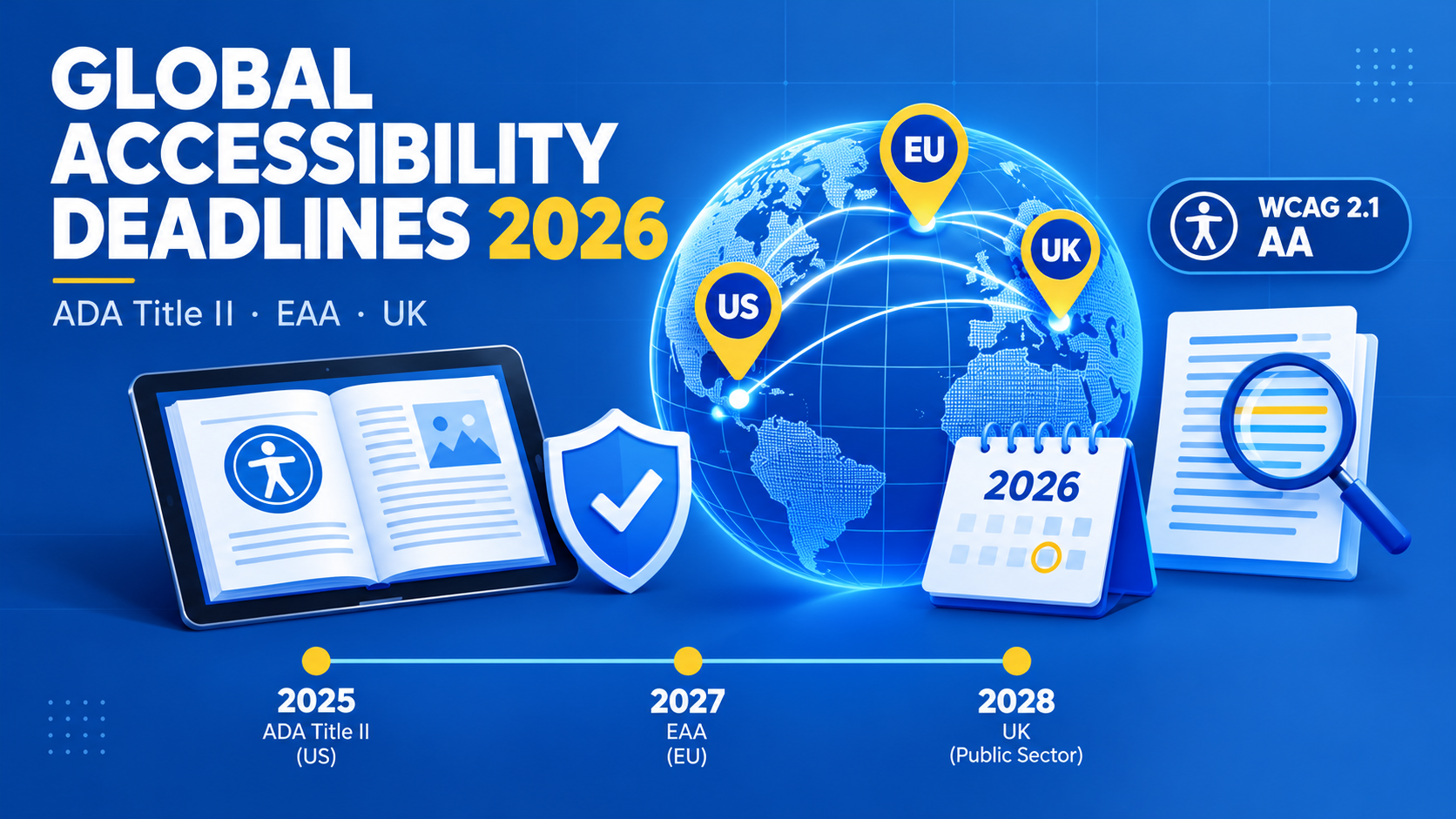
Three regimes now shape accessible publishing. The EU’s European Accessibility Act has applied since 28 June 2025 and covers e-books and e-reading software. The US ADA Title II web rule now takes effect on 26 April 2027 for larger public entities, after a one-year extension, and reaches publishers through public universities and libraries. The UK relies on the Equality Act 2010 and public sector regulations. All three point to the same practical baseline, WCAG 2.1 AA, so one accessible production standard can serve every market.
For a publisher selling across the Atlantic, 2026 brings three sets of rules, three sets of dates and three different enforcement styles. Treating them as separate projects multiplies cost. Treating them as one standard, built into end to end publishing services, is far cheaper and far safer.
This guide compares the three regimes, sets out the dates and penalties that matter, and shows how to build accessible files once and release them everywhere. It is a practical overview, not legal advice, and details were checked in October 2026.
Why 2026 Is the Year Accessibility Became Non-Negotiable Globally
The European Accessibility Act (EAA) became enforceable on 28 June 2025, and all 27 member states have now transposed it into national law. Enforcement is no longer theoretical: the first EAA lawsuits were reported in France in late 2025, and authorities in the Netherlands and Germany have signalled active auditing during 2026.
In the United States, the Department of Justice adopted a Title II rule in 2024 requiring state and local governments to meet WCAG 2.1 Level AA. On 20 April 2026 an Interim Final Rule moved the first compliance date by a year. The DOJ stated that the underlying obligations remain in force, so the extension changes the date, not the expectation.
The UK has no direct equivalent of the EAA, but the Equality Act 2010 applies to private and public organisations, and public sector bodies must meet accessibility regulations that universities and libraries then pass on to suppliers.
For publishers the pressure arrives through buyers as much as through law. Retailers, distributors, libraries and consortia increasingly ask for accessible files and accessibility metadata, and may reject content that lacks them.
EAA (EU) vs ADA Title II (US) vs UK Requirements Compared
Accessible publishing means producing books, journals and learning content so that people using screen readers, magnification, keyboard navigation or other assistive technology can read them with the same independence as other readers. In practice it combines semantic structure, text alternatives for images, logical reading order and machine-readable accessibility metadata.
| Criterion | EU: EAA | US: ADA Title II | UK |
|---|---|---|---|
| Main law | Directive (EU) 2019/882, enacted nationally | ADA Title II web and mobile rule (2024) | Equality Act 2010; Public Sector Bodies Accessibility Regulations 2018 |
| Who is covered | Products and services sold in the EU, including e-books and reading software, wherever the publisher is based | State and local governments, including public universities | Private and public providers (Equality Act); public sector bodies (regulations) |
| How publishers are affected | Directly, as suppliers of e-books | Indirectly, through public university and library procurement | Directly through reasonable adjustments; indirectly through public buyers |
| Technical benchmark | EN 301 549 (currently WCAG 2.1 AA) | WCAG 2.1 AA | WCAG AA for public sector bodies |
| Enforcement style | National market surveillance authorities | DOJ action and private lawsuits | Civil claims and regulator monitoring |
| Status in 2026 | In force since 28 June 2025 | Compliance dates extended to 2027 and 2028 | In force |
The common thread is WCAG 2.1 AA. EN 301 549 conformity gives a presumption of compliance with the EAA, the US rule adopts WCAG 2.1 AA directly, and UK public sector rules reference WCAG AA. A revised EN 301 549 incorporating WCAG 2.2 is in development, so building to the current baseline with headroom is sensible.
A Single Production Process That Satisfies All Three
Because the benchmarks overlap, a publisher does not need a US edition, an EU edition and a UK edition of each title. It needs one accessible master, produced consistently from the first stage. A complete service covering editorial, composition, conversion and delivery, such as end to end publishing services, makes that consistency easier because accessibility decisions are made once rather than patched at the end.
What the single accessible master includes:
- Clean semantic structure: real headings, lists, tables with header cells, and a logical reading order
- Text alternatives: meaningful alt text for figures, charts and equations, with long descriptions for complex images
- Accessible EPUB: files built to the EPUB Accessibility 1.1 standard, through EPUB conversion services that treat accessibility as a requirement rather than an add-on
- Accessible layout: typography, contrast and structure planned at the design stage, as in book formatting and layout design
- Tagged PDF: accessible PDF for libraries and institutional buyers
- Accessibility metadata: schema.org properties inside the EPUB package and matching ONIX metadata so retailers and libraries can see what each file supports
- Validation: automated checks, such as Ace by DAISY and EPUBCheck, followed by manual review, since automated tools cannot judge whether alt text is actually useful
Backlist deserves its own plan. Under the EAA, titles sold in the EU after the enforcement date are expected to conform, so a prioritised remediation list based on sales and market is more realistic than converting everything at once.
Compliance Timeline and Penalties by Region
| Region | Key dates | Penalties and consequences |
|---|---|---|
| EU / EAA | 28 June 2025: requirements apply. 2026: audits and first enforcement actions under way. Revised EN 301 549 expected to follow. | Set by each member state. Reported ranges run from tens of thousands of euros upward, and Ireland’s law reportedly allows fines up to €60,000 and imprisonment on indictment. Authorities can also order corrections or withdraw products. |
| US / ADA Title II | 26 April 2027: public entities serving 50,000 or more. 26 April 2028: smaller entities and special districts. | DOJ enforcement and private lawsuits, typically leading to remediation orders and legal costs. Vendors whose content fails procurement checks risk lost contracts. |
| UK | Equality Act duties apply now. Public sector accessibility regulations apply now, with annual monitoring of sampled sites. | Civil claims for failure to make reasonable adjustments, plus regulator action against public bodies. Public buyers may require accessible supply in tenders. |
The DOJ opened a comment period on the extension and has signalled it may revisit the technical standard. Dates and standards could shift again, so confirm the current position with legal counsel before committing to a deadline.
Penalties matter less than access. A file that screen-reader users cannot navigate is a failed product in every market, and the commercial risk of being delisted by a retailer or excluded by a library consortium usually exceeds the fine.
Building a One-Time, Multi-Market Accessible Model
The cheapest accessible title is one built accessible from the start. Retrofitting after delivery means reopening files, re-checking output and re-issuing metadata, and the cost is paid again for every format.
A practical sequence for publishers:
- Audit your active list and rank titles by sales, market and institutional demand
- Set one standard for all new titles: WCAG 2.1 AA with EPUB Accessibility 1.1 conformance
- Brief authors and editors on alt text, heading use and table structure before manuscripts arrive
- Build accessibility into copyediting, layout and conversion rather than adding a separate final check
- Add accessibility metadata and a published accessibility statement for each market
- Validate every file automatically, then sample manually for reading order and alt text quality
- Remediate backlist in priority order and document progress for buyers and auditors
Documented, sustained effort is also the best defence if a complaint arrives. Regulators and buyers respond better to a visible plan with dated milestones than to a claim of perfection.
Get a Global Accessibility Compliance Roadmap for Your List
Share your catalogue size, formats and target markets. We will map where your files stand against EU, US and UK expectations and what it would take to close the gaps.
Frequently Asked Questions
Does the European Accessibility Act apply to publishers outside the EU?
Yes, if you sell e-books or related services to customers in the EU. The Act applies to products and services placed on the EU market regardless of where the publisher is based, so US and UK publishers selling into Europe are in scope. Retailers and distributors also carry obligations and may ask suppliers for conforming files.
Was the ADA Title II deadline cancelled?
No. On 20 April 2026 the DOJ extended the compliance dates by one year, to 26 April 2027 for public entities serving 50,000 or more and 26 April 2028 for smaller ones. The WCAG 2.1 AA standard was not changed, and the DOJ confirmed that existing Title II obligations continue.
How does ADA Title II affect a commercial publisher?
Title II covers public bodies, not private publishers. The effect is indirect: public universities and libraries must make the digital materials they provide accessible, so they increasingly require accessible content from suppliers. Publishers that cannot supply conforming files may lose institutional sales.
What accessibility rules apply to UK publishers?
The Equality Act 2010 requires reasonable adjustments so disabled people are not placed at a substantial disadvantage, and public sector bodies must meet WCAG AA under the 2018 regulations. The UK has no direct copy of the EAA at the time of writing, but UK publishers selling in the EU must still meet it.
Is WCAG 2.1 AA enough for all three markets?
It is the common baseline today. EN 301 549 currently incorporates WCAG 2.1 AA, the US Title II rule adopts it, and UK public sector rules reference WCAG AA. A revised EN 301 549 incorporating WCAG 2.2 is expected, so many publishers build to 2.1 AA while following 2.2 practices where practical.
Do end to end publishing services cover accessibility?
They can, and that is the main advantage. When editorial, typesetting, EPUB conversion, PDF production and metadata are handled together, accessibility is specified once and checked at each stage. Ask any provider how they validate files, whether manual review is included and how accessibility metadata is delivered.
Where should a publisher start?
Start with an audit of your active list, ranked by sales and market exposure. Fix new titles first by adopting one standard, then remediate backlist in priority order. A roadmap with dated milestones gives buyers and regulators evidence of steady progress.
One Standard, Three Markets
The laws differ in wording, dates and enforcement, but the technical target is largely shared. Publishers who treat accessibility as a core production standard avoid paying for it three times over.
Talk to Our Accessible Publishing Team
Find out how accessible EPUB, tagged PDF and metadata can be built into your production from the first stage.