
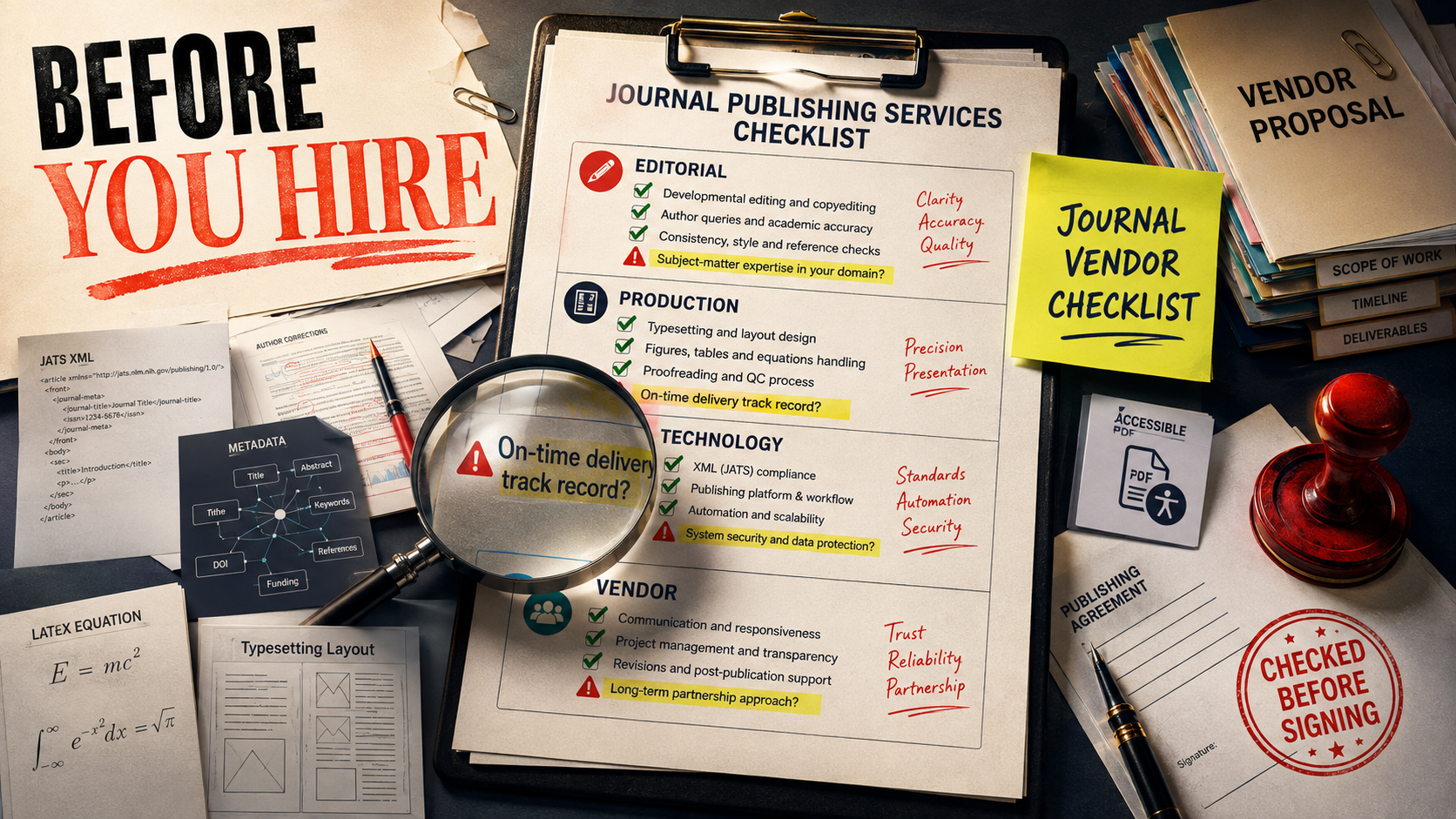
A journal publishing services checklist helps academic societies and publishers compare providers using the same editorial, production, technology, and service criteria. Before awarding a contract, confirm who controls peer-review decisions, how manuscripts move through production, which formats and metadata are delivered, how quality is measured, and whether the vendor can scale without weakening standards. The right checklist turns a broad sales proposal into evidence you can test.
Evaluate journal publishing services across four areas: editorial expertise, production control, publishing technology, and vendor governance. Require a representative pilot covering copyediting, complex typesetting, corrections, JATS XML, metadata, accessibility, and platform delivery. Compare responsibilities, acceptance criteria, exclusions, service levels, security, capacity, and quality reporting—not price or turnaround claims alone.
How to Use This Journal Publishing Services Checklist
Use the checklist to define mandatory, desirable, and out-of-scope requirements before requesting proposals. Ask every supplier to respond against the same content samples and delivery specification. Score both the output and the operating workflow, then validate shortlisted providers through a pilot that includes typical and technically difficult journal articles.
Start by mapping the production boundary. An academic society may retain submission management and peer review while outsourcing all post-acceptance production. Another publisher may require administrative support from submission through publication. A provider cannot quote or perform accurately if “journal publishing services” is not translated into specific responsibilities and outputs.
Define these requirements before contacting vendors
- Journal profile — disciplines, article types, languages, open-access model, annual volume, peak periods, and publication frequency
- Workflow boundary — submission administration, peer-review support, post-acceptance production, hosting, and post-publication updates
- Editorial scope — language polishing, copyediting level, technical editing, reference checks, proofreading, and author communication
- Content complexity — LaTeX, equations, MathML, chemical notation, multilingual text, figures, tables, code, and supplementary files
- Required outputs — JATS XML, semantic HTML, accessible PDF, EPUB, images, metadata deposits, and repository packages
- Systems — submission platform, content management system, journal hosting platform, DOI workflow, repositories, and file-transfer methods
- Quality criteria — editorial accuracy, correction accuracy, validators, accessibility checks, metadata completeness, and delivery requirements
- Commercial model — volumes, article bands, included rounds, out-of-scope work, urgency, setup, and change-control rules
| Requirement Level | Meaning | Procurement Use |
|---|---|---|
| Mandatory | The service, standard, output, or control is required for contract award | Treat failure as a disqualifier or documented exception requiring approval |
| Desirable | The capability adds value but is not essential at launch | Score it separately and assess whether it supports future plans |
| Optional | The service may be requested for selected articles, issues, or projects | Ask for unit pricing, lead time, and activation rules |
| Out of scope | Responsibility remains with the society, publisher, platform, author, or another supplier | Document the handoff and information each party must provide |
Editorial Services Checklist
The editorial checklist should confirm the editing level, subject expertise, journal-style application, reference treatment, language support, query process, integrity escalation, and proofreading responsibility. The provider must protect scientific meaning, record significant changes, and distinguish routine corrections from questions that require an author, editor, ethics team, or rights decision.
An academic or scientific publishing company needs more than general grammar correction. Scholarly editing operates within peer-review decisions, disciplinary terminology, reporting conventions, references, data statements, equations, tables, figures, and journal policy. The vendor should explain what its editors check—and what they do not claim to verify.
Editorial capability checklist
- Defined editing levels — language polishing, copyediting, technical editing, reference editing, and proofreading have separate specifications
- Discipline-aware allocation — medicine, mathematics, engineering, social science, humanities, and linguistics reach appropriately experienced editors
- House-style control — journal spelling, punctuation, terminology, abbreviations, headings, citations, tables, figures, and declarations are documented
- Meaning protection — editors query changes that could alter claims, methods, populations, results, limitations, or conclusions
- Reference scope — citation matching, style, identifiers, link checking, and source verification are explicitly included or excluded
- Author-query quality — queries identify the issue, preserve context, suggest a safe resolution where appropriate, and reach the correct owner
- Integrity escalation — conflicting data, missing declarations, authorship changes, image concerns, or suspected duplication follow publisher procedures
- Proofreading responsibility — the provider defines which proof stage is checked, against which source, and how corrections are verified
- Language support — native or qualified language expertise, multilingual content handling, and non-Latin script requirements are clear
- Editorial audit trail — edits, queries, author responses, exceptions, and final decisions remain traceable
| Editorial Service | Minimum Evidence to Request | Potential Red Flag |
|---|---|---|
| Language polishing | Tracked sample showing improved clarity without changed technical meaning | Heavy rewriting without queries or explanation |
| Scientific copyediting | Relevant editor profile, publisher-style sample, and query examples | The same generic process is applied to every discipline |
| Reference checking | Written scope covering matching, style, identifiers, links, and unresolved references | “References checked” is offered without defining the check |
| Proofreading | Marked proof, source-comparison method, and correction-verification procedure | Proofreading is treated as spell-checking alone |
| Integrity escalation | Responsibility matrix and examples of issues routed to the publisher | Vendor claims to make independent ethics or acceptance decisions |
Journal Production Checklist
The production checklist should cover accepted-manuscript intake, file preflight, typesetting, proof cycles, author corrections, XML, accessibility, metadata, issue or continuous publication, final validation, and live-article verification. It must identify the canonical source and show how every approved correction reaches all required print and digital outputs.
Production failures usually occur at handoffs. A missing figure is noticed after typesetting. An author correction reaches the PDF but not the XML. The metadata carries a different title from the article. A final file validates but uses the wrong journal profile. Strong journal publishing services control the relationships among files, people, and formats.
Production workflow checklist
- Accepted-manuscript preflight — confirm the authoritative version, source files, figures, tables, supplements, metadata, licences, and instructions
- Production schedule — define intake, copyedit, first proof, author review, correction, finalisation, delivery, and escalation milestones
- Article-type routing — research articles, reviews, editorials, corrections, data papers, protocols, and supplements receive the correct template and metadata
- Technical typesetting — control LaTeX, InDesign, equations, symbols, references, tables, figures, footnotes, and multilingual text
- Proof management — identify proof recipients, permitted changes, correction rounds, conflicting annotations, late changes, and approval authority
- Canonical source — specify whether XML, LaTeX, InDesign, or another controlled source governs downstream files
- Cross-format synchronisation — apply accepted corrections consistently to XML, HTML, PDF, EPUB, metadata, and supplements
- Continuous or issue publication — support article numbers, pagination, volume and issue assignment, table of contents, front matter, and special collections as required
- Accessibility production — include semantic structure, reading order, alt text workflow, table headers, language, navigation, and accessible equations
- Final package audit — verify file names, manifests, assets, identifiers, versions, validation reports, and destination requirements
- Post-publication check — inspect the live article, downloads, metadata, links, figures, supplements, and corrections process
| Production Area | Acceptance Evidence | Question for the Vendor |
|---|---|---|
| Preflight | Input checklist, asset inventory, and categorised query log | Which defects block production, and who receives each query type? |
| Typesetting | Representative first proof containing complex equations, tables, figures, and references | Which tools and specialists handle our most difficult content? |
| Corrections | Correction log and comparison of approved source, PDF, XML, and HTML | How are conflicting or substantive author changes escalated? |
| Accessibility | Automated validation plus documented manual review | Which checks occur at source, output, and reading-experience levels? |
| Delivery | Complete package, validation output, and platform-ingestion confirmation | Who owns resolution when technically valid files fail at the destination? |
Review Siliconchips Services’ professional typesetting services for books and journals, including LaTeX, InDesign, complex composition, and scalable production support.
Publishing Technology and Digital Delivery Checklist
The technology checklist should verify structured-content capability, metadata and identifier handling, platform integration, validation, accessibility, automation controls, security, and auditability. A modern vendor should support JATS XML, MathML, semantic HTML, accessible PDF, persistent identifiers, repository packages, and the publisher’s submission and hosting systems without creating disconnected versions.
Technology capability checklist
- JATS XML expertise — support the journal’s required schema, tag set, recipient profile, custom rules, and semantic quality checks
- MathML and technical content — preserve equations from LaTeX or source files and verify both structure and rendered meaning
- Semantic HTML — deliver responsive headings, tables, figures, links, references, language, landmarks, and accessible navigation
- Persistent identifiers — handle DOI, ORCID, ROR, ISSN, and related research identifiers consistently
- Contributor and relationship metadata — support CRediT roles, affiliations, funding, licences, data, corrections, supplements, and related objects
- Crossref and repository packages — prepare the required metadata or files and respond to validation and ingestion feedback
- Platform integration — work with the publisher’s submission, production, content management, hosting, and archive environments
- Validation stack — document XML, EPUB, HTML, link, accessibility, image, and package checks plus manual QA
- Automation governance — identify automated decisions, confidence thresholds, human review, exception routes, and change testing
- Secure transfer and access — define user permissions, encryption, retention, incident handling, and subcontractor controls
- Audit trail — retain versions, corrections, validation results, metadata changes, approvals, and delivery records
- Business continuity — document backup, recovery, alternate staffing, infrastructure resilience, and communication procedures
| Technology Component | Required Capability | Test During Pilot |
|---|---|---|
| JATS XML | Valid and semantically accurate full-text and metadata tagging | Journal profile, formulas, tables, references, contributors, licences, and relationships |
| HTML and accessibility | Responsive, navigable, screen-reader-compatible article presentation | Headings, reading order, MathML, tables, figures, alt text, links, and language |
| Metadata and identifiers | Consistent entity and relationship data across all destinations | DOI, ORCID, ROR, CRediT, funding, licence, corrections, and references |
| Integrations | Reliable transfer among submission, production, hosting, deposit, and archive systems | Authentication, field mapping, status updates, errors, retries, and audit logs |
| Automation | Repeatable processing with controlled exceptions and human oversight | Unexpected structures, poor source files, confidence failures, and rollback procedures |
Siliconchips Services’ digital publishing solutions connect XML, typesetting, EPUB, accessible PDF, metadata, validation, and multi-format delivery for academic, STM, book, and open-access programmes.
Journal Publishing Vendor Checklist
The vendor checklist should assess relevant experience, team structure, workflow transparency, quality management, communication, scalability, security, continuity, commercial clarity, and improvement capability. Select a partner that demonstrates its claims with representative work, named specialists, measurable acceptance criteria, and a realistic implementation plan—not a generic presentation or idealised sample.
The strongest supplier is not automatically the largest or cheapest. An academic society may value specialist journal knowledge, access to senior contacts, and flexibility. A high-volume publisher may prioritise automation, capacity, platform integrations, and reporting. The evaluation criteria should reflect the journal’s actual operational risks.
Vendor due-diligence checklist
- Relevant journal experience — evidence from similar disciplines, article complexity, publication models, platforms, and volumes
- Named operating team — account lead, project manager, editorial lead, production lead, XML specialist, accessibility owner, and escalation contact
- Transparent workflow — process map, responsibility matrix, quality gates, queries, approvals, and delivery records
- Quality management — error definitions, sampling, correction verification, root-cause analysis, preventive action, and reporting
- Scalable capacity — trained backup resources, peak planning, publisher-specific onboarding, and knowledge retention
- Communication model — status reporting, meetings, response priorities, escalation times, and decision documentation
- Security and confidentiality — access controls, transfer methods, retention, incidents, subcontractors, and staff responsibilities
- Implementation method — discovery, specification, sample production, pilot, acceptance, migration, training, and phased launch
- Commercial transparency — included services, assumptions, article bands, setup, rounds, rush work, corrections, and change requests
- Continuous improvement — regular quality reviews, trend analysis, automation opportunities, updated templates, and lessons learned
- References and evidence — relevant client references, complete sample packages, validation reports, and live workflow examples
| Provider Type | Potential Strength | Due-Diligence Question |
|---|---|---|
| Specialist journal production partner | Focused editorial, typesetting, XML, metadata, and platform knowledge | Can the team scale to our peak volume and support all required outputs? |
| Large publishing services group | Broad capacity, technology, geographic coverage, and service portfolio | Will our journals receive stable named teams and responsive senior attention? |
| Technology-led platform provider | Integrated systems, automation, workflow visibility, and rapid digital delivery | How are complex editorial, typesetting, and exception cases handled by people? |
| Multiple specialist vendors | Ability to select a separate expert for each production function | Who owns handoffs, canonical content, correction synchronisation, and final package QA? |
| Hybrid in-house and outsourced model | Publisher retains strategic control while adding specialist capacity | Are responsibilities, systems, data, approvals, and escalation boundaries documented? |
How to Score and Shortlist Journal Publishing Providers
Score vendors using weighted criteria tied to publication risk. Rate written responses, sample quality, pilot performance, operating-team capability, technology, and commercial clarity separately. Require mandatory items to pass regardless of total score, and record assumptions or exceptions. The final decision should combine measurable results with confidence in day-to-day collaboration.
| Suggested Score | Meaning | Decision Guidance |
|---|---|---|
| 0 — Not demonstrated | No relevant evidence, unclear response, or requirement not supported | Fail a mandatory requirement or request a formal exception |
| 1 — Partially demonstrated | Capability appears possible but evidence, coverage, or control is incomplete | Clarify gap, cost, implementation need, owner, and risk |
| 2 — Fully demonstrated | Requirement is supported by relevant evidence and a credible operating process | Accept subject to contract, pilot results, and references |
| 3 — Exceeds requirement | Provider adds proven value beyond the stated need without introducing unnecessary complexity | Score the additional value only if it supports publishing goals |
Do not let a strong presentation compensate for weak samples, and do not let one excellent sample compensate for an unclear operating model. Pilot both normal and difficult articles, then review correction handling, communication, validation evidence, and final packages—not only visual page quality.
Need a production assessment or representative pilot?
Siliconchips Services can review your journal specifications, article types, editorial scope, LaTeX and typesetting requirements, XML, metadata, accessibility, platforms, volume, and quality criteria before preparing a tailored workflow and quotation.
Frequently Asked Questions About Journal Publishing Services
Academic societies and publishers commonly ask which journal services to outsource, what to include in an RFP, how to compare quality, and which digital capabilities are essential. The answers below clarify scope, pilot design, JATS XML, accessibility, pricing comparisons, service levels, and evidence required before appointing a production partner.
What should a journal publishing services checklist include?
It should include editorial scope, manuscript intake, copyediting, technical typesetting, proofs, author corrections, XML, HTML, accessible PDF, metadata, identifiers, repositories, platform integration, validation, security, communication, capacity, quality reporting, service levels, implementation, pricing assumptions, and continuity. Each requirement should be marked mandatory, desirable, optional, or out of scope.
What journal publishing services can an academic society outsource?
An academic society can outsource submission administration, post-acceptance intake, copyediting, technical editing, reference checks, LaTeX or InDesign typesetting, proofreading, author proof management, JATS XML, metadata, accessibility, issue compilation, platform delivery, and post-publication corrections. Editorial policy, peer-review decisions, ethics oversight, and release authority should remain clearly governed by the society or publisher.
How should publishers test a journal production vendor?
Use a paid or agreed pilot containing representative and difficult articles. Include equations, tables, figures, references, multilingual text, supplementary files, author corrections, XML, metadata, accessibility, and platform delivery where relevant. Assess first-proof quality, queries, schedules, correction accuracy, cross-format consistency, validation reports, communication, and how the vendor handles unexpected or ambiguous content.
Is JATS XML essential for journal publishing services?
JATS XML is highly valuable for structured journal publishing, online display, repositories, archiving, metadata transformation, accessibility, and content reuse. Whether it is mandatory depends on the journal’s platforms and distribution requirements. If required, assess semantic tagging and recipient-specific rules as well as schema validity; technically valid XML can still represent content incorrectly.
What accessibility capabilities should a journal vendor provide?
The vendor should support semantic source structure, accessible HTML, tagged PDF where required, heading hierarchy, reading order, table headers, descriptive alt text workflows, accessible equations, language declaration, navigation, links, and accessibility metadata. Quality assurance should combine automated validation with manual review because technical conformance alone does not prove a usable reading experience.
How can publishers compare journal production prices fairly?
Compare prices only after aligning scope, article complexity, volumes, proof rounds, XML, metadata, accessibility, platform delivery, setup, urgent work, author changes, and exclusions. One provider may quote composition alone while another includes copyediting, proof management, validation, and final delivery. Use representative article bands and request rates for predictable out-of-scope scenarios.
Which service levels matter for journal publishing?
Useful service levels cover stage turnaround, on-time delivery, query response, correction accuracy, XML and package acceptance, metadata completeness, platform issue response, escalation, incident handling, and reporting. Define how each measure is calculated, which delays are excluded, what evidence is retained, and what corrective action follows repeated failure rather than relying on a single headline turnaround.
What is the difference between an academic publishing company and a production vendor?
An academic publishing company may own journals, set policy, manage peer review, make acceptance decisions, and publish the version of record. A production vendor provides editorial, typesetting, XML, metadata, accessibility, or platform services under that company’s authority. Some organisations perform both roles, so responsibilities and editorial independence should be documented explicitly.
What makes STEM publishing services different?
STEM publishing services require reliable handling of equations, scientific symbols, units, code, references, data-rich tables, technical figures, specialist terminology, LaTeX, MathML, and structured XML. Quality checks must protect scientific meaning across source files, proofs, HTML, XML, PDF, and metadata. Staff allocation should reflect the discipline and complexity rather than treating every manuscript identically.
Choose Evidence, Workflow Fit, and Quality Control
A journal publishing services checklist converts general vendor claims into requirements that academic societies and publishers can verify. Define scope, test difficult content, inspect the complete workflow, and compare evidence across editorial, production, technology, and governance. The best partner is the one that reliably supports your standards, systems, schedule, and future publishing plans.
A visually attractive proof is important, but it is only one part of the decision. Reliable journal production also requires accurate editing, controlled corrections, valid structured content, accessible outputs, complete metadata, platform readiness, transparent communication, and capacity that remains stable during peak periods.
Siliconchips Services combines UK-based management, UK and US editorial expertise, and scalable production delivery in India. Its teams support copyediting, proofreading, LaTeX and InDesign typesetting, JATS XML, metadata, accessibility, eBook conversion, and multi-format delivery for academic societies, scientific publishers, STM journals, and open-access programmes.
Compare your requirements with a tailored publishing workflow
Share your journal specifications, sample manuscripts, annual volume, current bottlenecks, required formats, and platform needs with Siliconchips Services. Our team can prepare a representative production approach and quotation.