
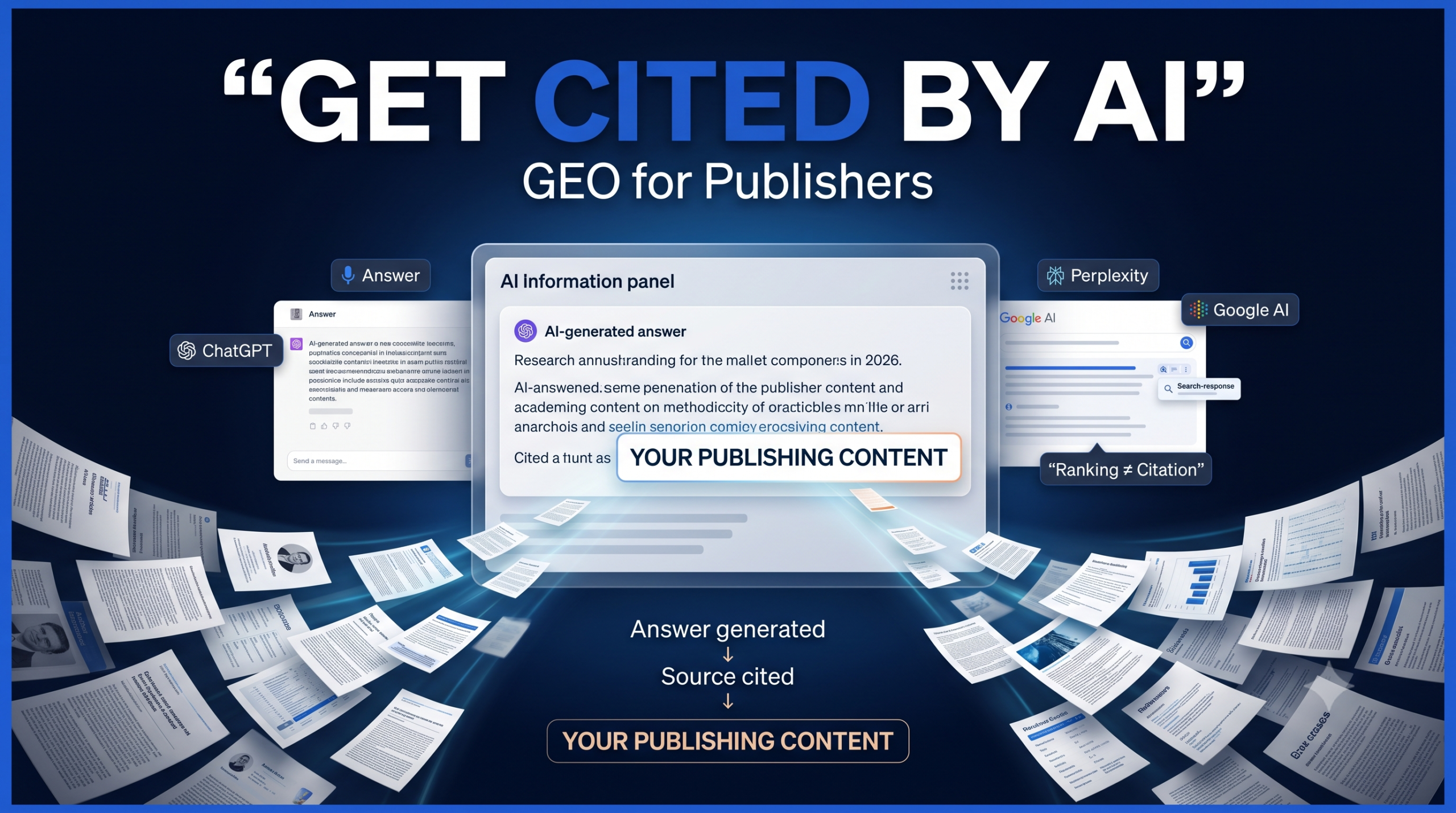
AI answer engines now sit between publishers and their readers. ChatGPT reached roughly 800 million weekly active users in early 2026, Google shows AI Overviews on a fifth of search results pages, and Perplexity has become a default research tool. When these systems answer a question, they cite a handful of sources — and everyone else is invisible.
That is why publisher SEO services now extend beyond rankings into generative engine optimization (GEO). This guide explains how to get cited by ChatGPT and its rival engines, why Google rankings no longer guarantee AI citations, and how to structure publisher content for LLM citation in 2026.
What GEO Means for Scholarly and Trade Publishers
Direct answer: For scholarly and trade publishers, generative engine optimization (GEO) means formatting and presenting content so ChatGPT, Perplexity, Gemini and Google AI Overviews can retrieve, trust and cite it. It extends traditional SEO: the same journalism and scholarship, restructured so AI engines can extract answers and attribute the source.
The term comes from Princeton-led research showing that specific content tactics — citations, statistics, quotations and clean structure — could raise an entity’s visibility in generative responses by up to 40%. In the GEO vs SEO vs AEO 2026 conversation, each discipline now has a distinct job:
SEO vs AEO vs GEO in 2026
| Discipline | Goal | Where it wins | What it rewards |
|---|---|---|---|
| SEO | Rank in organic results | Google, Bing SERPs | Technical health, relevance, backlinks |
| AEO | Be the chosen answer | Featured snippets, AI Overviews, voice | Question-led structure, FAQ schema |
| GEO | Be cited in generated answers | ChatGPT, Perplexity, Gemini, Claude | Extractable facts, entity trust, third-party validation |
For scholarly publishers, GEO overlaps with what good research communication already does: abstracts, structured findings and referenced claims map naturally onto AI extraction. Trade publishers face a different task — front-list marketing pages, author pages and backlist title pages must be rebuilt as answerable, attributable content rather than brochure copy. Neither can rely on rankings alone, which is the subject of the next section.
Why Google Rankings No Longer Guarantee AI Citations
Direct answer: No. In mid-2025, roughly three-quarters of pages cited in Google AI Overviews also ranked in the top ten organic results; by early 2026, Ahrefs put that overlap nearer 38% and BrightEdge lower still. Generative engines draw on training data, retrieval indexes and third-party validation, so a first-place ranking alone no longer guarantees citation.
The citation gap between engines is even wider than the gap between ranking and citation. A March 2026 analysis of 680 million AI citations found only 11% domain overlap between ChatGPT and Perplexity; a separate five-engine study found nearly 80% of websites cited for a question appear on a single engine, and full agreement across all five is a rounding error. Visibility on one platform tells you almost nothing about the others.
Three forces explain the decoupling. First, each engine has distinct source preferences — ChatGPT leans on Wikipedia and established editorial brands, Perplexity favours community and real-time sources, Gemini cites vendor domains more generously. Second, models weigh third-party validation heavily: editorial reviews earned 22.3% of citation slots in one 2026 cross-engine study, more than any single site type. Third, retrieval results are volatile — the same prompt can return different citations on repeat runs, which is why SeoClarity’s 432,000-keyword analysis found AI Overviews almost always include at least one top-20 organic result, but rarely the same ones twice. SEO remains the foundation; GEO decides who gets named.
Structuring Content for AI Extraction (Answer-First, Tables, Schema)
Direct answer: AI engines favour content that can be lifted cleanly: a 40–60 word answer immediately under each question heading, dense comparison tables, statistics with named sources and dates, and schema that removes ambiguity about who wrote and published the work. Structure pages so any section survives being read out of context.
AI Overviews content structure follows a simple rule: answer first, evidence second. Open each section with a self-contained summary a model can quote verbatim, then support it. Concretely:
- Question-shaped headings. Match the way readers actually ask (“How do publishers get cited by ChatGPT?”), then answer in the first sentence.
- Statistics with provenance. “Perplexity’s median answer cited 6.4 sources in May 2026, up from 4.9 a year earlier” is extractable; “many sources are cited” is not.
- Tables over prose for comparisons. Structured, fact-dense passages are easier for retrieval systems to parse and for readers to verify.
- Fresh dates and bylines. Generative engines favour current, attributable content; undated evergreen pages underperform.
On schema markup for AI visibility, honesty matters: Google states no special schema is required for AI Overviews or AI Mode. Schema still earns its place by removing ambiguity — Article, ScholarlyArticle, Book, Person and Organization markup that matches visible page content helps engines confirm who published a claim, when, and under what expertise. Producing this structure at scale across a catalogue is exactly where end-to-end digital publishing services and publishing process automation pay for themselves: structure is applied once, at source, and flows to every output.
Entity Authority and E-E-A-T for Publishers
Direct answer: Generative engines cite entities they can verify. Publishers hold the strongest E-E-A-T assets in search: named authors with ORCID iDs, DOIs, editorial review, and decades of cited scholarship. Connecting those identifiers across your site, schema and third-party records turns institutional authority into machine-readable proof that AI systems reward with citations.
Publisher content for LLM citation succeeds when the publisher, its authors and its publications exist as consistent, verifiable entities everywhere AI systems look. That means identical name, affiliation and biography data on your site, in Wikipedia and Wikidata where eligible, in Crossref and ORCID records, and in Organization and Person schema. It also means designing publisher content for LLM citation as primary evidence: original data, expert quotation and dated analysis that AI engines must attribute to someone. If your brand is absent from the sources engines already trust — encyclopedic, editorial and community platforms — your own pages will struggle regardless of on-page quality.
Measuring AI Citation Share
Direct answer: AI citation share is the percentage of tracked prompts in your subject area where your content is cited by ChatGPT, Perplexity, Gemini or AI Overviews. Measure it by running a fixed prompt set across engines weekly, logging citations per engine and competitor, and validating results across multiple runs — single checks mislead because citations vary.
Treat AI citations like a share-of-voice metric, not a ranking report. A practical 2026 measurement stack: a fixed panel of 50–200 representative reader questions; weekly runs across at least four engines; citation logging by domain, including competitors; AI referral traffic segmented in GA4; and multi-run averaging to absorb volatility. Two benchmark figures help calibrate expectations — median citations per generated answer rose from 2.7 to 3.4 across engines between May 2025 and May 2026, so more citation slots are opening, while a 34,234-response study found a 46× spread in brand citation rates between platforms (0.59% on ChatGPT versus 13.05% on Perplexity). Per-platform measurement is the only honest way to see that gap — and it is why modern publisher SEO services now report AI citation share alongside organic positions.
Frequently Asked Questions About GEO for Publishers
How do publishers get cited by ChatGPT?
Publishers get cited by ChatGPT by publishing extractable, attributable content: answer-first sections under question headings, original statistics with named sources, dated and bylined pages, and consistent entity records across their site, schema and trusted third-party platforms. Because ChatGPT leans on encyclopedic and editorial sources, coverage in those ecosystems — combined with crawlable, well-structured pages — materially improves citation odds.
What is the difference between SEO, AEO and GEO in 2026?
SEO ranks pages in organic results; AEO structures content to be selected as the answer in snippets, voice assistants and AI Overviews; GEO optimises content to be cited inside generated answers on ChatGPT, Perplexity, Gemini and Claude. They overlap — technical SEO and entity clarity underpin all three — but each has distinct outputs and metrics: positions, answer appearances and AI citation share.
Do publishers need special schema markup for AI visibility?
No special schema exists for AI Overviews or AI Mode — Google has said so explicitly. Standard, accurate Article, ScholarlyArticle, Book, Person and Organization markup remains valuable because it confirms authorship, dates and institutional identity, which helps generative engines attribute and trust your content. Schema supports AI visibility; it does not guarantee citation.
Does ranking first in Google guarantee an AI citation?
No. The overlap between top-ten organic rankings and AI Overview citations fell from roughly three-quarters of cited pages in mid-2025 to around 38% by early 2026 by Ahrefs’ measure, and lower still in BrightEdge’s. Rankings remain a strong foundation, but citation also depends on structure, entity trust and third-party validation.
How is AI citation share measured?
Run a fixed panel of representative prompts weekly across ChatGPT, Perplexity, Gemini and Google, log every cited domain including competitors, average results across multiple runs to absorb volatility, and segment AI referral traffic in analytics. Track your share of citations per engine rather than a single “AI ranking,” because platforms cite different sources up to 89% of the time.
How long does GEO take to work for publisher content?
Retrieval-based citations can move within weeks of restructuring pages, because engines index fresh content continuously. Training-corpus effects take longer, since models update on their own cycles. Most publishers see meaningful citation-share movement within one to two quarters of consistent answer-first publishing, entity cleanup and third-party validation.
Request a GEO/AEO Visibility Audit
Which engines cite your catalog today — and which cite your competitors instead? Our GEO/AEO visibility audit runs your subject-area prompts across ChatGPT, Perplexity, Gemini and Google AI Overviews, benchmarks your citation share, and returns a prioritised plan: content structure, schema, and entity fixes. Request a GEO/AEO visibility audit and find out where you stand.