
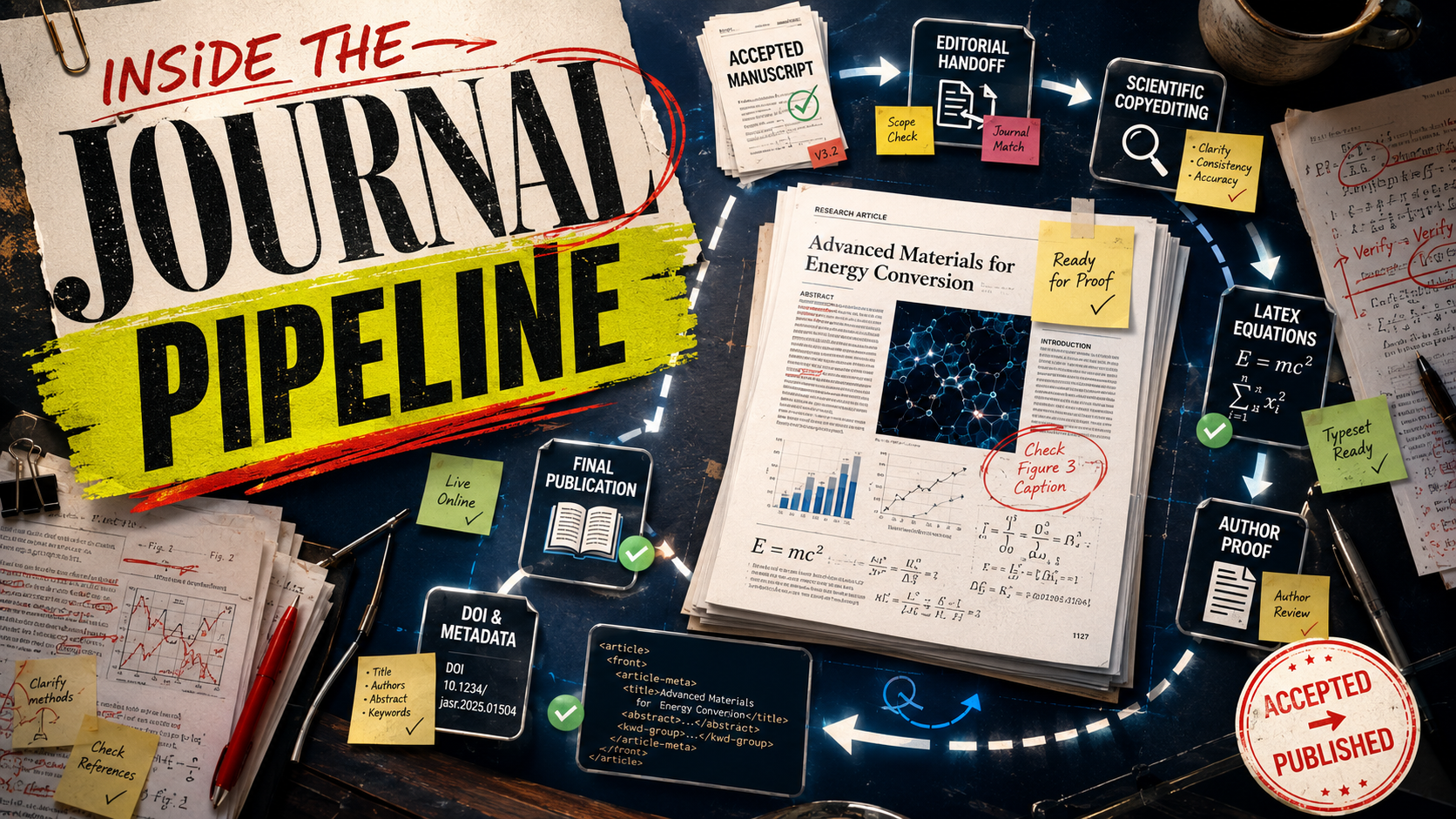
A scientific publishing company manages journal production by converting an accepted manuscript into accurate, discoverable, accessible, and platform-ready content. The workflow connects editorial handoff, technical preflight, copyediting, LaTeX or XML composition, proof review, author corrections, JATS XML, metadata, and final quality assurance. Clear ownership at every stage prevents version conflicts, preserves scientific meaning, and keeps articles moving towards publication.
Scientific journal production normally follows seven controlled stages: accepted-manuscript handoff, file and metadata preflight, copyediting, typesetting or XML composition, proof and correction management, multi-format generation, and final platform delivery. Publishers retain peer-review and acceptance authority, while production specialists apply journal standards and validate each article’s text, structure, identifiers, and outputs.
What Does a Scientific Publishing Company Manage?
A scientific publishing company or production partner coordinates the people, files, rules, technology, and quality checks needed to publish research reliably. Its scope may include submission administration, post-acceptance production, copyediting, technical typesetting, author proofs, XML and metadata, accessibility, platform packages, issue assembly, and publication support for journals and scholarly societies.
Not every scientific publishing company has the same role. A commercial or society publisher may own journals, establish editorial policy, appoint editors, and control publication decisions. A specialist service provider may operate the post-acceptance workflow on the publisher’s behalf. Some programmes use a hybrid model in which in-house teams manage submissions and peer review while an external partner handles production.
The workflow must therefore begin with responsibility mapping. The agreement should state who approves manuscripts, resolves ethics concerns, answers author queries, applies corrections, registers or deposits metadata, uploads files, and authorises publication. Technology cannot compensate for unclear ownership.
| Workflow Stage | Main Production Activity | Primary Deliverable |
|---|---|---|
| Accepted-manuscript handoff | Transfer the approved files, decisions, metadata, licences, and production instructions | Controlled production package |
| Preflight | Check completeness, article type, artwork, tables, equations, references, permissions, and identifiers | Validated input or documented queries |
| Copyediting | Apply journal style, improve clarity, review consistency, and raise technical or editorial queries | Edited manuscript |
| Composition | Create structured content and format equations, figures, tables, citations, and article metadata | First PDF or online proof |
| Proof management | Collect author and editor corrections, maintain version control, and resolve queries | Approved final proof |
| XML and digital outputs | Generate JATS XML, HTML, accessible PDF, metadata, images, and supplementary packages | Validated multi-format files |
| Release | Run final QA, deliver to the journal platform, and verify the publication record | Publication-ready article or issue |
Specialist academic publishing services connect these stages through one specification, query process, production schedule, and quality framework for journals, STM publishers, scholarly societies, and open-access programmes.
Submission to Production: Preparing the Accepted Manuscript
The submission-to-production stage creates a complete and authoritative package from the accepted manuscript. Production staff verify the approved version, source files, contributor metadata, figures, tables, supplementary content, licences, permissions, and editorial instructions. Any conflict is queried before editing or typesetting so later proofs are not built from incomplete or outdated material.
Scientific manuscripts often arrive from submission systems such as ScholarOne, Editorial Manager, Open Journal Systems, or Janeway. The production team may receive a Word manuscript, LaTeX source, bibliographic files, separate figures, data supplements, reporting checklists, licence information, and reviewer-approved changes. These files must be reconciled into one controlled version.
Preflight is not a new round of peer review. It identifies production risks: a missing figure, an unreferenced table, a corrupted equation, inconsistent author names, incomplete affiliations, unclear supplementary-file labels, or differences between the accepted PDF and editable source. Questions involving scientific validity or editorial policy return to the journal.
Accepted-manuscript preflight checklist
- Authoritative manuscript — confirm the exact accepted version and record any editorial changes still required
- Source completeness — inventory Word, LaTeX, bibliography, equation, figure, table, data, video, and supplementary files
- Contributor metadata — check names, affiliations, corresponding author, ORCID iDs, and contributor roles where provided
- Article metadata — verify title, abstract, keywords, article type, dates, funding, data statements, and related identifiers
- Rights and access — confirm the supplied licence, copyright, permissions, open-access status, and third-party material
- Technical integrity — open all assets, compare callouts and captions, inspect equations, and flag missing fonts or packages
- Journal requirements — apply the correct style, template, reference system, XML profile, accessibility rules, and platform specification
- Query ownership — route production, editorial, author, permission, and integrity questions to named decision-makers
| Input Problem | Risk If Missed | Production Response |
|---|---|---|
| Accepted PDF and source differ | Rejected changes or outdated content enters production | Compare versions and request editorial confirmation of the authoritative text |
| Figure or table is missing | Incomplete proof, incorrect numbering, and delayed author review | Raise a blocking query before composition |
| Author metadata is inconsistent | Incorrect attribution, indexing, DOI metadata, or correspondence details | Reconcile manuscript and system metadata through the journal |
| LaTeX dependency fails | Equations, citations, fonts, or document structure render incorrectly | Inspect logs, packages, macros, bibliography, and source assets |
| Licence or permission is unclear | The article may be released with incorrect rights information | Hold affected content and escalate to the publisher’s rights owner |
Peer-Review Handoff: Where Editorial Control Meets Production
The peer-review handoff transfers an editorially accepted manuscript into production without transferring editorial authority. It should include the final decision, approved files, reviewer-driven changes, declarations, permissions, and unresolved instructions. Production teams may coordinate and query the package, but scientific acceptance, ethics decisions, and substantive changes remain with the journal’s editors.
This boundary protects both speed and integrity. If production assumes every issue is settled, unresolved reviewer requests may be lost. If production reopens scholarly decisions independently, responsibility becomes unclear. The handoff needs a defined exception route for contradictory files, missing declarations, suspected duplication, questionable images, data inconsistencies, or author changes after acceptance.
| Decision or Task | Editorial / Journal Owner | Production Team |
|---|---|---|
| Accept or reject the manuscript | Owns the decision and communicates its conditions | Does not make the acceptance decision |
| Confirm reviewer changes | Determines whether required revisions are complete | Checks that the approved version and instructions are present |
| Apply journal style | Defines policy, house style, and exceptions | Applies the specification and raises ambiguity |
| Resolve substantive scientific queries | Consults editors, reviewers, or authors as required | Identifies the issue and records the response |
| Manage technical corrections | Approves changes that may alter meaning | Implements approved corrections across every output |
| Authorise publication | Provides final release authority | Completes QA and delivers the approved package |
Information the handoff should preserve
- Decision history — final outcome, conditions of acceptance, editor notes, and any production-relevant reviewer request
- Version history — accepted manuscript, tracked revisions, supplements, and the relationship between source files
- Contributor declarations — authorship, competing interests, funding, data availability, acknowledgements, and ethics information as supplied
- Policy exceptions — approved deviations from style, length, figure, data, licence, or article-type requirements
- Post-acceptance change rules — who can approve author changes, added contributors, new data, altered conclusions, or withdrawn material
Copyediting Scientific and STM Journal Articles
Scientific copyediting improves clarity, consistency, and journal compliance while protecting the evidence and author’s intended meaning. Editors review language, terminology, abbreviations, units, references, tables, figures, and technical presentation. They correct defined errors, query genuine ambiguity, and escalate substantive or integrity-related concerns instead of silently rewriting scientific claims.
Copyediting is the point where language and production structure begin to converge. Headings, lists, citations, figure callouts, table notes, equations, and metadata must be consistent before composition. A well-edited manuscript produces cleaner proofs and more reliable XML; an unresolved inconsistency can spread into PDF, HTML, metadata, and repository files.
Scientific editors work within a stated level of service. Language polishing may focus on grammar and readability. Full copyediting adds house style, consistency, reference treatment, and presentation rules. Technical editing may include deeper checks of notation, terminology, units, equations, and discipline-specific conventions. None of these replaces peer review or validates the research conclusions.
| Copyediting Area | Editorial Check | When to Query |
|---|---|---|
| Language and meaning | Grammar, syntax, clarity, parallel structure, and unambiguous expression | A correction could change the claim, emphasis, population, method, or result |
| Terminology and abbreviations | Preferred terms, definitions, capitalisation, spelling, and consistent abbreviations | Terms conflict or a replacement may alter disciplinary meaning |
| Numbers, units, and statistics | Journal style, unit presentation, decimal consistency, symbols, and internal agreement | Values conflict among text, table, figure, abstract, or supplement |
| Figures and tables | Numbering, callouts, captions, legends, notes, labels, and order | An element is missing, duplicated, unreadable, or inconsistent with the narrative |
| Citations and references | Citation-reference matching, order, style, completeness, and identifiers where supplied | A citation has no reference, details conflict, or a source cannot be resolved under the agreed scope |
| Declarations | Presence and presentation of funding, conflicts, data, ethics, consent, and author contributions | Required information is absent, contradictory, or outside the production team’s authority |
What protects scientific meaning during copyediting?
- Discipline-aware allocation — route mathematics, medicine, engineering, chemistry, linguistics, and other specialist content appropriately
- Defined intervention levels — distinguish direct corrections from author queries and editorial escalations
- Visible changes — preserve a reviewable record of edits, responses, and approved exceptions
- Source comparison — check equations, figures, tables, and technical symbols against the accepted material
- Publisher-specific style — maintain journal rules for terminology, references, units, declarations, and article structure
- Human accountability — use automated checks to support, not silently replace, editorial judgement
Typesetting and Proof Management for Scientific Journals
Scientific typesetting converts edited content into an accurate journal proof and structured digital article. LaTeX, InDesign, or XML-based composition may be used according to content and workflow. Proof management then collects editor and author corrections, controls versions, prevents unapproved rewriting, and synchronises every accepted change across final formats.
Composition must preserve both presentation and structure. Mathematical formulas, chemical symbols, multi-level tables, graphs, figure labels, footnotes, references, and supplementary links should remain accurate while following the journal template. The proof must also contain complete article metadata and a logical hierarchy that can support HTML, XML, and accessibility.
| Composition Route | Suitable Content | Production Control |
|---|---|---|
| LaTeX | Mathematics, physics, computer science, engineering, and equation-heavy articles | Manage macros, packages, fonts, bibliography, cross-references, equations, and conversion rules |
| Adobe InDesign | Design-led journals, humanities, social sciences, image-rich and complex page layouts | Maintain styles, placement, artwork, typography, output settings, and structured handoffs |
| XML-first composition | High-volume, continuous-publication, multi-format, and platform-led programmes | Validate JATS, transformations, MathML, templates, metadata, and exception handling |
| Hybrid production | Mixed source types, legacy titles, specialist layouts, or phased workflow migration | Define the canonical source and reconcile corrections across systems |
Proof correction is a controlled stage, not an opportunity to restart manuscript development. The journal should define acceptable author changes, who approves substantive alterations, how late corrections are charged or scheduled, and which source becomes authoritative. Production staff should flag changes to title, authorship, data, conclusions, figures, or declarations for editorial review.
Siliconchips Services provides scientific journal typesetting services using LaTeX, InDesign, XML-based workflows, and specialist quality control for equations, tables, figures, references, and technical symbols.
XML, Metadata, and Indexing Preparation
XML and metadata make a scientific article understandable to publishing platforms, repositories, citation systems, libraries, and discovery tools. Production teams structure content in JATS XML, connect persistent identifiers, prepare required deposits, and validate delivery packages. They support discoverability and indexing readiness, but cannot guarantee acceptance by selective databases or search services.
XML quality depends on more than passing a schema validator. An article can be technically valid while using weak structure, incomplete metadata, incorrect references, or publisher-inappropriate tagging. Production teams must apply the journal’s JATS profile, recipient requirements, identifier rules, and transformation logic.
Metadata connects the article to the scholarly record. DOI identifies the work; ORCID distinguishes researchers; ROR identifies institutions; CRediT can describe contributor roles. Funding, licence, data, correction, and reference relationships should remain consistent across JATS, the article page, PDF, Crossref deposit, repository package, and journal platform.
| Entity or Output | Production Purpose | Quality Check |
|---|---|---|
| JATS XML | Represent full text and article metadata for transformation, exchange, repositories, and archives | Schema, journal profile, hierarchy, tables, references, formulas, links, and completeness |
| DOI and Crossref metadata | Register and connect the article’s persistent scholarly record | Title, contributors, dates, resource URL, references, licences, funding, and relationships |
| ORCID, ROR, and CRediT | Disambiguate people and organisations and describe contribution roles | Identifier validity, correct entity mapping, supplied roles, and cross-output consistency |
| Repository package | Deliver eligible content and assets to an archive or subject repository | Recipient specification, file names, assets, XML profile, supplementary content, and ingestion feedback |
| Semantic HTML | Provide responsive, accessible, linkable, and discoverable online reading | Headings, landmarks, tables, links, MathML, alt text, language, and visible metadata |
| Accessible PDF | Support downloadable reading with semantic tags and assistive technology | Reading order, headings, figures, alt text, tables, links, language, and document metadata |
Indexing-readiness checklist
- Consistent article identity — title, journal, article type, DOI, dates, volume, issue, pagination or article number agree
- Complete contributor records — names, affiliations, corresponding author, ORCID iDs, and roles are mapped correctly
- Reliable reference links — citations match references and available identifiers are associated with the right sources
- Structured abstracts and keywords — sections, labels, subjects, and language are encoded according to the recipient profile
- Clear rights and access metadata — copyright, licence, open-access status, and permissions match the visible publication
- Valid relationships — corrections, retractions, supplements, datasets, preprints, reviews, and related articles use accurate relation types
- Recipient validation — test each package against the destination’s rules and review ingestion feedback rather than assuming delivery succeeded
Professional digital publishing solutions connect JATS XML, semantic HTML, accessible PDF, MathML, metadata, eBook conversion, and platform validation so approved content remains consistent across every destination.
Final Quality Control and Journal Release
Final quality control confirms that the approved scientific content, metadata, and files are complete and synchronised before release. It combines visual proofreading, source comparison, XML and link validation, accessibility checks, file-package auditing, and platform verification. Publication should occur only after blocking errors are resolved and the authorised owner approves release.
The final gate should assess the whole publication package. A flawless PDF does not compensate for incorrect DOI metadata. Valid XML does not compensate for a missing figure. An accessible HTML article does not compensate for an unapproved author change. Quality is the agreement among content, structure, presentation, metadata, and delivery.
Pre-publication release checklist
- Approved content — all author and editor corrections are resolved, recorded, and applied to the canonical source
- Scientific elements — equations, symbols, figures, tables, units, references, and supplementary links match approved material
- Cross-format consistency — PDF, HTML, XML, metadata, images, and supplements represent the same article version
- Identifier accuracy — DOI, ORCID, ROR, ISSN, article number, dates, and relationships are correctly associated
- Technical validation — XML, HTML, links, files, images, and destination packages meet the required specifications
- Accessibility review — headings, reading order, tables, figures, alt text, language, navigation, and document metadata are checked
- Release authority — the journal’s authorised editor or publishing owner gives final approval
- Post-publication verification — inspect the live article, metadata, downloads, citations, links, and supplementary content
After release, the workflow must support corrections and updates without overwriting history. Changes to a version of record should follow journal policy and propagate to the visible article, metadata, XML, PDF, Crossref record, and related systems as appropriate.
How to Evaluate a Journal Production Partner
Evaluate a journal production partner using representative manuscripts, defined acceptance criteria, and evidence from the complete workflow. Assess editorial skill, scientific typesetting, XML and metadata, accessibility, platform integration, quality reporting, communication, security, and peak capacity. The provider should explain exception handling and correction control, not only quote turnaround and price.
| Evaluation Area | Question for the Provider | Evidence to Review |
|---|---|---|
| Workflow integration | Can you work with our submission system, journal platform, files, and approval model? | Process map, responsibility matrix, handoff rules, and pilot plan |
| Scientific editorial support | How are editors allocated and substantive concerns escalated? | Sample edit, query examples, editor profiles, and quality criteria |
| Technical production | Can you handle our most complex equations, tables, figures, symbols, and templates? | Representative proof, source files, correction results, and technical QA |
| XML and discovery | Which JATS profiles, metadata deposits, identifiers, and platform packages are supported? | Validated XML, metadata output, transformation sample, and ingestion feedback |
| Quality and scalability | How do standards remain stable during volume peaks? | Capacity plan, quality report, root-cause process, and trained backup model |
| Communication | Who owns daily delivery, urgent escalation, and improvement activity? | Named contacts, status reports, meeting cadence, and escalation service levels |
Need a more reliable scientific journal production workflow?
Siliconchips Services can review your peer-review handoff, copyediting, typesetting, proofing, JATS XML, metadata, accessibility, platform delivery, and publication volumes before proposing a workflow around your journal standards.
Frequently Asked Questions About Scientific Journal Production
Journal publishers most often ask where production begins, how the peer-review handoff works, which copyediting and typesetting skills are required, and how XML supports discovery. The answers below define the responsibilities, files, controls, and outputs involved when a scientific publishing company manages an STM journal production workflow.
How does a scientific publishing company manage journal production?
It establishes a controlled workflow from the accepted manuscript to publication. Typical stages include editorial handoff, preflight, copyediting, technical typesetting, proof management, author corrections, JATS XML, metadata, accessibility, final QA, and platform delivery. The company coordinates files and specialists while following the journal’s style, policies, acceptance authority, schedule, and quality criteria.
Does journal production begin before or after peer review?
Full production normally begins after editorial acceptance, although submission administration, technical checks, or early XML preparation may start sooner in some workflows. The handoff must identify the accepted version and unresolved instructions. Production does not replace peer review: decisions about validity, significance, acceptance, ethics, or substantive revision remain with the journal’s editors and reviewers.
What files should be included in the peer-review handoff?
The package should contain the accepted manuscript, editable source, figures, tables, bibliography, equations, supplements, contributor metadata, declarations, licence information, permissions, editorial instructions, and relevant decision history. The exact contents depend on the journal. Production should compare the accepted reference version with the source and query any missing, conflicting, damaged, or outdated files.
What does scientific copyediting include?
Scientific copyediting can cover language, journal style, terminology, abbreviations, units, numbers, references, citations, tables, figures, equations, cross-references, and required declarations. Editors correct clear errors, query ambiguity, and escalate substantive concerns. The defined scope should state whether reference verification, technical editing, language polishing, or research-integrity screening is included rather than assumed.
Why do STM journals use LaTeX?
LaTeX provides precise and repeatable composition for equations, mathematical notation, bibliographies, cross-references, and structured technical documents. It is especially useful in mathematics, physics, engineering, and computer science. Production specialists still need to manage macros, packages, fonts, source errors, journal templates, accessibility, and conversion to XML, MathML, HTML, or PDF.
How does JATS XML help journal indexing?
JATS XML identifies article content and metadata in a machine-readable structure, including contributors, abstracts, sections, citations, formulas, funding, and licences. It supports platform ingestion, repositories, archiving, HTML generation, and metadata transformation. It improves indexing readiness, but selective databases maintain their own inclusion criteria, so technically valid XML does not guarantee acceptance or coverage.
What metadata should a scientific article include?
Core metadata includes title, abstract, article type, contributors, affiliations, corresponding author, dates, journal identity, DOI, licence, funding, references, and subject terms. Where available, ORCID identifies researchers, ROR identifies organisations, and CRediT describes contributor roles. Data, correction, supplement, and preprint relationships should also be encoded accurately when relevant.
How are author corrections controlled during proofing?
The journal defines permitted changes, proof rounds, deadlines, and approval authority. Production records each correction, resolves contradictory annotations, flags substantive changes, and applies approved updates to the canonical source. Final comparison checks confirm that the same content appears in PDF, XML, HTML, metadata, and supplementary files without introducing new errors or version drift.
What should publishers look for in journal publishing services?
Look for discipline-aware copyediting, complex LaTeX or InDesign typesetting, JATS and MathML capability, metadata expertise, accessibility, platform integration, transparent quality reporting, secure file handling, scalable capacity, and clear communication. Test the provider with representative difficult content and agree responsibilities, acceptance criteria, correction rules, validators, outputs, and escalation routes before scaling.
A Controlled Workflow Protects Scientific Content and Publication Speed
Scientific journal production succeeds when editorial authority, production responsibility, files, metadata, and quality gates are clearly connected. A specialist partner can manage copyediting, typesetting, proofs, XML, accessibility, and delivery at scale, but the workflow must preserve the accepted record, route substantive decisions correctly, and keep every output synchronised.
The strongest journal workflow is not simply the fastest route from acceptance to PDF. It is a controlled system that protects scientific meaning, gives authors and editors clear review points, creates reusable structured content, and delivers accurate publication records to readers and platforms.
Siliconchips Services combines UK-based management, UK and US editorial expertise, and scalable production delivery in India. Its teams support copyediting, proofreading, LaTeX and InDesign composition, JATS XML, metadata, accessibility, eBook conversion, and multi-format delivery for academic, scientific, technical, medical, and open-access publishers.
Strengthen your journal production workflow
Discuss your submission systems, editorial handoff, article types, technical content, production volume, XML, metadata, accessibility, and platform requirements with Siliconchips Services.