
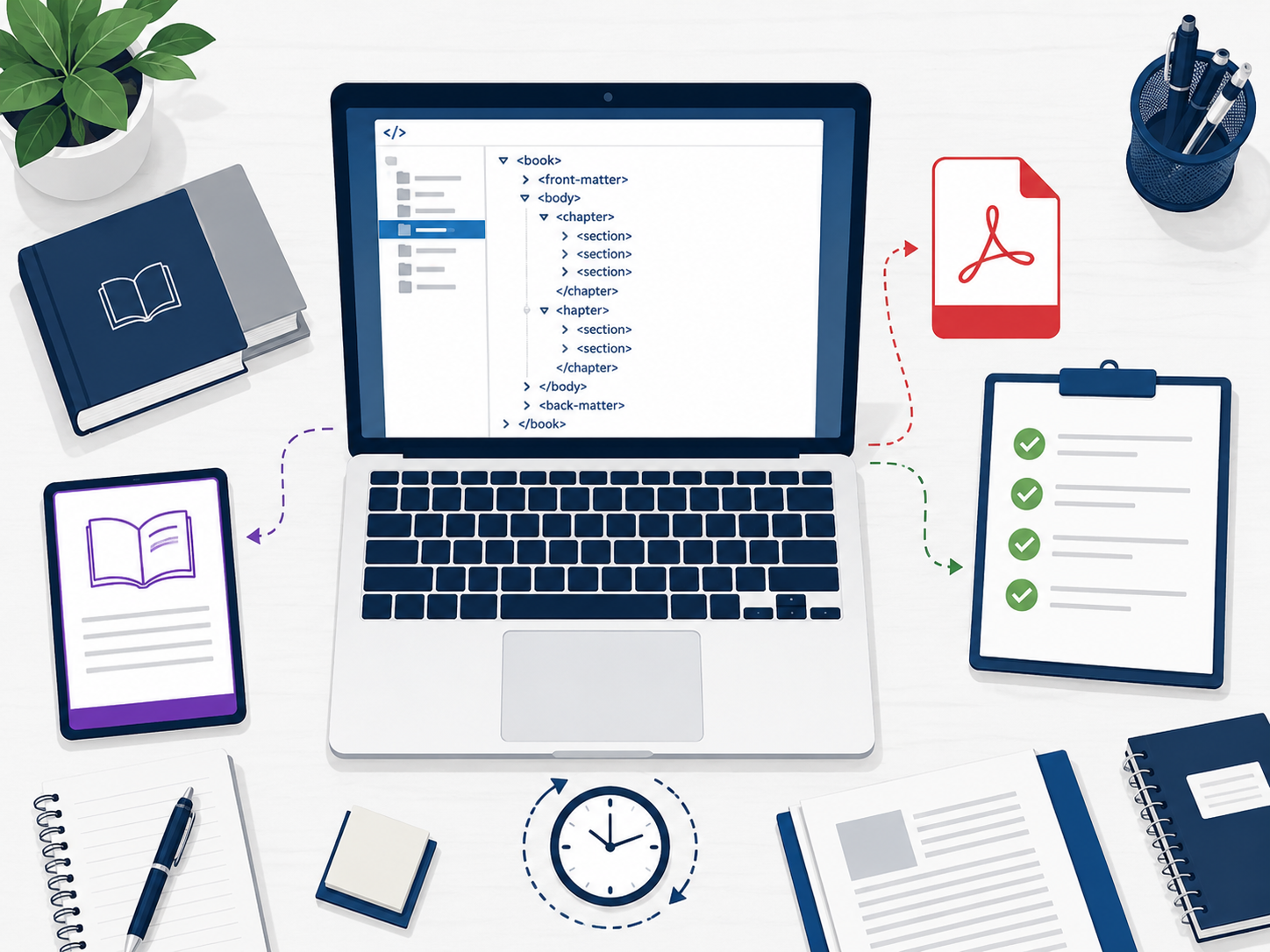
Digital publishing services are the technical and editorial workflows that convert manuscripts, print files, or raw content into structured digital formats — EPUB 3, JATS XML, accessible PDF, HTML5 — ready for indexing, distribution, and multi-device consumption. In 2026, the baseline for what these services must deliver has shifted significantly: XML-first workflows are now standard in academic publishing, the European Accessibility Act is enforceable across EU markets, and AI is reshaping both production workflows and how digital content is discovered by readers. Publishers who last reviewed their production partnerships two or three years ago are likely operating against a standard that has already moved.
This guide covers what digital publishing services include, how modern production workflows operate, what the 2026 standards require, and the specific capabilities global publishers should expect from any production partner they commission.
Digital publishing services in 2026 encompass the full production pipeline from structured manuscript intake through to validated, multi-format digital output — EPUB 3, JATS XML, accessible PDF, and HTML5 delivered simultaneously from a single XML source. The defining standard in 2026 is XML-first production, WCAG 2.1 / EPUB Accessibility 1.1 compliance, and simultaneous multi-format delivery. Publishers using PDF-first or sequential format workflows are operating against an outdated production model.
What Are Digital Publishing Services?
The distinction between a file conversion and a digital publishing service matters commercially. A PDF exported from Word and renamed as an “ebook” is technically a digital file. It is not a digital publishing deliverable. A properly produced EPUB 3 file encodes the book’s structural hierarchy in semantic HTML5, includes accessibility metadata conforming to EPUB Accessibility 1.1, passes EPUBCheck 5.x validation with zero errors, and renders correctly on Kindle Paperwhite, Apple Books, and Google Play Books simultaneously. Those are different products — and the difference determines whether content appears on retail platforms, passes library system ingestion checks, and reaches readers with disabilities.
Professional digital publishing services cover the full spectrum from editorial preparation through to validated final output, including:
- Manuscript analysis and source file preparation — reviewing Word, LaTeX, or InDesign source files; identifying complex elements (mathematics, tables, chemical structures, figures) before production begins.
- Content structuring and semantic tagging — applying a logical hierarchy to headings, paragraphs, lists, figures, tables, and metadata so that all outputs inherit consistent structure from a single source.
- XML-first production — creating JATS XML (for journals) or BITS XML (for books) as the primary production file, from which all other formats are generated simultaneously.
- Typesetting and layout — professional composition in Adobe InDesign or LaTeX for print-quality PDF output, maintaining underlying digital structure throughout.
- Multi-format conversion and export — simultaneous generation of EPUB 3, accessible PDF, JATS/BITS XML, and HTML5 from the XML source in a single production cycle.
- Validation and device testing — files checked against official validators (EPUBCheck, JATS schema, WCAG) and tested on physical devices before delivery.
Modern Production Workflows in 2026: What Has Changed and Why It Matters
The production workflow standard in academic and STM digital publishing has shifted materially since 2023. XML-first, component-based workflows are now standard across the sector — not advanced practice. Publishers still receiving PDF-first production with XML as an afterthought are receiving a 2022-model service from their vendor, regardless of what the contract says.
Three structural changes in the publishing environment since 2023 have redefined what a production workflow must deliver.
1. Open Access Volume Growth Has Accelerated Production Pressure
Just over 50% of published academic articles are now open access globally. Funder mandates from UKRI, the NIH, and Horizon Europe require machine-readable, accessible outputs as a condition of publication — not as an optional enhancement. This means JATS XML and EPUB 3 are now compliance requirements for a majority of article output, not differentiators. Production workflows that cannot deliver both formats in a single cycle are creating a structural bottleneck at a point of growing volume.
2. Accessibility Is Now a Legal Requirement in the EU
The European Accessibility Act (EAA), enforceable from June 2025, requires that digital publications sold in EU markets meet accessibility standards. For publishers, this means EPUB 3 files must carry EPUB Accessibility 1.1 metadata, PDFs must be tagged and pass PAC 2024 validation, and all images must have descriptive alt text — not empty attributes or filenames. Publishers who have not audited their digital output for EAA compliance are at active regulatory risk in their largest institutional markets.
3. AI Discovery Has Changed What “Structured Content” Means
With Google AI Mode now serving 1 billion monthly active users and AI Overviews appearing in nearly half of all search queries, the semantic structure of digital content directly affects whether that content is cited and surfaced by AI systems. Content that is correctly structured — with semantic headings, entity-rich metadata, and clearly defined relationships between elements — is significantly more likely to be extracted and cited in AI-generated answers than content that exists only as a visual layout in a PDF. This is an entirely new dimension of discoverability that was not relevant to production decisions three years ago.
| Production Standard | 2022–2023 Expectation | 2026 Requirement | Risk if Not Met |
|---|---|---|---|
| XML production | XML delivered post-typesetting on request | XML-first: JATS/BITS created before typesetting; all formats generated from XML | Post-typesetting rework costs; sequential format delays; schema errors at indexing submission |
| EPUB format | EPUB 2 acceptable on most platforms | EPUB 3 required by Amazon KDP, Apple Books, Google Play Books; EPUB 2 fails platform validation | Platform rejection; inaccessible content; EAA non-compliance in EU markets |
| Accessibility | Best-effort accessibility tagging | EPUB Accessibility 1.1 + WCAG 2.1 AA mandatory; EAA enforceable in EU from June 2025 | EU regulatory risk; library platform rejection; exclusion of readers with disabilities |
| Multi-format delivery | Sequential: PDF first, then EPUB, then XML | Simultaneous: all formats from single XML source in one production cycle | 2–4 additional days per title; format inconsistencies; higher per-title production cost |
| AI discoverability | Not a production concern | Semantic structure, entity-rich metadata, and correct heading hierarchy directly affect AI citation frequency | Reduced visibility in AI Overview citations; content buried 1,674px below AI-dominated fold |
XML-First Publishing: The Standard, Not the Exception
Industry data from 2026 is clear on adoption: XML-first, component-based workflows are now standard across academic publishing, enabling content reuse for print, HTML, and EPUB without duplication. Publishers operating PDF-first pipelines — where typesetting happens first and XML is generated as a derivative output — are in the minority, and they are paying for it in rework costs and format inconsistencies.
Why PDF-First Is the Wrong Starting Point
In a PDF-first workflow, a manuscript is typeset into a print layout first. XML is then generated by parsing the typeset file — a process that frequently introduces structural errors, because typeset layouts prioritise visual appearance over semantic hierarchy. Mathematical notation becomes images rather than MathML. Heading levels get inferred incorrectly from font size rather than encoded from manuscript structure. Author affiliations are tagged as plain text rather than structured elements. Each of these errors requires manual correction after XML generation — which means rework, additional time, and the possibility that schema errors reach indexing platform submission before they are caught.
What XML-First Produces That PDF-First Cannot
- Schema-valid JATS XML at first delivery — because the XML is the source, not a derivative, structural decisions are made correctly once rather than corrected repeatedly after typesetting.
- Simultaneous multi-format output — PDF, EPUB 3, HTML5, and XML all generated from the same source in a single production cycle, with guaranteed content consistency across all formats.
- MathML encoding for mathematical and scientific content — in an XML-first workflow, mathematical notation is encoded in MathML at source, not converted to images. MathML is searchable, accessible to screen readers, and correctly rendered by modern EPUB readers and web browsers.
- Correct accessibility metadata from the start — EPUB Accessibility 1.1 metadata is written into the XML source and inherited by the EPUB output. It is not added as a final step, where it is more likely to be incomplete or incorrectly attributed.
- Reusable content components — structured XML content can be repurposed across multiple output channels — print monograph, digital edition, open access repository, eLearning module — without re-editing the source content.
Siliconchips Services operates an XML-first production architecture as standard across its academic publishing services, meaning JATS XML for journals and BITS XML for books are primary production files — not post-typesetting conversions. Schema validation reports are provided alongside every delivery as standard, not available on request.
Still receiving PDF-first production with XML as an afterthought?
Our team can assess your current workflow against 2026 production standards — and show you the specific rework costs and format inconsistencies a PDF-first model is generating for your titles.
Talk to a Production Specialist
View Digital Publishing Services
Multi-Format Delivery: What Publishers Should Receive in 2026
A professional digital publishing services engagement in 2026 should deliver all required output formats simultaneously — not sequentially. Sequential format delivery (PDF approved first, then EPUB conversion, then XML generation) adds 2–4 days per title compared to parallel delivery from an XML-first source. Publishers who are waiting for each format to complete before the next begins are absorbing a production cost that XML-first architecture eliminates.
The output formats required from a modern digital publishing engagement depend on content type and distribution channel. The table below maps each format to its purpose, the validator it must pass, and the platform or database that requires it.
| Output Format | Purpose | Validator | Required By |
|---|---|---|---|
| JATS XML | Academic journal indexing and full-text database submission | JATS 1.2 schema; CrossRef, PubMed submission validation | PubMed, CrossRef, DOAJ, Scopus, Web of Science |
| BITS XML | Book-level XML for institutional libraries and aggregator databases | BITS 2.0 schema | ProQuest Ebook Central, EBSCO eBook Collection, library aggregators |
| EPUB 3 (reflowable) | Retail ebook distribution; text-heavy books and journals | EPUBCheck 5.x; EPUB Accessibility 1.1 | Amazon KDP, Apple Books, Google Play Books, Kobo |
| EPUB 3 (fixed-layout) | Illustrated, art, children’s, and design-intensive titles | EPUBCheck 5.x; device rendering on iOS and Kindle Fire | Apple Books, Amazon KDP (Fixed Layout) |
| Accessible PDF | Print-fidelity document; journal articles; formal reports | PAC 2024 (PDF Accessibility Checker); Adobe Acrobat Accessibility Checker | Publisher websites, institutional repositories, open access platforms |
| HTML5 | Web hosting; online reading platforms; AI discoverability | W3C HTML validator; WCAG 2.1 AA | Publisher websites, IngentaConnect, online reading rooms, open access repositories |
What a Complete Digital Publishing Delivery Package Looks Like
A complete digital publishing services delivery for an academic journal issue or book title in 2026 should include the following as standard — not as optional extras or on-request items.
- JATS XML (journals) or BITS XML (books) — schema-validated, with conformance report included.
- Print PDF — typeset-quality, with correct colour profiles and printer marks where required.
- Accessible PDF — tagged, reading-order defined, language declared, all images with alt text, PAC 2024 pass report included.
- EPUB 3 — EPUBCheck 5.x validated with zero errors; EPUB Accessibility 1.1 metadata present; tested on Kindle, Apple Books, and desktop reader.
- HTML5 — semantically structured, WCAG 2.1 AA compliant, responsive layout.
- CrossRef deposit XML (journals) — DOI registration metadata formatted and ready for submission.
- All validation reports provided alongside deliverables — not as separate requests.
Accessibility Standards Every Publisher Must Meet in 2026
The European Accessibility Act (EAA) became enforceable in June 2025, making accessibility requirements a legal matter for publishers selling digital content in EU markets — not a best-practice aspiration. Publishers who have not audited their digital output against EAA requirements are at active regulatory and commercial risk. Library platform rejection, retailer validation failures, and institutional procurement exclusions are all potential downstream consequences of non-compliant digital files.
The Three Accessibility Standards That Apply in 2026
WCAG 2.1 Level AA — the Web Content Accessibility Guidelines at Level AA are the baseline accessibility standard for all web-delivered and HTML-based digital content. They cover text alternatives for images, keyboard navigation, colour contrast ratios, and adaptable content presentation. WCAG 2.1 AA is referenced by the EAA and by most institutional procurement policies as the minimum standard for digital content.
EPUB Accessibility 1.1 — the EPUB Accessibility specification defines how ebooks must be structured and described to be accessible to readers using screen readers and other assistive technologies. It requires specific accessibility metadata in the content.opf file, descriptive alt text on all images, logical reading order, and MathML encoding for mathematical content. Compliance is verified through EPUBCheck and additional accessibility checkers such as Ace by DAISY.
European Accessibility Act (EAA) — enforceable from June 2025, the EAA requires that digital publications, ereaders, and related services sold in EU member states meet accessibility requirements aligned with WCAG 2.1 and EN 301 549. Publishers based outside the EU who sell to EU libraries, institutions, or individual readers are within scope. Non-compliance carries regulatory penalties and may result in sales being blocked in EU markets.
Common Accessibility Failures in Digital Publishing Files
- Empty or filename-based alt text on images. Alt attributes set to empty strings or file paths (“figure1.png”) fail WCAG 2.1 AA and EPUB Accessibility 1.1. Every image in an ebook or accessible PDF requires a descriptive alt text that conveys the meaning and content of the figure to a reader who cannot see it.
- Equations rendered as images rather than MathML. Mathematical notation converted to images is inaccessible to screen readers and unsearchable by indexing systems. MathML encoding is required for STM content in any format claiming WCAG or EPUB Accessibility compliance.
- Untagged PDF structure. PDFs that are not tagged — meaning they have no underlying reading order or element hierarchy — fail PAC 2024 validation and are not accessible to screen readers. Tagged PDF is not the same as a visually correct PDF.
- Missing EPUB Accessibility 1.1 metadata. An EPUB 3 file without the required
schema:accessMode,schema:accessibilityFeature, andschema:accessibilitySummarymetadata blocks will fail EPUB Accessibility 1.1 compliance checks run by library platform ingestion systems. - Colour contrast below WCAG 4.5:1 ratio. Body text against background colour must meet a minimum contrast ratio of 4.5:1 under WCAG 2.1 AA. Design choices that fail this threshold — commonly light grey text on white, or navy text on dark blue — must be corrected before accessibility compliance can be claimed.
How AI Is Changing Digital Publishing Workflows in 2026
AI is influencing digital publishing at three distinct levels in 2026: production workflow automation (manuscript triage, reference validation, automated accessibility tagging), reader-facing features (text-to-speech, AI translation, adaptive reading modes), and content discoverability (structured content is more likely to be cited in AI-generated answers than unstructured PDF content). The dominant theme at the London Book Fair 2026 was not AI content generation — it was compliance, responsible use, and the distinction between AI for production efficiency and AI for editorial decision-making.
AI in Production Workflows: Where It Is Being Used
Manuscript triage and reference checking. Several academic publishers now use AI for initial manuscript screening — checking reference formatting, identifying missing ORCID identifiers, flagging potential compliance issues before peer review. This is where AI adoption is most mature: well-defined tasks with clear acceptance criteria, applied to structured data. It does not replace editorial judgment; it removes administrative overhead from the steps before editorial judgment is applied.
AI-assisted accessibility tagging. Integrated with XML-first workflows, AI-powered alt-text generation is being used to create initial accessibility metadata for figures at production speed — with human review at the QA stage. This is particularly relevant for backlist digitisation projects where hundreds of legacy titles require accessibility remediation. AI generates a first draft of alt text from figure content; a specialist editor reviews and corrects it. The combination is significantly faster than manual alt-text writing without sacrificing accuracy.
Workflow automation and routing. AI-assisted workflow systems can now manage proof routing, escalate technical queries to named specialists, and trigger stage transitions automatically — reducing the inter-stage idle time that is the primary source of production delays. This is the practical, unglamorous AI application that is generating measurable return in production operations: not AI writing content, but AI removing the coordination overhead between production steps.
Where AI Is Not Replacing Human Expertise
At the London Book Fair 2026, the clearest consensus among academic and STM publishers was that AI for content generation requires fundamentally different treatment from AI for production efficiency. Academic publishing rests on author credibility, peer review integrity, and verifiable citation. AI-generated or AI-substantially-revised content raises questions in all three areas that the industry has not yet resolved. Publishers who have moved aggressively to AI content generation in trade and consumer markets are operating under different constraints than those managing scholarly journals where the credibility of the published record is the core product.
For production workflows — typesetting, XML tagging, accessibility checking, proof routing — AI assistance is being adopted broadly and without the same scrutiny. The distinction matters for publishers setting internal AI policy: the risk profile is entirely different depending on whether AI is managing a proof delivery timeline or contributing to the intellectual content of a published article.
What to Expect from a Digital Publishing Services Partner in 2026
In 2026, any digital publishing services partner who cannot confirm all six of the following is operating against an outdated production model: (1) XML-first pipeline; (2) in-house LaTeX capability for STM content; (3) validation reports as standard deliverables; (4) simultaneous multi-format output; (5) EPUB Accessibility 1.1 and WCAG 2.1 AA compliance built into the workflow; (6) named account manager in the publisher’s time zone. These are not differentiators — they are the baseline.
Six Capabilities That Distinguish a 2026-Ready Partner
1. XML-first production architecture. JATS XML for journals and BITS XML for books must be created as primary production files — not generated by parsing finished PDFs. Ask specifically: “Is your pipeline XML-first, or is XML a post-typesetting conversion?” The answer determines whether you receive schema-valid XML at first delivery or spend time managing rework cycles.
2. In-house LaTeX capability. STM content — mathematics, chemistry, physics, engineering — requires specialist LaTeX operators for correct rendering of complex notation. This is not a standard capability at general digital publishing vendors. A vendor who subcontracts LaTeX work introduces a quality inconsistency and an additional communication layer at precisely the stage where technical precision is most critical.
3. Validation reports as standard deliverables. EPUBCheck 5.x reports, JATS schema conformance reports, and PAC 2024 accessibility reports should be provided alongside finished files — not available on request. Validation reports are the evidence that compliance has been verified, not asserted.
4. Simultaneous multi-format output. PDF, EPUB 3, XML, and HTML5 should be delivered in a single production cycle from the XML source. Sequential format delivery adds days per title and risks format inconsistencies when content decisions are made independently in each format conversion step.
5. Accessibility compliance built in, not bolted on. EPUB Accessibility 1.1 metadata, WCAG 2.1 AA compliance, MathML encoding, and tagged PDF should be integral to the production workflow — not an accessibility remediation step applied to finished files. Remediation is significantly more expensive and less reliable than compliance built into the source.
6. Account management in your time zone. A delivery centre operating in a different time zone without a management layer in the publisher’s time zone creates a structural communication delay. For journals with tight issue schedules and books with retailer submission deadlines, a correction or query that cannot be escalated in real time is a production risk. UK-based account management backed by a scalable delivery centre in India — the model operated by Siliconchips Services — addresses this directly.
For publishers reviewing their current production arrangements against the full range of available publishing production services, the complete service scope at Siliconchips Services covers every stage from manuscript editorial through to multi-format digital delivery and accessibility validation.
Questions to Ask Before Commissioning a Digital Publishing Partner
- Is your production pipeline XML-first — or is XML generated after typesetting is complete?
- Do you have in-house LaTeX operators for STM and mathematical content?
- Do you provide EPUBCheck, JATS schema, and PAC 2024 validation reports as standard deliverables alongside every file?
- Do you deliver PDF, EPUB 3, XML, and HTML5 simultaneously in a single production cycle?
- Is EPUB Accessibility 1.1 and WCAG 2.1 AA compliance part of your standard workflow — or an add-on service?
- Who is our named account manager, and are they based in our time zone?
- Can you handle volume surges — special issues, backlist digitisation programmes — without slowing your standard queue?
- What is your documented SLA for standard title production, and can you provide compliance evidence for the past 12 months?
Frequently Asked Questions: Digital Publishing Services
What are digital publishing services?
Digital publishing services are the technical and editorial processes that convert manuscripts, print layouts, or legacy content into structured digital formats — EPUB 3, JATS XML, accessible PDF, HTML5 — ready for electronic distribution, platform indexing, and multi-device consumption. Professional digital publishing services go beyond format conversion: they ensure content is semantically structured, accessibility-compliant, and validated against the schemas required by the platforms and databases where it will be distributed.
What is XML-first publishing and why does it matter in 2026?
XML-first publishing is a production workflow in which structured XML — JATS for journals or BITS for books — is created as the primary source file, with all other formats (PDF, EPUB, HTML) generated from it simultaneously. It matters in 2026 because XML-first workflows are now standard across academic publishing, enabling content reuse across formats without duplication. Publishers still using PDF-first pipelines face rework costs when XML errors are discovered post-typesetting, sequential format delays, and format inconsistencies that XML-first architecture eliminates structurally.
What is the difference between EPUB 2 and EPUB 3?
EPUB 2 supports basic reflowable text but lacks native support for MathML, audio/video, interactive features, and the accessibility metadata required by WCAG 2.1 and the European Accessibility Act. EPUB 3 — the current W3C standard — supports all of these, plus semantic HTML5, CSS3 layout, SVG graphics, and EPUB Accessibility 1.1 compliance. All major distribution platforms including Amazon KDP, Apple Books, and Google Play Books require EPUB 3. EPUB 2 submissions fail platform validation on these channels.
What accessibility standards apply to digital publishing in 2026?
Three standards apply to most digital publishing output in 2026. WCAG 2.1 Level AA is the baseline for web-based and HTML content. EPUB Accessibility 1.1 covers ebooks distributed through retail and library platforms. The European Accessibility Act (EAA), enforceable from June 2025, requires digital publications sold in EU markets to meet accessibility requirements — including tagged PDFs, accessible EPUB 3, and descriptive alt text for all images. Publishers selling into EU markets who have not audited for EAA compliance are at active regulatory risk.
What should a global publisher look for in a digital publishing services partner in 2026?
In 2026, the minimum requirements are: an XML-first production pipeline; in-house LaTeX capability for STM content; validation reports (EPUBCheck, JATS schema, PAC 2024) provided as standard deliverables; simultaneous multi-format output in a single production cycle; accessibility compliance built into the workflow rather than added at the end; and a named account manager in the publisher’s time zone. Vendors who cannot confirm all six of these represent a compliance and schedule risk, not just a quality preference.
How does AI affect digital publishing services in 2026?
AI is influencing digital publishing at three workflow stages in 2026: automated manuscript triage and reference checking; AI-assisted accessibility tagging integrated into XML-first workflows (particularly for backlist digitisation); and reader-facing features including text-to-speech and AI translation. The dominant theme at the London Book Fair 2026 was responsible AI use and the distinction between AI for production efficiency — widely adopted — and AI for editorial content generation — approached cautiously by academic and STM publishers where author credibility and peer review integrity are paramount.
What 2026 Requires from Digital Publishing Services — and From the Teams Delivering Them
The baseline for digital publishing services has moved. XML-first production, EPUB 3 as the retail standard, WCAG 2.1 and EPUB Accessibility 1.1 as compliance requirements rather than enhancements, and AI-structured content for discoverability in AI-dominated search results — these are not emerging trends. They are the current operating environment, and publishers whose production arrangements predate them are absorbing costs and risks that have become structural, not incidental.
Reviewing a production partnership against the six capability criteria in this guide — XML-first architecture, LaTeX capability, validation reports as standard, simultaneous multi-format delivery, built-in accessibility, and time-zone-aligned management — takes less time than managing a single rework cycle caused by a vendor who cannot meet the 2026 production standard.
Ready to Review Your Digital Publishing Arrangements Against 2026 Standards?
Siliconchips Services provides XML-first digital publishing services for academic, STM, and book publishers — including JATS XML, EPUB 3, accessible PDF, LaTeX typesetting, and multi-format delivery. London-based account management, dedicated delivery centre in India.