
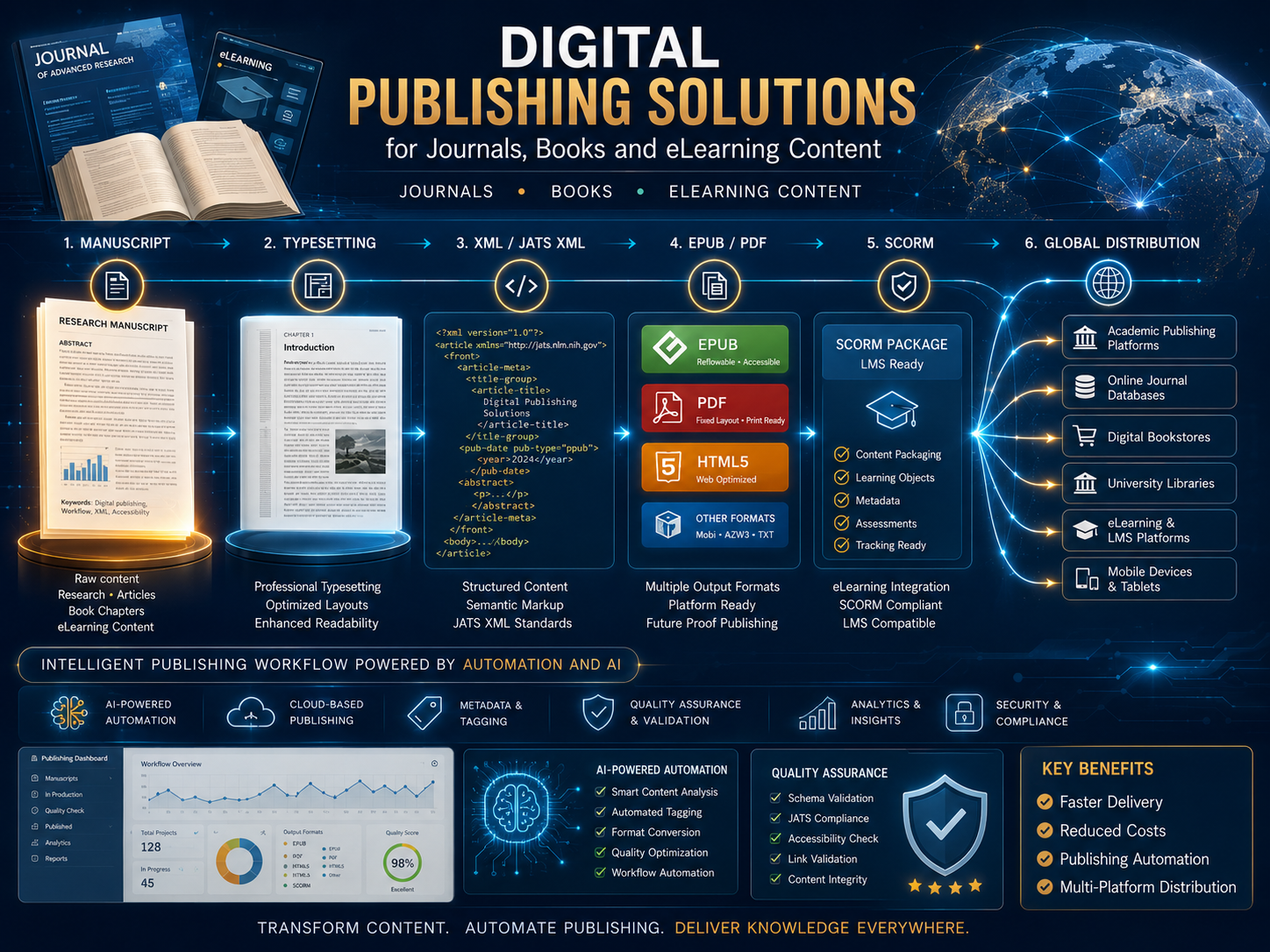
Digital publishing solutions are end-to-end production services that convert manuscripts into structured digital formats — EPUB, XML, JaATS, PDF, and SCORM — ready for distribution across academic platforms, retail bookstores, and eLearning systems. Publishers outsource these workflows to reduce cost, accelerate delivery, and eliminate in-house technical overhead.
Academic journals, trade books, and eLearning modules each have distinct structural requirements that a single internal production team rarely covers at scale. Digital publishing solutions from a specialist partner handle every stage — manuscript intake, XML conversion, typesetting, accessibility compliance, and multi-format output — under one coordinated workflow.
This guide maps the right solution to each content type. If you publish journals, produce books, or convert training content to eLearning formats, the sections below outline exactly what a structured end-to-end engagement covers, how workflows differ by content type, and what to look for in a publishing production partner.
Contents
What Are Digital Publishing Solutions?
The term covers a broad spectrum. At the narrow end, it may refer to a single-format conversion: a Word manuscript converted to a reflowable EPUB3 file. At the full-service end, it encompasses an entire production pipeline: manuscript analysis, semantic XML tagging (JATS, BITS, or SCORM), copyediting, typesetting, accessibility remediation, multi-format export, and platform validation.
Publishers choose publishing outsourcing services for three primary reasons: technical complexity they cannot cost-effectively staff in-house, volume that exceeds internal capacity, and the need for consistent quality across multiple simultaneous projects.
Core outputs that digital publishing services produce:
- JATS XML — the global standard for scholarly journal articles, required by PubMed Central, CrossRef, and most academic aggregators
- BITS XML — the book-equivalent of JATS, used for monograph archiving and large-scale academic book platforms
- EPUB3 / EPUB2 — reflowable ebook formats for retail distribution via Amazon KDP, Apple Books, Kobo, and Google Play Books
- Accessible PDF (PDF/UA) — tagged, screen-reader-compatible PDFs meeting WCAG 2.1 and PDF/UA-1 standards
- SCORM / xAPI packages — LMS-ready eLearning modules compatible with Moodle, Canvas, Cornerstone, and other delivery platforms
- HTML5 web content — browser-based article and chapter formats for online-first and open access publishing
Digital Publishing Solutions by Content Type
Not all publishing workflows are interchangeable. A journal production pipeline is optimised for speed, volume, and metadata compliance. A book production workflow prioritises design fidelity and multi-format structural integrity. An eLearning conversion project demands instructional segmentation and LMS packaging logic. Matching the solution to the content type is the first decision any publisher or training department needs to make.
The three primary content types — journals, books, and eLearning — each have distinct technical requirements, output formats, and quality benchmarks. The sections below cover each in full.
Journal Publishing Workflows: From Manuscript to JATS XML
Journals have unique production pressures. Issue deadlines are non-negotiable. Articles contain complex elements — mathematical equations, chemical notation, multi-panel figures, data tables — that generic conversion tools handle poorly. Reference lists must map to active DOIs. Metadata must conform to the publisher’s submission requirements for DOAJ, PubMed, Scopus, or Web of Science.
Key stages in an end-to-end journal publishing workflow:
- 1. Manuscript Intake and Analysis
Source files are assessed for structure, equation complexity, figure quality, and reference format. Issues are flagged before production begins, not discovered mid-workflow. - 2. Copyediting and Language Checking
Subject-aware editors review grammar, consistency, and adherence to the journal’s style guide. For STM content, this includes verifying units, symbols, and nomenclature standards. - 3. Typesetting and Page Layout
Articles are typeset using InDesign or LaTeX (for STEM journals), producing print-ready proofs that meet the journal’s established visual template while retaining accessible digital structure. - 4. JATS XML Tagging
Full semantic tagging of article structure — front matter, body, back matter, figures, tables, supplementary data — in compliance with JATS 1.2 or the publisher’s required DTD. - 5. Reference Linking and Metadata
Reference lists are validated and linked to DOIs via CrossRef. Article-level metadata — author ORCID, funding statements, data availability — is captured and exported. - 6. HTML5 and Multi-Format Export
Web-ready HTML5 article pages are generated for online-first and open access delivery, alongside the final tagged PDF and JATS XML archive package.
Content types within journal publishing that require specialist handling:
- STM and STEM articles — chemical structures, mathematical notation, statistical tables, and clinical data requiring LaTeX or MathML rendering
- Humanities and social science journals — complex footnote structures, non-Latin character sets, multi-language abstracts
- Open Access journals — JATS XML for repository deposit, Creative Commons licence metadata, funder acknowledgement tagging
- Special issues and supplements — multi-editor attribution, guest editorial workflow, compressed production schedules
Publishers managing high-volume journal portfolios benefit specifically from books and journals production services that operate across multiple simultaneous issues without creating a scheduling bottleneck.
Book Publishing Workflows: Manuscripts to Multi-Format Retail and Archive
Books present a different complexity profile from journals. A single title may need to be produced simultaneously as a print-ready PDF, a reflowable EPUB3 for Kindle, a fixed-layout EPUB for illustrated content, an accessible PDF for library distribution, and a BITS XML package for institutional repositories. Getting each format right from a single production pass — rather than re-converting from each previous output — requires an XML-first production approach.
Stages of an end-to-end book production workflow:
- 1. Structural Editing and Manuscript Preparation
Developmental and copy edits complete. Source file cleaned and structured for production. Front and back matter elements (TOC, index, bibliography) confirmed. - 2. Design and Typesetting
Interior layout produced in Adobe InDesign or LaTeX, matched to series template or custom design brief. Complex elements — tables, figures, sidebars, callouts — positioned and styled. - 3. XML-First Conversion
Content is structured in BITS XML or a custom schema, creating the single-source file from which all output formats are generated. This eliminates format-by-format rework. - 4. EPUB3 Conversion and Accessibility
Reflowable EPUB3 generated with semantic HTML structure, ARIA roles, alt text for images, and logical reading order. Validated against EPUBCheck and tested on Kindle, Apple Books, and Kobo. - 5. Accessible PDF Production
Tagged PDF meeting PDF/UA-1 standards, with navigational bookmarks, correct reading order, and heading structure for screen reader compatibility. - 6. Retail Metadata and Distribution Package
ONIX metadata record generated for distributor ingestion. ISBN, BISAC codes, territorial rights, and pricing metadata included. Final files packaged for KDP, IngramSpark, or publisher’s own platform.
Book types that benefit most from specialist outsourcing:
| Book Type | Key Production Requirement | Critical Output Format |
|---|---|---|
| Academic monographs | BITS XML, citation accuracy, footnote structure | BITS XML + PDF/UA |
| STEM textbooks | LaTeX equation rendering, figure labelling | LaTeX → PDF + EPUB3 |
| Trade nonfiction | Reflowable layout, brand-accurate design | EPUB3 + Print PDF |
| Illustrated/children’s books | Fixed-layout EPUB, image fidelity | Fixed-layout EPUB + PDF |
| Reference works and handbooks | Deep indexing, cross-referencing, online search | HTML5 + BITS XML |
| Backlist conversion | PDF-to-XML or scan-to-digital OCR workflows | EPUB3 + searchable PDF |
eLearning Content Conversion: From Source Material to LMS-Ready Modules
The critical distinction in eLearning conversion is that it is not a format change — it is a structural redesign. A 200-page training manual does not become a useful eLearning course by being converted to HTML. Effective eLearning conversion requires chunking content into learnable segments (typically 5–15 minutes), embedding interactive elements, aligning content to measurable learning objectives, and packaging the result so the LMS can track completion, scores, and progression.
What a complete eLearning conversion workflow includes:
- Content audit: mapping source material to learning objectives and identifying gaps or outdated sections before conversion begins
- Instructional design segmentation: dividing content into modules, lessons, and topic chunks aligned to the 5–15 minute engagement window
- Interactive element design: knowledge checks, branching scenarios, drag-and-drop activities, and embedded video placeholders
- Accessibility compliance: WCAG 2.1 AA, captions, alt text for interactive elements, keyboard-navigable course structure
- SCORM 1.2 / SCORM 2004 / xAPI packaging for LMS ingestion, with completion and score tracking configured
- Cross-platform testing: validation on Moodle, Canvas, Cornerstone, SAP SuccessFactors, Docebo, and Blackboard
- Version control and update pathway: structured source files that allow content updates without full rebuilds
Common eLearning conversion scenarios:
| Source Content | Output Format | Primary Challenge |
|---|---|---|
| PowerPoint training decks | SCORM module (HTML5) | Adding interactivity, removing presenter dependency |
| PDF training manuals | SCORM / xAPI module | Segmentation, learning objective alignment |
| Academic textbook chapters | LMS-hosted HTML5 content | Assessment integration, rights clearance |
| Instructor-led course materials | Self-paced SCORM module | Adapting for asynchronous delivery |
| Legacy Flash / deprecated content | HTML5 SCORM rebuild | Full content reconstruction, no Flash support |
| Compliance training documents | xAPI tracked modules | Score threshold configuration, audit trail |
Comparing Digital Publishing Solutions: Journals vs Books vs eLearning
The table below summarises the key differences between the three major content types handled by end-to-end digital publishing services. Use it to identify which service scope applies to your project.
| Criteria | Journal Publishing | Book Publishing | eLearning Conversion |
|---|---|---|---|
| Primary output format | JATS XML, HTML5, PDF | EPUB3, PDF/UA, BITS XML | SCORM, xAPI, HTML5 |
| Volume profile | High (articles per issue/year) | Medium (titles per season) | Variable (modules per course) |
| Key technical requirement | JATS compliance, DOI/metadata | XML-first multi-format output | SCORM packaging, LMS testing |
| Editorial complexity | STM language, citation accuracy | Design, index, front/back matter | Instructional design, chunking |
| Accessibility standard | WCAG 2.1, PDF/UA | EPUB Accessibility 1.1, PDF/UA | WCAG 2.1 AA, Section 508 |
| Distribution platform | PubMed, Scopus, DOAJ, CrossRef | Amazon, Apple Books, libraries | Moodle, Canvas, Cornerstone |
| Turnaround pressure | Issue-deadline driven | Seasonal title schedule | Launch-date driven |
| Outsourcing benefit | Volume throughput, XML expertise | Multi-format consistency | Instructional design + tech stack |
Why Siliconchips Services for End-to-End Digital Publishing
Siliconchips Services operates a hybrid model that combines London-based project management with a high-capacity production centre in India. This structure gives publishers local accountability and direct communication alongside the technical depth and throughput capacity to manage large or fast-moving portfolios.
Capabilities that differentiate Siliconchips Services:
- XML-first production — JATS, BITS, and custom DTD expertise means outputs are structurally consistent regardless of source format complexity
- LaTeX proficiency for STEM content — mathematical notation, chemical structures, and scientific tables handled natively, not approximated in Word-based tools
- InDesign and multi-format typesetting — print-quality layout with integrated digital structure, not design-only files that require separate XML conversion
- End-to-end accessibility — WCAG 2.1, EPUB Accessibility 1.1, PDF/UA, and Section 508 compliance built into production, not retrofitted
- Platform validation experience — EPUBCheck, ACE by DAISY, SCORM validators, and device testing on Kindle, Apple Books, Kobo, Moodle, and Canvas
- Scalability for seasonal peaks — capacity to absorb volume increases without requiring publishers to build permanent in-house headcount
- Editorial Services integration — editorial support services including copyediting and proofreading are available as part of the production workflow, not siloed from it
Publishing production checklist: what to verify before choosing a partner
- Can they process your source file formats (Word, LaTeX, InDesign, PDF, legacy XML)?
- Do they produce JATS XML natively or outsource XML to a third party?
- What EPUB and PDF accessibility validators do they use — and will they share validation reports?
- Do they have STEM/STM experience, or only trade/consumer book workflows?
- How is project management handled — dedicated contact, or shared inbox?
- Can they provide case studies or references from publishers with similar volume and content types?
- What is the escalation process when a file fails platform validation?
Ready to review your publishing workflow?
Speak directly with a publishing production expert about your journal, book, or eLearning project scope.
Frequently Asked Questions: Digital Publishing Solutions
What is included in end-to-end digital publishing services?
End-to-end publishing services cover every stage from manuscript intake to final distribution-ready output: editorial review and copyediting, XML conversion and semantic tagging, typesetting and layout design, multi-format export (EPUB, PDF, JATS XML, SCORM), accessibility remediation, platform validation, and metadata preparation. The scope varies by content type — journal, book, or eLearning — but a genuine end-to-end service eliminates the need for publishers to coordinate multiple separate vendors across the workflow.
What is the difference between JATS XML and EPUB3 for journal content?
JATS (Journal Article Tag Suite) XML is an archival and exchange format designed for academic journal content. It structures article metadata, references, figures, and body text for ingestion into scholarly databases, repositories, and aggregators like PubMed Central and CrossRef. EPUB3 is a consumer reading format optimised for ebooks and reflowable content. Journals require both: JATS XML for archiving and platform compliance, and often HTML5 or PDF for reader-facing delivery. They are not interchangeable — each serves a different part of the distribution chain.
How long does a book publishing workflow take from manuscript to finished files?
A standard trade or academic book workflow — including copyediting, typesetting, EPUB3 conversion, accessible PDF production, and metadata preparation — typically takes four to eight weeks depending on complexity, word count, and the number of figures or mathematical elements. STEM textbooks with heavy equation content or illustrated books with fixed-layout requirements sit at the longer end of that range. Rush delivery options are available for reprints, backlist conversions, and projects with locked editorial content.
What does eLearning content conversion cost?
eLearning conversion pricing depends on source content type, number of modules, level of interactivity required, and the complexity of LMS packaging. A basic PDF-to-SCORM conversion with minimal interactivity is significantly less expensive than a full instructional redesign with branching scenarios and custom assessments. Most publishers and training departments receive a scoped quote based on a content audit rather than a per-page rate, because the instructional complexity — not the word count — drives the effort. A free sample conversion is the most reliable way to establish an accurate cost estimate.
Can digital publishing services handle legacy or backlist content?
Yes. Backlist and legacy conversion is one of the highest-value applications for publishing outsourcing services. Source material may include scanned PDFs requiring OCR processing, older InDesign or QuarkXPress files, Word documents without consistent styles, or legacy XML in non-standard schemas. A specialist team assesses the source files before quoting, identifies which elements require manual remediation (tables, figures, equations, footnotes), and delivers a structured production plan. Backlist conversion projects commonly produce EPUB3, accessible PDF, and BITS XML from a single production pass.
What standards do digital publishing outputs need to meet for academic platforms?
Academic platform requirements vary by repository and aggregator, but common standards include JATS XML 1.2 (PubMed Central, PORTICO), CrossRef metadata schema (DOI registration), DOAJ metadata requirements (open access journals), EPUB Accessibility 1.1 (digital libraries), and PDF/UA-1 for accessible PDF distribution. STEM content additionally requires MathML or LaTeX-rendered equations rather than image-based formula presentation. A qualified publishing production partner validates outputs against these standards before delivery and resolves rejection issues at no additional charge.
Is publishing outsourcing secure for confidential manuscripts?
Established publishing outsourcing services operate under formal non-disclosure agreements and data handling protocols that cover manuscript confidentiality, author data, and proprietary content. Siliconchips Services uses secure file transfer systems, access-controlled production environments, and staff NDAs to protect pre-publication content throughout the workflow. Publishers working on embargoed research, commercially sensitive titles, or author-sensitive content should request details of the partner’s data handling policy and confirm it aligns with their own compliance requirements before beginning work.
Choosing the Right Publishing Production Partner
The right digital publishing solution depends on what you publish, how frequently you publish it, and where the production bottlenecks sit in your current workflow. Journal publishers prioritise JATS XML accuracy and volume throughput. Book publishers need multi-format consistency from a single production pass. eLearning teams need instructional structure and LMS compliance alongside format conversion.
What all three have in common: the cost and complexity of managing these workflows in-house typically exceeds the cost of working with a specialist partner — particularly when platform validation, accessibility compliance, and volume flexibility are factored in.
If you’re evaluating whether to outsource part or all of your publishing production, the clearest first step is a free sample conversion against your actual source files. It eliminates speculation about what the workflow produces and how long it takes.
Get a Free Publishing Production Sample
Submit a representative sample — a journal article, book chapter, or training module — and receive a converted output along with a scoped quote for your full project.