
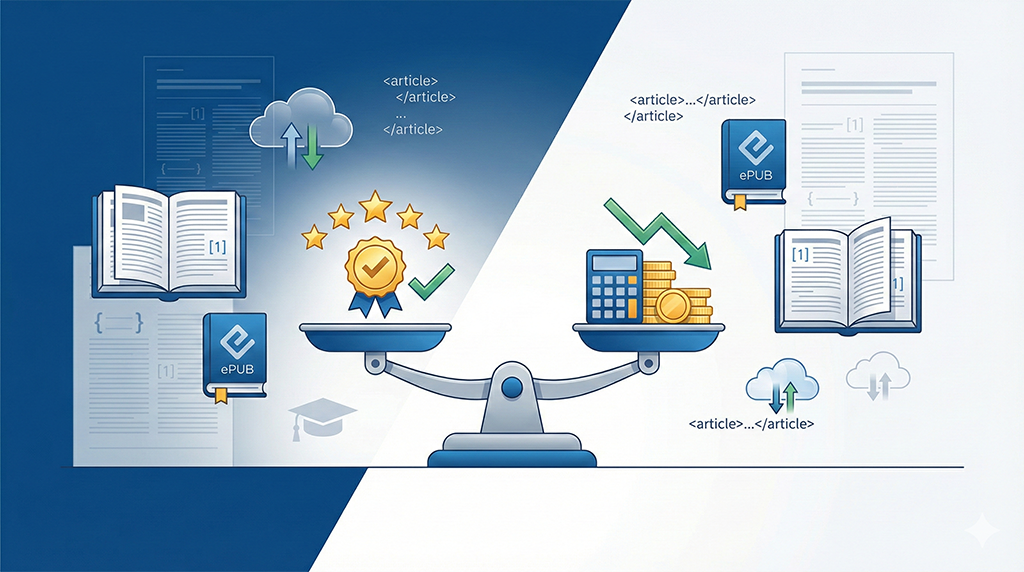
The open access revolution has transformed scholarly communication, breaking down barriers to knowledge and expanding research impact across the globe. Yet for many publishers, this transformation comes with a persistent tension. How do you maintain rigorous quality standards whilst managing the financial realities of open access publishing? The pressure to reduce costs can feel at odds with the commitment to excellence that defines credible academic publishing.
This challenge is particularly acute in the production phase. Quality assurance processes, technical formatting, XML conversion, and metadata enrichment all require expertise and precision. Cut corners here, and you risk publishing errors that undermine author credibility and reader trust. Overspend, and your publishing programme becomes financially unsustainable. The question facing many publishers is not whether to invest in quality, but how to achieve it without exhausting limited budgets.
The answer lies in strategic partnerships with ebook publishing services that understand both the technical demands of scholarly content and the economic constraints of modern publishing. When production workflows are designed with efficiency and precision in equal measure, excellence becomes achievable at sustainable costs.
Understanding the True Cost of Quality in Open Access
Quality in academic publishing extends far beyond copyediting. It encompasses structural integrity, technical accuracy, accessibility compliance, and discoverability through proper metadata. Each element requires specialised knowledge and careful attention. A single error in reference linking can frustrate researchers. Inconsistent XML tagging can compromise searchability. Poor accessibility features can exclude entire communities of scholars.
Traditional publishing models often addressed these requirements through large in-house teams and lengthy production cycles. Whilst this approach could deliver quality, it came with substantial overhead costs. Office space, equipment, training, and employee benefits all added layers of expense that made high-volume open access publishing economically challenging. Many publishers found themselves trapped between maintaining standards and meeting article processing charge expectations.
The digital transformation of publishing has introduced new possibilities. Distributed teams, cloud-based workflows, and automation technologies have fundamentally changed what cost-effective production can look like. However, technology alone does not guarantee quality. The critical factor is how these tools are integrated into workflows that preserve human expertise where it matters most whilst automating routine tasks that benefit from consistency and speed.
The Strategic Value of Specialised Production Partners
Publishers who successfully balance cost and quality typically share a common strategy. They focus internal resources on editorial judgement, peer review coordination, and strategic development whilst partnering with specialists for technical production. This division of labour allows organisations to maintain control over scholarly integrity whilst accessing production expertise at scale.
Specialist production partners bring advantages that go beyond simple cost reduction. Their focus on technical processes means they develop refined workflows, invest in appropriate technologies, and build teams with deep expertise in scholarly formats and standards. They work across multiple publishers and content types, which allows them to refine best practices and achieve efficiencies that would be difficult for individual publishers to replicate. This concentrated expertise translates directly into faster turnaround times, fewer errors, and more consistent output quality.
Geographic diversity in production teams offers additional value. Partners operating from locations with different cost structures can provide the same quality standards at more accessible price points. When managed properly, with clear communication protocols and quality checkpoints, such arrangements deliver genuine cost savings without compromising standards. The key is ensuring that cultural and linguistic competence matches the content being processed, particularly for disciplines where terminology precision is critical.
Building Efficient Quality Assurance Without Inflating Budgets
Quality assurance often represents a significant cost centre in publishing operations. Multiple rounds of checking, extensive manual reviews, and redundant verification steps can consume substantial time and resources. Yet reducing QA investment carries obvious risks. The solution is not to check less, but to check smarter.
Modern QA approaches combine automated validation with targeted human review. Software can quickly identify technical errors such as broken links, incorrect metadata formatting, or structural inconsistencies in XML files. This allows quality reviewers to focus their expertise on substantive issues that require human judgement. Context-aware spell checking, reference validation against databases such as Crossref, and automated accessibility testing all reduce the manual burden whilst improving consistency.
Establishing clear quality benchmarks at the outset prevents costly revision cycles. When publishers and production partners agree on specific standards before work begins, teams can work efficiently towards defined targets rather than making iterative adjustments through trial and error. Detailed style guides, template libraries, and reference materials reduce ambiguity and enable production teams to make correct decisions independently. This upfront investment in clarity pays dividends throughout the production process.
Continuous improvement systems further enhance efficiency over time. When production partners track error patterns, analyse bottlenecks, and implement refinements based on data, quality steadily improves whilst processing times decrease. This creates a virtuous cycle where cost per article trends downward even as output quality rises. Publishers benefit from both improved economics and enhanced reliability.
Technology Investment That Delivers Measurable Returns
The right technology infrastructure can dramatically reduce production costs whilst enhancing quality. However, not all technology investments deliver equal value. The distinction lies in selecting tools that address genuine bottlenecks rather than pursuing innovation for its own sake.
XML-first workflows have become standard in scholarly publishing for good reason. When content is structured semantically from the beginning, it becomes far easier to generate multiple output formats, maintain consistency across platforms, and integrate with discovery services. The initial investment in proper XML conversion pays ongoing dividends through reduced reformatting work and improved content reusability. Publishers using professional ebook publishing services gain access to mature XML workflows without needing to build this capability internally.
Workflow automation platforms that connect different stages of production reduce manual handoffs and associated delays. When manuscript tracking, version control, and approval routing happen systematically through integrated systems, production teams spend less time on administrative coordination and more time on value-adding activities. This not only reduces costs but also improves transparency, allowing publishers to monitor progress and identify issues before they escalate.
Artificial intelligence tools are beginning to play a useful role in production processes, particularly for tasks requiring pattern recognition or systematic checking. Reference formatting, figure extraction, and initial metadata generation can all benefit from AI assistance when properly supervised. The key is using these technologies to augment human expertise rather than replace it. Quality still requires human judgement, but technology can handle routine tasks more efficiently, freeing skilled professionals to focus on complex decisions.
Why Siliconchips Services Delivers Both Quality and Value
Siliconchips Services has built its reputation on understanding that cost-effectiveness and quality excellence are not competing priorities. Our approach to ebook publishing services integrates efficient production workflows with rigorous quality standards, creating sustainable solutions for open access publishers.
Our teams bring extensive experience in STM and journal publishing, understanding the specific requirements of scholarly content. We maintain detailed knowledge of industry standards including JATS XML, EPUB accessibility requirements, and metadata schemas used by major discovery platforms. This expertise ensures that content is not merely produced but prepared for maximum impact and discoverability.
We have invested systematically in technology infrastructure that enhances both speed and accuracy. Our XML conversion processes are refined through years of handling diverse content types. Quality assurance protocols combine automated checking with expert human review at critical control points. This balanced approach catches errors efficiently whilst maintaining the scholarly precision that academic content demands.
Transparency is fundamental to our client relationships. We provide clear pricing structures with no hidden costs, detailed quality metrics that track performance against agreed standards, and regular communication that keeps publishers informed throughout the production cycle. This openness allows publishers to plan confidently and budget accurately.
Our geographic model enables us to offer competitive pricing whilst maintaining the quality standards expected in academic publishing. Teams are carefully selected for linguistic competence and subject matter familiarity, ensuring that technical production does not compromise content integrity. We view ourselves as partners in your publishing mission, not simply service providers completing tasks.
Achieve Excellence Without Overspending
The challenge of balancing cost and quality in open access publishing is real, but it is far from insurmountable. Strategic partnerships with experienced production specialists, smart technology deployment, and efficient quality assurance processes can deliver the excellence your authors and readers deserve whilst keeping your publishing programme financially sustainable.
Siliconchips Services understands both the economic pressures facing modern publishers and the quality standards that maintain scholarly credibility. Our ebook publishing services are designed to resolve this tension, providing the technical expertise, production efficiency, and rigorous quality control that open access publishing requires.
If your organisation is seeking to optimise production costs without compromising the quality that defines your reputation, we invite you to explore how our approach might serve your needs. Contact Siliconchips Services today to discuss how we can support your publishing goals with solutions that deliver measurable value alongside consistent excellence.
Frequently Asked Questions
How can publishers reduce production costs without sacrificing quality standards?
Publishers can achieve cost reduction through strategic partnerships with specialist production services, investment in efficient workflows that combine automation with targeted human review, and clear quality benchmarks established before production begins. The key is distinguishing between tasks that benefit from expert judgement and those that can be automated or standardised. Modern XML-first workflows, automated validation tools, and experienced production teams can deliver high quality at sustainable costs when properly integrated.
What role does XML play in cost-effective ebook publishing?
XML provides the structural foundation that enables efficient multi-format publishing. When content is properly tagged in XML at the outset, it becomes straightforward to generate PDF, HTML, EPUB, and other formats without extensive manual reformatting. This reduces redundant work and ensures consistency across platforms. XML also facilitates automated quality checking, improves searchability, and enhances long-term content reusability. The upfront investment in quality XML conversion delivers ongoing cost savings throughout the content lifecycle.
How do specialist ebook publishing services maintain quality with distributed teams?
Quality in distributed production environments depends on clear communication protocols, detailed style guides and templates, systematic quality checkpoints, and robust project management systems. Professional services invest in training programmes that ensure teams understand both technical requirements and scholarly standards. Regular quality audits, error tracking, and continuous improvement processes maintain consistency. When properly managed, distributed teams can deliver the same quality as in-house operations whilst offering cost advantages through optimised resource allocation.
What quality assurance processes are essential for academic ebook production?
Essential QA processes include automated validation of XML structure and metadata, reference verification against authoritative databases, accessibility compliance checking, visual inspection of formatted output, and subject-matter review of technical terminology. Effective QA combines automated tools that efficiently identify technical errors with expert human review focused on substantive issues requiring judgement. Establishing clear quality benchmarks and acceptance criteria before production begins prevents costly revision cycles and ensures all parties work towards consistent standards.
How can publishers evaluate whether outsourced production services offer genuine value?
Publishers should assess potential partners based on demonstrable expertise in scholarly publishing, transparent pricing structures, clear quality metrics and reporting, references from similar publishers, and willingness to customise workflows to specific requirements. Request sample output and inquire about error rates, turnaround times, and revision policies. Strong partners provide detailed service level agreements, maintain regular communication, and demonstrate continuous improvement in their processes. The goal is finding services that function as genuine partners in your publishing mission rather than simply executing tasks.
What technologies most significantly improve production efficiency without requiring large capital investment?
Cloud-based workflow platforms that connect different production stages, XML editing and validation tools, automated reference checking services, and accessibility testing software all deliver substantial efficiency gains without requiring extensive infrastructure investment. Many effective tools are available through subscription models that distribute costs over time. Working with experienced production partners provides access to mature technology ecosystems without needing to build this capability internally. The most valuable technologies are those that reduce manual handoffs, enable systematic quality checking, and support content reusability across multiple output formats.