
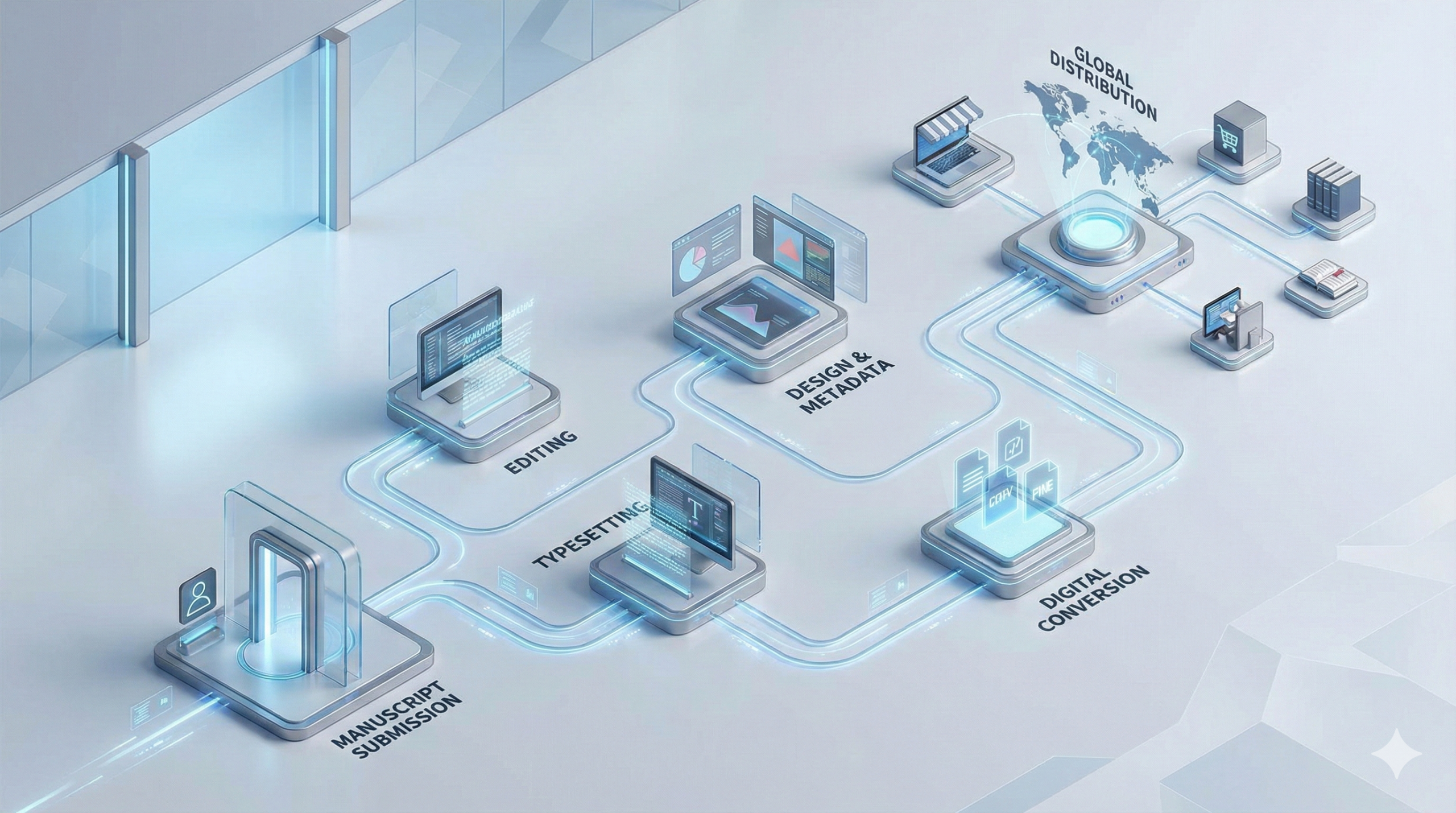
The publishing landscape is shifting faster than ever. New formats emerge, automation reshapes workflows and global authors expect quicker turnarounds with uncompromising quality. Amid this transformation, one truth has become clearer: publishers thrive when their workflow is supported by a single, integrated, end-to-end system rather than fragmented, multi-vendor setups.
When every stage — from manuscript intake to final digital distribution — moves through a unified process, quality strengthens, costs reduce and teams finally gain the breathing room to focus on strategy and growth. This is where end to end publishing services prove their real value.
The Rise of Integrated Publishing Ecosystems
The traditional publishing workflow involved a patchwork of vendors handling different stages: copyediting with one provider, typesetting with another, XML conversion elsewhere and digital output with someone else. While this model served publishers for years, it introduced inefficiencies:
- Higher operational overhead
- Limited accountability
- Slow handovers between vendors
- Risk of inconsistent quality
- Difficulty implementing workflow-level improvements
As digital markets expanded, publishers needed to scale faster without multiplying their vendor base. The result is a shift towards publishing outsourcing services that offer end-to-end capabilities — not just production tasks, but workflow optimisation supported by technology, automation and skill depth.
Why End-to-End Publishing Services Create Long-Term Stability
A complete publishing solution covers every stage of content creation and distribution. But the real power lies in how everything works together. Integrated models support sustainable success in several crucial ways.
Streamlined workflows without fragmentation
When every stage is handled by one expert team, workflow friction disappears. A unified team uses standardised rules, automated systems and a shared understanding of project requirements, house styles, editorial guidelines and production schedules. This reduces delays and ensures seamless coordination across every task.
Higher consistency across all formats and content types
Inconsistency is one of the biggest hidden costs in publishing. With end to end publishing services, quality standards are uniform, formatting rules remain consistent and XML and metadata follow stable schemas. Complex STEM layouts and OA compliance are managed from the start.
Better efficiency through automation and human expertise
The best integrated publishing systems combine advanced automation with skilled specialists. Automation handles repetitive tasks such as tagging and file conversion while editors and production engineers address LaTeX equation fixes, complex design decisions and platform-specific formatting.
Stronger accountability with a single point of ownership
One team accountable for the complete workflow brings faster problem resolution, clear visibility across production and simplified communication: one partner, one workflow and one responsible system.
Technology-driven publishing that adapts quickly
Integrated providers offer automated composition, editorial workflow management tools, InDesign XML automation, accessibility tagging, cloud submission systems and multi-format output engines. Technology becomes the backbone while experts ensure judgement and quality.
What Comprehensive, End-to-End Publishing Services Include
A complete service ecosystem typically covers editorial, typesetting, conversion, metadata, post-production and project technologies. Key domains include:
- Editorial and pre-editing support: manuscript assessment, copyediting, reference checking, plagiarism review
- Typesetting and layout: professional book formatting, journal composition, LaTeX and STEM-specific typesetting
- Digital conversion and XML services: JATS XML, EPUB conversion, accessible EPUB3, web-ready HTML
- Metadata and compliance: indexing metadata, OA repository compliance, DOI and funder tagging
- Post-production and delivery: multi-platform distribution, archival packages and QA
- Project management and workflow technology: dashboards, automated routing and version control
Real-World Scenarios Where End-to-End Solutions Outperform Multi-Vendor Setups
Scenario: A journal requires rapid OA compliance. With a single integrated partner, metadata, XML, accessibility and DOI integrations are handled in one flow — no delays, no mismatched formats.
Scenario: A monograph with mixed media and LaTeX. One production team manages LaTeX content, image workflows, EPUB and print outputs so all deliverables align precisely.
Scenario: Seasonal volume spikes. End-to-end providers scale quickly with teams trained in your house style, avoiding onboarding delays and quality dips.
Benefits Beyond Production
- Better cost predictability: single contracts and clear SLAs
- Performance insights: dashboards showing delivery timelines, error patterns and bottlenecks
- Stronger author satisfaction: consistent communication and predictable outputs
- Reduced governance complexity: one accountable partner for the whole workflow
Frequently Asked Questions
Why are end-to-end publishing services becoming essential?
They eliminate workflow fragmentation, reduce errors and provide a single accountable system from manuscript intake to final delivery.
Do integrated services improve consistency across outputs?
Yes. They standardise styles, metadata, XML and digital formats across all content types.
Are publishing outsourcing services reliable for long-term support?
High-quality outsourcing partners maintain trained teams, stable workflows and scalable infrastructure suited for journals, books and OA projects.
How do end-to-end systems support global distribution?
They produce compliant XML, EPUB, PDF and metadata tailored to the indexing platforms, repositories and markets publishers depend on.
Can automation fully replace human editorial expertise?
No. Automation enhances speed but human judgement remains essential for complex content, STEM structures and quality assurance.
How do integrated solutions reduce production costs?
By removing vendor handovers, reducing rework and streamlining technology across the entire workflow.
Which publishing tasks benefit most from an integrated approach?
XML workflows, STEM typesetting, EPUB conversion, metadata assignment, accessibility tagging and QA gain the most from a unified system.

